

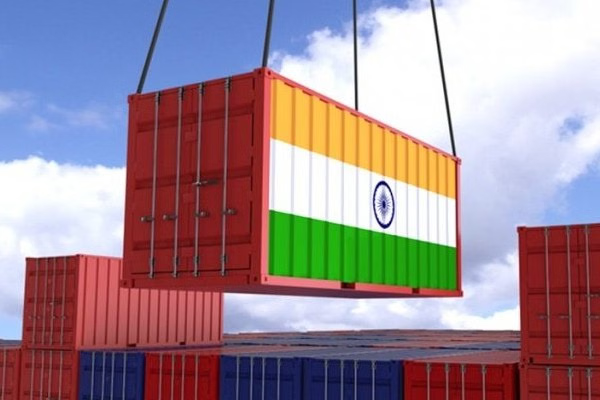
India’s exports surged 19.4% in November, marking the fastest growth rate in more than three years and signalling a sharp rebound in outbound trade activity. The jump reflects stronger global demand, sector specific momentum, and a favourable base effect compared to last year.
India’s exports surge of 19.4% in November stands out at a time when global trade remains uneven. After months of moderate or uneven performance, the sharp acceleration suggests that Indian exporters have regained traction across multiple sectors. The growth comes amid currency volatility, easing supply chain pressures, and improved demand from key overseas markets.
What drove the 19.4% export growth in November
The November export performance was driven by a broad based pickup rather than a single category. Engineering goods, pharmaceuticals, electronics, chemicals, and select agricultural products recorded strong outbound shipments. Engineering exports benefited from higher demand for industrial machinery and auto components, while pharma shipments remained resilient due to steady global healthcare demand.
Electronics exports continued their upward trajectory, supported by increased manufacturing capacity and rising overseas orders. The festive season in key global markets also contributed to higher shipments of consumer goods. In addition, a lower base from November last year amplified the year on year growth rate, making the increase appear sharper.
Key markets supporting India’s export momentum
Demand from the United States, parts of Europe, the Middle East, and emerging markets played a significant role in November’s export surge. Indian exporters benefited from diversification beyond traditional markets, with higher shipments to West Asia, Africa, and Southeast Asia.
Trade with the US remained stable, particularly for pharmaceuticals, textiles, and engineering products. European demand showed selective recovery, especially for specialty chemicals and auto components. Exporters catering to infrastructure and energy projects in West Asia also saw higher order flows during the month.
Sector wise performance highlights
Engineering goods remained the backbone of export growth, supported by strong order books and improved production capacity. Pharmaceuticals continued to post steady gains, driven by both generic drug demand and specialty formulations.
Electronics exports showed one of the fastest growth rates, reflecting India’s push to become a global manufacturing hub. Chemicals and petrochemicals benefited from better global pricing and demand normalization. Agricultural exports such as rice, marine products, and spices also contributed, aided by seasonal shipments and competitive pricing.
How the export surge impacts the broader economy
A sharp rise in exports provides support to India’s overall economic growth at a time when domestic demand shows mixed signals. Higher exports help narrow the trade deficit, improve foreign exchange inflows, and support employment across manufacturing clusters.
For small and medium exporters, the November numbers offer relief after months of margin pressure. Increased order volumes improve capacity utilization and cash flows. Export oriented clusters in Tier 2 and Tier 3 cities benefit directly through higher factory activity, logistics demand, and ancillary services.
Currency movement and export competitiveness
The weaker rupee during November played a supportive role by improving price competitiveness of Indian goods in global markets. Exporters received higher rupee realizations for dollar denominated sales, which helped offset higher input costs.
However, the benefit was uneven. Exporters dependent on imported raw materials faced cost pressures that diluted currency gains. Still, for sectors with high domestic value addition, the currency environment remained favourable and supported aggressive pricing strategies.
Is the export growth sustainable
While the November surge is encouraging, sustainability depends on global economic conditions and policy stability. Global interest rates, geopolitical risks, and demand trends in advanced economies will influence export momentum in the coming months.
Structural factors such as production linked incentives, logistics improvements, and manufacturing scale up continue to support long term export growth. However, month to month volatility is likely, and exporters remain cautious about overextending capacity based on a single strong data point.
Outlook for the coming months
Exporters enter the final quarter of the financial year with cautious optimism. Order pipelines for several sectors remain healthy, but pricing pressures and global uncertainties persist. Continued focus on market diversification and value added exports will be key to sustaining momentum.
If global demand holds and domestic production remains stable, India’s export performance could remain resilient through the next few months. Policymakers will closely watch whether the November surge marks a trend reversal or a temporary spike.
Takeaways
India’s exports rose 19.4% in November, the fastest pace in over three years
Engineering goods, pharmaceuticals, and electronics led the export growth
Diversified global demand supported shipments beyond traditional markets
Sustainability depends on global conditions and domestic production strength
FAQs
Why did India’s exports grow sharply in November
The growth was driven by strong performance across multiple sectors, improved global demand, and a favourable base effect from last year.
Which sectors contributed most to export growth
Engineering goods, pharmaceuticals, electronics, chemicals, and select agricultural products were the top contributors.
Did the weak rupee help exports
Yes, a weaker rupee improved price competitiveness and rupee realizations, though benefits varied by sector.
Is this export growth likely to continue
Momentum may continue if global demand holds, but volatility is expected due to external economic risks.












Leave a comment