

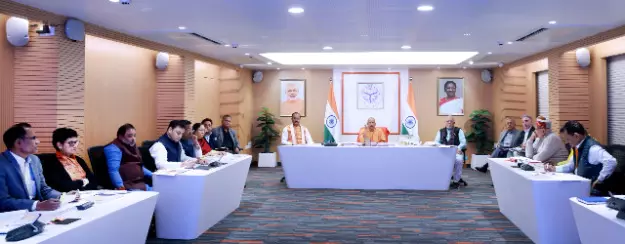
UP’s Marketing Development Support Scheme has been introduced to strengthen service exporters by reducing market entry barriers and improving global visibility for small businesses. The scheme targets export oriented service firms in Uttar Pradesh and aims to improve competitiveness in international markets through structured financial and institutional support.
This topic is time sensitive news because the scheme has been recently announced and exporters are actively evaluating eligibility and benefits. The tone below follows a news reporting style with practical guidance.
The UP Marketing Development Support Scheme is part of the state government’s broader export promotion strategy. While merchandise exports often receive attention, service exports such as IT services, consultancy, education services, design, healthcare support, and digital solutions have grown steadily from Tier 2 and Tier 3 cities. The scheme acknowledges this shift and attempts to close gaps that small service exporters face in marketing and client acquisition abroad.
What the UP Marketing Development Support Scheme covers
The scheme focuses on reimbursing a portion of marketing and promotional expenses incurred by service exporters. These expenses typically include participation in international trade fairs, business delegations, exhibitions, buyer seller meets, and digital marketing campaigns targeting overseas clients.
Support also extends to branding related activities such as website localization, brochures, and presentation material designed for foreign markets. The intent is to help small exporters build credibility in competitive global environments where marketing costs often act as a barrier.
Secondary keyword focus service export incentives UP
Who is eligible under the scheme
Eligibility is primarily aimed at service providers registered in Uttar Pradesh with valid export credentials. This includes firms registered under applicable export promotion councils or recognized government bodies. MSMEs form the core target group, especially first time exporters and small firms expanding beyond domestic markets.
The scheme typically prioritizes businesses operating from non metro cities where access to international exposure is limited. Firms must demonstrate that services offered are export oriented and revenue is derived or expected from overseas clients. Compliance with tax and regulatory requirements is a basic prerequisite.
Practical benefits for small service exporters
For small exporters, marketing expenses are often the first cost to be cut due to limited cash flow. The scheme reduces this pressure by sharing the financial burden of overseas promotion. This allows firms to test new markets without committing large upfront budgets.
Participation in international events helps exporters understand client expectations, pricing benchmarks, and service standards. It also improves lead generation and partnership opportunities. For digital service firms, support for online campaigns enables targeted outreach in specific geographies, improving conversion efficiency.
Secondary keyword focus MSME export support scheme
How the scheme impacts Tier 2 and Tier 3 exporters
Service exporters from smaller cities face unique challenges such as limited global networks and lower brand recognition. The scheme helps bridge this gap by offering structured exposure opportunities that would otherwise be inaccessible.
Cities like Lucknow, Noida, Kanpur, Varanasi, and Prayagraj have growing pools of service providers in IT, education, and professional services. With marketing support, these firms can compete with metro based players on visibility and outreach. Over time, this contributes to regional employment and skill development.
Application process and compliance considerations
The application process involves submitting details of proposed or completed marketing activities along with supporting documentation. Exporters are usually required to obtain prior approval for participation in events to ensure eligibility for reimbursement.
Compliance plays a critical role. Claims must be backed by invoices, proof of participation, and evidence of payment. Delays or rejections often occur due to incomplete documentation or mismatch between approved activities and actual expenditure. Exporters should maintain clear records and timelines to avoid issues.
Secondary keyword focus export scheme application process
Limitations and points exporters should evaluate
While the scheme provides valuable support, exporters should not view it as a substitute for a long term export strategy. Reimbursements may cover only a portion of costs, and caps may apply per firm or activity.
Timing of reimbursement is another factor. Cash flow planning is essential because expenses are usually incurred upfront. Exporters should also evaluate the relevance of events and markets rather than participating only to claim benefits. Strategic selection delivers better outcomes than broad participation.
How this fits into UP’s export growth strategy
The scheme aligns with Uttar Pradesh’s effort to diversify exports beyond traditional goods. Service exports require lower physical infrastructure but higher visibility and trust. By supporting marketing, the government addresses a critical bottleneck.
Over time, increased service exports improve foreign exchange earnings and position UP as a services hub. The focus on MSMEs ensures that growth is distributed rather than concentrated among large firms.
What service exporters should do next
Exporters should assess their readiness for international markets, identify target geographies, and shortlist relevant promotional activities. Early engagement with implementing agencies helps clarify eligibility and approval timelines.
Firms should also invest in service quality, compliance, and delivery capability. Marketing support works best when backed by strong execution and client satisfaction.
Takeaways
The scheme lowers marketing cost barriers for UP based service exporters
MSMEs and first time exporters benefit the most from reimbursement support
Tier 2 and Tier 3 cities gain better access to global markets
Strategic planning and compliance are key to maximizing benefits
FAQs
What is the main objective of the UP Marketing Development Support Scheme
The scheme aims to help service exporters promote their offerings in international markets by reimbursing eligible marketing expenses.
Which service sectors can benefit from this scheme
IT services, consultancy, education services, healthcare support, design, and other export oriented services are covered.
Is the scheme only for large exporters
No, it primarily targets MSMEs and small service exporters based in Uttar Pradesh.
Does the scheme guarantee export orders
No, it supports marketing and exposure, but actual business outcomes depend on service quality and market strategy.









Leave a comment