

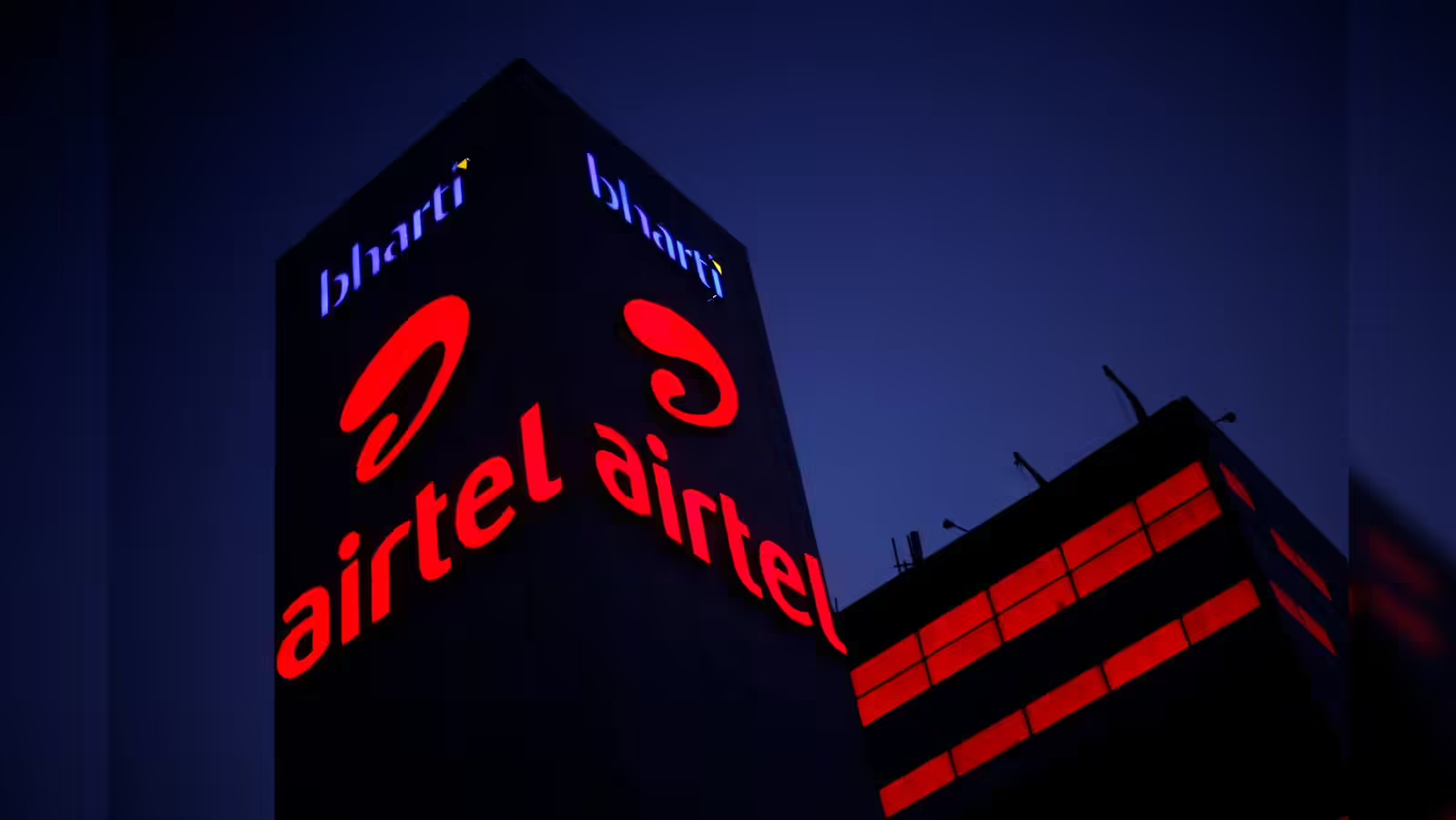
Bharti Airtel’s ₹20,000 crore NBFC expansion marks a major shift in India’s digital lending landscape. The move signals aggressive scaling of consumer credit in Tier 2 and Tier 3 cities, where formal credit penetration remains uneven despite rapid digital adoption.
Airtel’s ₹20,000 crore NBFC plan positions the telecom major to deepen its presence in consumer credit through its financial services arm. The strategy aligns with India’s expanding digital payments ecosystem and growing appetite for small ticket loans in non metro markets.
What Airtel’s NBFC Expansion Actually Means
Airtel has already built a large fintech base through Airtel Payments Bank and its digital lending partnerships. By scaling up its non banking financial company operations, the company aims to move beyond distribution and into deeper credit underwriting and balance sheet participation.
An NBFC structure allows Airtel to directly offer loans, structure products and manage credit risk instead of acting only as a sourcing or distribution partner. This is significant because telecom led lending models rely on customer data, usage behavior and payment history to assess borrower risk.
The ₹20,000 crore scale indicates long term ambition rather than a pilot expansion. In practical terms, this level of capital supports large volumes of personal loans, micro credit, device financing and possibly small business loans. For smaller cities, this could widen formal credit access where traditional banks still operate conservatively.
Consumer Credit in Tier 2 and Tier 3 Markets
India’s smaller cities have witnessed a surge in digital adoption over the past five years. UPI transactions, smartphone penetration and digital KYC have made onboarding seamless. However, credit availability has not grown at the same pace.
Many borrowers in Tier 2 and Tier 3 cities still rely on informal lenders or high interest financing channels. Banks often require strong documentation and credit history. NBFC led models fill this gap by offering smaller ticket loans with faster approval cycles.
Airtel’s telecom footprint gives it access to millions of prepaid and postpaid customers. Data driven lending can help assess repayment behavior even when formal credit bureau records are limited. This reduces friction in first time borrower acquisition.
The larger implication is improved financial inclusion. When structured responsibly, small ticket consumer loans support purchases such as smartphones, appliances, education fees and emergency expenses.
How Airtel Competes in the Digital Lending Space
The digital lending market is already competitive with banks, fintech startups and established NBFCs expanding aggressively. Airtel’s advantage lies in its ecosystem integration.
It controls distribution through mobile connectivity, has an existing payments bank infrastructure and access to recurring recharge data. This creates a closed loop model where customer acquisition cost can remain lower than standalone lenders.
However, scaling an NBFC also brings regulatory scrutiny. The Reserve Bank of India has tightened norms for digital lending, data privacy and capital adequacy in recent years. Airtel will need to maintain strong governance standards and transparent lending practices.
The capital commitment of ₹20,000 crore suggests readiness to operate at meaningful scale rather than experimenting with marginal lending exposure.
Impact on Local Retail Borrowers and Small Merchants
For consumers in smaller cities, faster approval and digital access could translate into wider credit availability. Instant personal loans, buy now pay later options and small business working capital financing may expand further.
Retail merchants in semi urban clusters could also benefit. Device financing for point of sale machines, inventory credit and short term liquidity loans are likely verticals where telecom driven data insights become valuable.
Lower transaction costs and app based servicing mean borrowers do not need to visit branches. This is especially important in districts where banking density remains limited.
If priced competitively, Airtel’s NBFC could pressure traditional lenders to simplify credit products and improve turnaround time in non metro regions.
Risks and Regulatory Considerations
Rapid consumer credit expansion always carries risk. India has seen periods where unsecured retail lending growth raised concerns among regulators. Asset quality and repayment discipline remain key.
Airtel’s underwriting model will need to balance growth with prudence. Over reliance on telecom usage data without robust credit bureau integration could increase default exposure.
The RBI’s digital lending guidelines require clear disclosure of interest rates, recovery practices and grievance redressal. Any misstep in collections could attract regulatory penalties and reputational damage.
Therefore, while the opportunity is large, execution discipline will determine long term sustainability.
What This Signals for India’s Credit Ecosystem
The move reflects a broader shift where large technology enabled platforms are entering regulated financial services at scale. Telecom companies, ecommerce platforms and fintech apps are increasingly blurring the lines between distribution and direct lending.
For India’s smaller cities, this could accelerate formalization of borrowing patterns. More borrowers entering the credit system means stronger credit history building and potentially lower cost of capital over time.
At the same time, financial literacy will become critical. Easy access to instant credit must be matched with awareness around repayment obligations and interest costs.
Airtel’s NBFC expansion is not just a corporate growth story. It is a structural development in how consumer credit reaches the next 200 million borrowers.
Takeaways
• Airtel’s ₹20,000 crore NBFC scale up aims to deepen consumer credit access in Tier 2 and Tier 3 cities
• Telecom data driven underwriting could expand lending to first time borrowers
• Regulatory compliance and asset quality will determine long term success
• The move signals intensifying competition in India’s digital lending market
FAQs
Q1. What is an NBFC and how is it different from a bank?
An NBFC is a non banking financial company that can offer loans and financial products but does not hold a full banking license. It cannot accept demand deposits like a traditional bank.
Q2. How does Airtel benefit from entering consumer credit directly?
Airtel can leverage its telecom customer base, digital payments ecosystem and data analytics to cross sell loans and reduce acquisition costs.
Q3. Will this make loans cheaper in smaller cities?
Pricing depends on risk assessment and cost of capital, but increased competition may improve access and potentially moderate borrowing costs over time.
Q4. Is digital lending safe for borrowers?
Digital lending is regulated in India. Borrowers should check interest rates, repayment terms and lender credentials before accepting any loan.










Leave a comment