

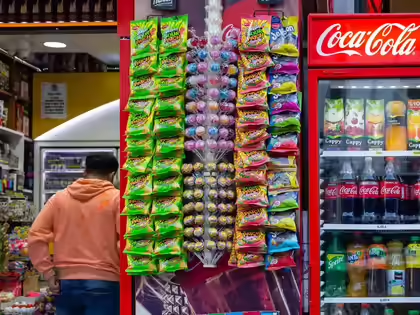
India’s small town consumption surge is forcing FMCG companies to rethink distribution strategies in 2026. Demand from Tier-2 and Tier-3 markets is now driving volume growth, pushing brands to redesign supply chains, expand rural reach, and localize product availability.
The small town consumption surge in India is no longer a supporting trend. It has become central to FMCG growth strategy as urban demand stabilizes and non-metro markets deliver higher incremental sales. Companies are actively shifting focus to capture this expanding consumer base.
Rising Rural Demand and FMCG Growth Trends in India
FMCG growth trends in India clearly show stronger volume expansion coming from smaller towns and rural regions. Industry data over recent quarters indicates that rural demand has either matched or outpaced urban growth, especially in categories like packaged food, personal care, and household essentials.
Higher agricultural income in certain cycles, government welfare spending, and increasing rural wages have contributed to improved purchasing power. At the same time, aspirational consumption is rising, with consumers willing to upgrade from unbranded to branded products.
This shift is visible across product segments. From premium soaps to packaged snacks, brands are seeing deeper penetration in districts that were previously under-served.
FMCG Distribution Strategy Adapts to Last-Mile Challenges
FMCG distribution strategy is undergoing a structural shift to address last-mile delivery challenges in small towns. Traditional wholesale-driven models are being supplemented with direct distribution networks and tech-enabled supply chains.
Companies are increasing the number of rural distributors and sub-stockists to improve product availability. Direct reach models are expanding, allowing brands to serve smaller retail outlets without relying solely on intermediaries.
Technology is also playing a role. Sales force automation tools and route optimization systems are helping companies improve efficiency in remote areas where logistics can be inconsistent.
Rural Supply Chain Expansion and Logistics Investments
Rural supply chain expansion has become a priority for FMCG companies aiming to capture small town consumption. Investments are being made in warehousing, cold chain infrastructure, and regional distribution hubs closer to demand centers.
Shorter supply chains reduce stockouts and improve turnaround time, which is critical for fast-moving categories. Companies are also experimenting with hub-and-spoke models to ensure consistent product availability across clusters of towns and villages.
Third-party logistics providers are increasingly involved in rural distribution, helping brands scale faster without heavy capital investment.
Product Localization and Pack Size Innovation in FMCG
One of the most visible changes in response to small town demand is product localization. FMCG companies are tailoring offerings based on regional preferences, climate conditions, and consumption habits.
Pack size innovation remains a key lever. Smaller, affordable packs continue to drive penetration, while mid-sized packs are gaining traction as incomes rise. This dual strategy allows brands to cater to both entry-level and upgrading consumers.
For example, sachet-based products still dominate in many rural markets, but there is a clear shift toward larger packs in categories like detergents and edible oils.
Role of Digital and Rural Retail Transformation
Digital adoption is accelerating rural retail transformation, directly impacting FMCG distribution. Retailers in small towns are increasingly using digital ordering platforms provided by companies or third-party apps.
This reduces dependency on physical sales visits and improves inventory planning. Digital payments, especially UPI, have simplified transactions between retailers and distributors.
E-commerce is also contributing to demand, although its role is still complementary in many rural areas. The bigger impact comes from digital tools that strengthen offline retail networks.
Challenges in Scaling Small Town FMCG Operations
Despite strong demand, scaling FMCG operations in small towns comes with challenges. Infrastructure gaps, fluctuating demand patterns, and higher distribution costs can impact margins.
Seasonality plays a significant role in rural consumption, linked to agricultural cycles and local economic conditions. Companies must plan inventory and distribution carefully to avoid overstocking or shortages.
Another challenge is retailer fragmentation. A large number of small, independent stores require consistent engagement and support, increasing operational complexity.
Takeaways
Small towns are now the primary drivers of FMCG volume growth in India
Distribution models are shifting toward direct and tech-enabled networks
Localization and pack size innovation are key to capturing rural demand
Supply chain investments are critical to ensuring consistent product availability
FAQs
Why is small town consumption important for FMCG companies?
Small towns offer untapped demand and higher growth potential compared to saturated urban markets, making them critical for volume expansion.
How are FMCG companies changing their distribution strategies?
They are increasing direct distribution, expanding rural networks, and using technology to improve last-mile delivery and efficiency.
What role does pricing play in small town markets?
Affordable pricing through smaller pack sizes helps drive initial adoption, while larger packs support consumers as incomes increase.
What are the biggest challenges in rural FMCG distribution?
Key challenges include logistics inefficiencies, demand variability, and managing a highly fragmented retail network.










Leave a comment