

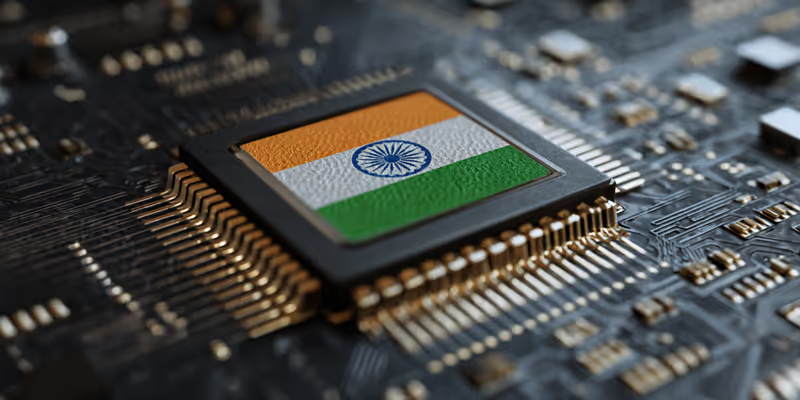
India’s DeepTech, semiconductor, and space startups are entering a new phase of growth, supported by government initiatives, private investment, research collaboration, and rising global demand. These sectors are creating new opportunities for innovation, manufacturing, and high-skilled employment across the country.
Editorial Note: This topic is evergreen with strong current relevance, not a breaking news story. The momentum behind DeepTech, semiconductor, and space startups is driven by long-term policy support, technological advancements, and increasing investor interest. The article follows an explanatory business style.
DeepTech, Semiconductor and Space Startups Are Shaping India’s Innovation Economy
DeepTech, semiconductor and space startups in India are becoming major contributors to the country’s innovation ecosystem. Once dominated by e-commerce, fintech, and consumer internet businesses, India’s startup landscape is now witnessing rapid growth in technology-intensive sectors that require advanced engineering, scientific research, and long development cycles.
Government support through initiatives such as the India Semiconductor Mission, the Production Linked Incentive (PLI) scheme for semiconductor manufacturing, and reforms that opened the space sector to private participation have encouraged entrepreneurs to enter industries previously considered difficult to access.
Today, startups are developing semiconductor components, satellite technologies, space launch systems, robotics, artificial intelligence, quantum computing, advanced manufacturing solutions, and next-generation communication technologies. This shift represents an important evolution in India’s ambition to become a global technology and manufacturing hub.
Government Policies Are Strengthening the Innovation Ecosystem
Public policy has played a significant role in accelerating India’s DeepTech ecosystem. The government has introduced several initiatives aimed at strengthening research, manufacturing capabilities, and technology commercialization.
The India Semiconductor Mission has encouraged investments in chip manufacturing, semiconductor packaging, and design capabilities. Alongside financial incentives, the government has promoted collaborations between industry, academia, and research institutions to build a sustainable semiconductor ecosystem.
In the space sector, policy reforms have enabled private companies to participate in satellite development, launch services, downstream applications, and space-based communication solutions. Regulatory support through organizations such as IN-SPACe has made it easier for startups to work alongside the national space program.
These policy measures are helping reduce dependence on imports while creating opportunities for domestic innovation and manufacturing.
Investor Interest in DeepTech Is Rising
Unlike traditional consumer-focused startups, DeepTech companies require significant research, technical expertise, and patient capital before generating commercial returns. Despite these challenges, venture capital firms and strategic investors are showing growing confidence in the sector.
Artificial intelligence, semiconductor design, cybersecurity, defense technologies, climate technology, aerospace, robotics, and industrial automation have emerged as attractive investment themes. Investors increasingly recognize that these sectors address long-term global challenges while offering opportunities to build globally competitive companies.
Corporate venture funds, institutional investors, and international technology firms are also partnering with Indian startups through accelerator programs, research collaborations, and strategic investments.
Although funding cycles may vary depending on market conditions, investor confidence in technology-led innovation continues to strengthen across India’s startup ecosystem.
Semiconductor and Space Technologies Create New Business Opportunities
Semiconductor technology has become strategically important as demand for electronic devices, electric vehicles, telecommunications equipment, industrial automation, and artificial intelligence hardware continues to increase worldwide.
Indian startups are focusing on chip design, embedded systems, semiconductor testing, electronic design automation, and specialized hardware solutions. While large-scale semiconductor fabrication remains capital intensive, India’s strength in engineering talent is creating opportunities across the semiconductor value chain.
Meanwhile, private space startups are developing satellites, launch vehicles, Earth observation technologies, communication systems, navigation solutions, and space-based analytics for agriculture, disaster management, environmental monitoring, logistics, and defense applications.
These innovations are opening commercial opportunities that extend well beyond the traditional aerospace industry.
Talent, Research and Collaboration Are Driving Growth
India’s growing pool of engineers, scientists, and technology professionals provides a strong foundation for DeepTech innovation. Leading institutes, including IITs, IISc, and several research laboratories, continue to produce highly skilled graduates capable of developing advanced technologies.
Many startups are emerging directly from university research, incubation centers, and technology transfer programs. Partnerships between academic institutions, private companies, and government agencies are helping convert scientific research into commercially viable products.
Artificial intelligence is further accelerating research by improving simulation, product design, predictive analytics, and engineering workflows. Cloud computing and high-performance computing resources have also lowered development costs for startups working on complex technologies.
As collaboration increases across academia, industry, and government, India’s innovation ecosystem continues to mature.
Challenges Remain Despite Strong Growth Prospects
While the outlook for DeepTech and semiconductor startups is encouraging, significant challenges remain. Research-intensive businesses often require larger capital investments, longer product development cycles, and specialized talent compared to traditional software startups.
Global competition, intellectual property protection, supply chain dependencies, regulatory compliance, and commercialization risks continue to influence business success. Building advanced manufacturing capabilities also requires sustained investment in infrastructure, skilled workforce development, and international partnerships.
Access to patient capital remains essential because DeepTech companies often take several years before achieving commercial scale. Continued policy stability and industry collaboration will therefore play a critical role in supporting future growth.
Despite these challenges, India’s expanding innovation ecosystem positions the country to become an increasingly important player in advanced technology industries over the coming decade.
Key Takeaways
- DeepTech, semiconductor, and space startups are becoming key drivers of India’s innovation economy.
- Government initiatives and policy reforms are encouraging research, manufacturing, and private sector participation.
- Venture capital firms are increasing investments in AI, semiconductors, aerospace, robotics, and advanced technologies.
- Talent development, research collaboration, and long-term funding will remain essential for sustainable growth.
Frequently Asked Questions
Q1. What are DeepTech startups?
DeepTech startups develop advanced technologies based on scientific research and engineering, including artificial intelligence, robotics, semiconductors, quantum computing, biotechnology, and aerospace.
Q2. Why is India’s semiconductor sector gaining importance?
Growing demand for electronic devices, electric vehicles, telecommunications equipment, and AI hardware has increased the strategic importance of semiconductor design and manufacturing.
Q3. How has the private space sector expanded in India?
Policy reforms have enabled private companies to participate in satellite development, launch services, space applications, and commercial space technologies alongside government institutions.
Q4. What challenges do DeepTech startups face?
They typically require higher research investments, longer development timelines, specialized talent, intellectual property protection, regulatory compliance, and sustained access to long-term funding.












Leave a comment