

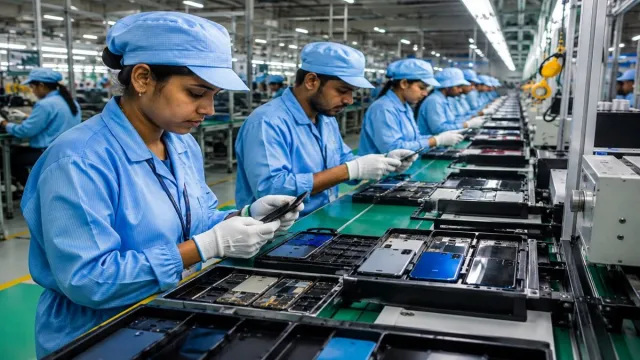
India’s manufacturing push is increasingly extending beyond Bengaluru, Mumbai, Delhi and other major industrial centres. New investments in electronics, semiconductors, defence and industrial infrastructure are creating opportunities for Tier-2 and Tier-3 cities, while improving prospects for local businesses, workers and MSMEs.
India’s manufacturing strategy is widening the industrial map
India’s manufacturing push is moving into a phase where industrial growth is no longer limited to traditional metropolitan centres. Government incentives, new industrial corridors, improved connectivity and sector-specific manufacturing schemes are encouraging companies to consider locations beyond established hubs.
The National Manufacturing Mission announced in the Union Budget 2025-26 focuses on improving the ease and cost of doing business, building a future-ready workforce, strengthening MSMEs, expanding technology access and improving product quality. The mission also places emphasis on clean-tech manufacturing, including solar PV cells, EV batteries, motors, electrolyzers and wind turbines.
This approach matters for smaller cities because manufacturing growth does not depend only on large factories. It creates demand for suppliers, logistics companies, maintenance services, skilled workers, housing, retail and other supporting businesses.
Tier-2 cities gain from new industrial investments
Several emerging industrial locations show how manufacturing activity is spreading geographically.
Tumakuru in Karnataka is one current example. The state government has proposed developing the city as a major manufacturing hub, with an estimated investment potential of around ₹7,000 crore and more than 88,000 projected jobs. The proposed industrial development is expected to strengthen Tumakuru’s position as an industrial centre outside Bengaluru.
In Telangana, the Zahirabad Industrial Smart City is another major project aimed at creating a large industrial ecosystem. The project covers 3,245 acres and is expected to attract around ₹15,000 crore in investment, with nearly two lakh direct and indirect employment opportunities projected by the state government.
Such projects can change the economic profile of smaller cities. Instead of depending mainly on agriculture, trading or government employment, local economies can develop around manufacturing and industrial services.
Electronics manufacturing creates opportunities for smaller cities
Electronics is becoming one of the most important parts of India’s manufacturing strategy.
The government approved 31 investment proposals worth ₹7,877 crore under the Electronics Component Manufacturing Scheme, according to a report published on August 18. The objective is to strengthen domestic component production and reduce dependence on imports.
The broader electronics industry has already expanded considerably. Production increased from ₹6.41 lakh crore in FY22 to ₹11.32 lakh crore in FY25, according to industry reporting, with electronics increasingly becoming an important export category.
For Tier-2 and Tier-3 cities, the opportunity is not necessarily limited to hosting large electronics factories. Component suppliers, packaging companies, testing facilities, logistics operators and technical service providers can become part of the wider manufacturing ecosystem.
This is particularly relevant for cities that have engineering colleges and technical institutes but traditionally have fewer industrial employment opportunities.
Semiconductor investment could build new industrial clusters
Semiconductors represent another area where India’s industrial geography could change.
The government approved Semicon 2.0 in July 2026 with an outlay of ₹1.275 lakh crore. The programme is intended to support semiconductor design, manufacturing, equipment, materials, research and workforce development. Under the earlier phase, 12 semiconductor manufacturing units had been approved with cumulative investment of more than ₹1.64 lakh crore, according to the Prime Minister’s Office.
Semiconductor manufacturing requires a large network of supporting industries. These include specialised equipment, chemicals, materials, logistics, engineering services and technical manpower.
That means the impact can extend well beyond the location of a semiconductor plant. Nearby cities and industrial areas can potentially benefit as suppliers and service providers establish operations around these facilities.
Manufacturing growth can strengthen local MSMEs
One of the biggest potential beneficiaries of India’s manufacturing expansion is the MSME sector.
Large factories typically require hundreds of suppliers for components, packaging, transportation, repairs, fabrication, food services and other operational requirements. When an industrial cluster develops in or near a smaller city, local enterprises can become part of these supply chains.
This can create a more diversified business ecosystem.
For example, a manufacturing unit may directly employ factory workers, but its wider economic impact can include transport operators, machine maintenance firms, security services, warehouse operators and component suppliers.
The Production Linked Incentive schemes have already attracted more than ₹2.40 lakh crore in investment and generated over 14.15 lakh jobs, according to government figures reported in July 2026. Exports under the schemes had crossed ₹15.2 lakh crore.
The next challenge is ensuring that smaller businesses have the capital, technology and skills required to participate in these supply chains.
Better infrastructure will determine where companies invest
Government incentives alone are unlikely to determine whether a manufacturing cluster succeeds.
Companies also need reliable electricity, industrial land, water, transport links, skilled workers and predictable approvals. This makes infrastructure development particularly important for Tier-2 and Tier-3 locations.
Industrial corridors and smart industrial cities can help address some of these requirements by concentrating infrastructure and business services in designated areas.
Improved road, rail and logistics connectivity can also make smaller cities more attractive. If goods can move efficiently between a manufacturing unit, suppliers, ports and major consumption markets, the location becomes commercially more viable.
This is where India’s expanding industrial infrastructure could have a broader economic impact beyond the factory itself.
Jobs may shift from metros to regional industrial centres
The employment impact could be one of the most important changes.
Manufacturing creates demand for engineers, technicians, machine operators, quality-control professionals, logistics workers and administrative staff. It can also create indirect employment in construction, transportation, retail and services.
For young people in smaller cities, this could reduce the need to move permanently to large metros for industrial and technical careers.
However, the availability of jobs will depend heavily on local skills. The National Manufacturing Mission specifically identifies a future-ready workforce as one of its core priorities.
Industrial growth therefore needs to be accompanied by stronger vocational training, engineering education and industry-linked skill development.
What this means for India’s smaller business centres
The manufacturing expansion does not mean every Tier-2 or Tier-3 city will become an industrial hub. Investment will continue to concentrate in locations with strong infrastructure, workforce availability, supply-chain advantages and supportive policies.
But the direction is becoming clearer. Manufacturing opportunities are increasingly being distributed across a wider network of cities and industrial regions.
For local entrepreneurs, this could open opportunities in areas that were previously dominated by traditional commerce. For workers, it could create more regional employment choices. For MSMEs, it could provide access to larger corporate supply chains.
The success of this shift will ultimately depend on whether infrastructure, skills and local businesses develop alongside large manufacturing investments.
Key Takeaways
- India’s manufacturing expansion is increasingly reaching industrial locations outside major metros.
- Electronics, semiconductors, defence and clean-tech manufacturing are creating new supply-chain opportunities.
- Tier-2 and Tier-3 cities could benefit through jobs, MSME growth and supporting industries.
- Infrastructure, skilled manpower and reliable business conditions will determine which locations succeed.
FAQs
Why is manufacturing moving beyond major Indian cities?
Rising industrial infrastructure, government incentives, better connectivity, land availability and the need for specialised industrial clusters are encouraging companies to explore locations beyond established metropolitan centres.
Which sectors could benefit smaller cities the most?
Electronics, semiconductor-related manufacturing, defence, EVs, renewable energy, food processing, textiles and industrial components could create opportunities for emerging manufacturing centres.
How can MSMEs benefit from India’s manufacturing push?
MSMEs can participate as component suppliers, logistics providers, maintenance contractors, packaging companies and other service providers within larger industrial supply chains.
Will manufacturing reduce migration to major cities?
It could create more employment options closer to people’s home regions, but the impact will depend on the number and quality of jobs created and whether smaller cities develop the required skills and infrastructure.












Leave a comment