

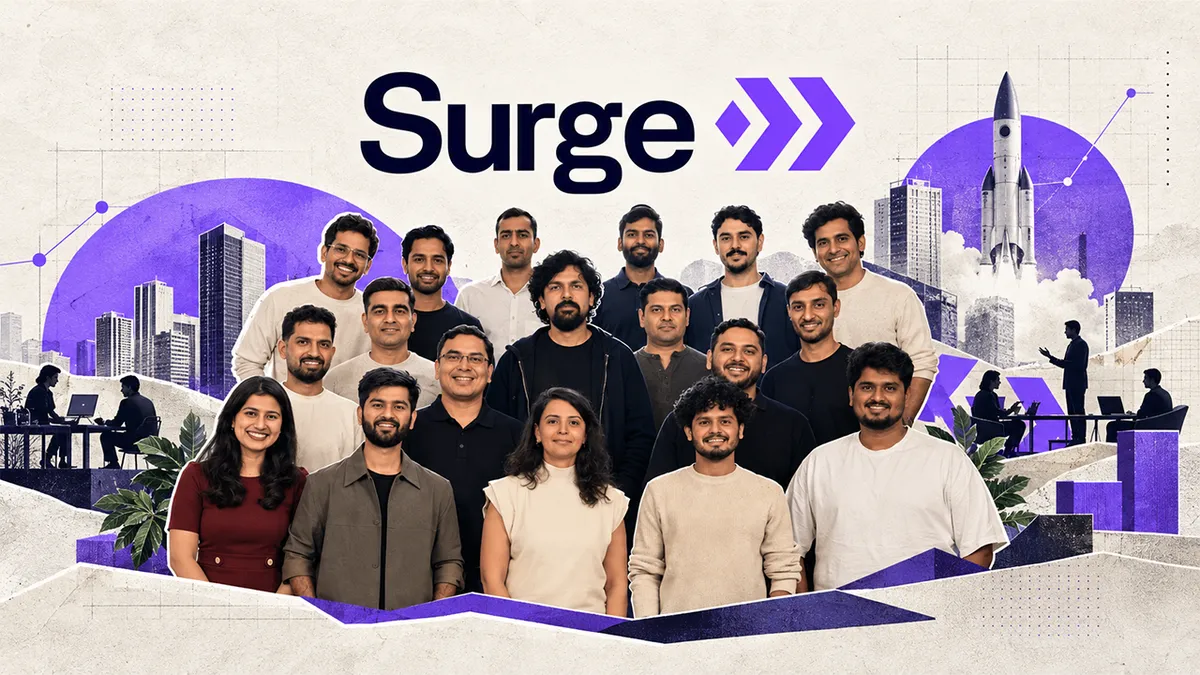
Peak XV Partners has selected 18 startups for the latest Surge cohort, increasing its maximum seed investment to $5 million per company. The focus on AI, robotics, space and other technology sectors highlights how venture capital investors are moving toward technically complex, globally scalable businesses.
Peak XV Raises the Bar for Seed Investments
Peak XV Partners has selected 18 startups for the 12th cohort of its Surge seed-stage investment programme, marking a significant change in how the venture capital firm approaches early-stage companies.
The new cohort is the first under a revised Surge structure that allows Peak XV to invest up to $5 million in an individual startup, compared with the previous ceiling of $3 million. The firm invested more than $50 million across the cohort, while the 18 startups had collectively raised more than $90 million in seed funding, according to TechCrunch. TechCrunch
The companies selected for Surge 12 operate across artificial intelligence, robotics, space technology, healthcare, consumer technology, fintech and music.
The selection is significant because it reflects where venture capital investors see opportunities at the earliest stages of company building. Instead of focusing only on consumer internet businesses, investors are increasingly backing companies developing technology for physical infrastructure, enterprise systems and specialised industries.
AI Is Moving From Feature to Core Infrastructure
Artificial intelligence is one of the clearest themes in the latest Surge cohort. Peak XV’s portfolio includes companies working on consumer AI, enterprise AI, AI infrastructure, healthcare AI and AI security.
Peak XV’s official Surge portfolio lists companies such as Alma, which is developing a consumer AI and personal computing platform; August AI, which focuses on health AI and primary care; and hiloop, which works on enterprise AI and AI infrastructure. Surge
Reinforce Labs is another example. The company is developing tools to evaluate, red-team and remediate enterprise AI systems. This points to a broader shift in the startup market.
As companies adopt AI, there is growing demand not only for AI applications but also for infrastructure, security, monitoring and tools that help businesses deploy these systems safely.
For venture capital investors, this creates multiple potential entry points. A startup does not necessarily have to build a large language model to participate in the AI economy. It can develop software, infrastructure or specialised systems around the technology.
Robotics Takes AI Into the Physical World
The Surge 12 cohort also shows why robotics is receiving greater attention from investors.
One of the companies, Puralink, is developing autonomous robots designed to navigate underground pipe networks. Its technology is aimed at a physical infrastructure problem where inspection and maintenance can be difficult, expensive and potentially dangerous for humans. TechCrunch
This category is part of a wider movement toward what investors often describe as physical AI. Instead of AI remaining inside software applications, intelligent systems are increasingly being combined with robots, machines, sensors and industrial infrastructure.
The investment case is different from that of conventional software startups. Robotics companies generally require more engineering, hardware development and testing. They can therefore need more capital before reaching commercial scale.
Peak XV’s decision to increase the Surge investment ceiling to $5 million is particularly relevant in this context. The firm’s Rajan Anandan said the Series A fundraising bar has increased significantly and that more capital-intensive deeptech companies are raising larger rounds at the seed stage. TechCrunch
Space Startups Gain From Technology and Policy Tailwinds
Space technology is another area represented in the latest Surge cohort.
The interest in space startups comes as India’s broader space ecosystem develops around satellite technology, launch systems, communications and downstream applications. The latest Surge group includes startups working on space-related technology, alongside companies in robotics and AI.
The importance of the sector extends beyond rocket launches. Satellite data can be used for communications, mapping, agriculture, climate monitoring and infrastructure management. This creates opportunities for startups that build applications and services around space infrastructure.
For venture capital investors, the appeal is also linked to the possibility of global markets. A specialised space technology developed in India can potentially serve customers beyond the domestic market if it solves a problem that exists across countries.
That global orientation is visible in Surge 12. TechCrunch reported that only five of the 18 startups are focused on the Indian market, while more than half of the companies are based in India and many are targeting international customers. TechCrunch
Why Investors Are Willing to Fund Capital-Intensive Startups
Traditional startup investing often favoured businesses that could acquire large numbers of customers without significant physical infrastructure. AI, robotics and space businesses can have very different economics.
They may require expensive computing resources, specialist engineering teams, laboratories, hardware development, testing facilities or regulatory approvals.
That can make early funding more important.
Peak XV’s February 2026 fund announcement also provides broader context. The firm announced $1.3 billion in new capital commitments across its India Seed, India Venture and APAC funds, saying a majority would be deployed in India over the following two to three years. The firm specifically highlighted AI opportunities and technical innovation across India and the wider Asia-Pacific region. Peak XV Partners
The Surge 12 investment strategy therefore fits into a wider effort to back technically specialised companies early, when their capital requirements may be higher but their potential markets can also be much larger.
The Series A Challenge Is Changing Startup Funding
One important signal from the latest Surge cohort is the changing fundraising environment after the seed stage.
Rajan Anandan said the bar for raising a Series A has risen significantly. That means startups are expected to demonstrate stronger evidence of product-market fit, customer demand and business potential before securing larger institutional rounds. TechCrunch
This has consequences for founders.
A larger seed round can give a startup more time to develop technology, hire specialised talent and reach meaningful commercial milestones. But it also increases expectations around execution.
For investors, the strategy can provide more room to support technically complex companies before they reach their next funding milestone.
The challenge is that additional capital does not remove the fundamental risks associated with early-stage businesses. A technically impressive product still needs customers, a viable business model and a path toward sustainable growth.
India Could Benefit From the Deeptech Shift
The increasing focus on AI, robotics and space has particular relevance for India’s startup ecosystem.
India has a large engineering talent pool, established technology services capabilities and a growing network of universities, research institutions and technology companies. These factors can support startups working on technically demanding products.
The latest Surge cohort also demonstrates that Indian-founded companies do not necessarily need to build exclusively for Indian consumers.
Many startups can develop technology in India while targeting international markets. This can potentially expand the addressable market and create opportunities for Indian technical talent to build globally relevant companies.
At the same time, the capital requirements of deeptech businesses mean that access to patient funding remains important.
What Surge 12 Says About VC Priorities
Peak XV’s latest cohort does not mean that every venture capital investor is abandoning consumer startups or traditional software. The cohort spans several sectors, including healthcare, fintech, consumer technology and music.
However, its composition provides a useful snapshot of where early-stage investors see technological change creating new businesses.
AI is becoming a foundational layer rather than simply a feature. Robotics is connecting AI with physical environments. Space technology is creating new opportunities around satellites and infrastructure.
For venture capital, these sectors combine technical barriers to entry with potentially large markets. That combination can make them attractive despite the higher capital requirements and longer development timelines.
The bigger question for these startups will be whether they can convert technological capability into repeatable commercial businesses. The next stage of India’s deeptech ecosystem will depend not only on funding, but also on customers, talent, infrastructure and the ability to scale.
Key Takeaways
- Peak XV has selected 18 startups for the 12th Surge cohort across AI, robotics, space, healthcare, fintech and other sectors.
- The maximum investment per Surge startup has increased from $3 million to $5 million.
- AI, robotics and space startups often require more capital because of their technical and infrastructure requirements.
- The higher Series A fundraising bar is pushing early-stage investors and founders to focus more closely on technology, customers and commercial traction.
FAQ
What is Peak XV’s Surge programme?
Surge is Peak XV Partners’ seed-stage investment programme for early-stage startups. It provides funding and support across areas such as product development, hiring, engineering, go-to-market strategy and global expansion. YourStory.com
How much can Peak XV invest through Surge?
Under the revised Surge structure, Peak XV can invest up to $5 million in an individual startup, compared with the earlier ceiling of $3 million. TechCrunch
Why are AI and robotics startups attracting venture capital?
AI and robotics can address large markets across software, enterprise operations, manufacturing and physical infrastructure. Investors are also interested in businesses where specialised technology can create barriers to entry.
Why is space technology attracting startup investors?
Space technology is expanding beyond launch vehicles into satellite systems, communications, data and downstream applications. Startups can potentially serve both Indian and international markets, creating opportunities for global expansion.









Leave a comment