

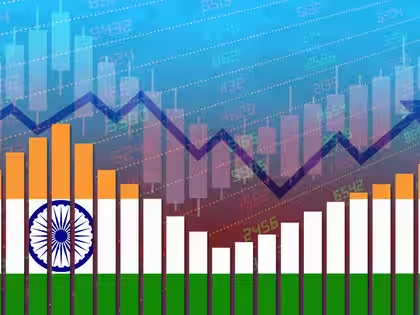
India’s GDP growth outlook for FY27 has strengthened, with the Finance Ministry projecting 7.3% expansion amid resilient domestic demand, investment and services activity. However, higher crude oil prices, inflation risks and global trade uncertainty could influence the economy’s performance.
India GDP Growth Forecast for FY27 Reaches 7.3%
India’s economic growth forecast has received a positive revision, with the Finance Ministry expecting the economy to expand by 7.3% during the financial year ending March 2027. The projection reflects continued strength in domestic consumption, investment activity and the services sector, despite uncertainty in the global economy.
According to a Reuters report published on October 29, the Finance Ministry’s October economic review places India’s FY27 growth expectation at 7.3%. This is slightly higher than the Reserve Bank of India’s 7.1% projection announced earlier in October.
The latest assessment indicates that India continues to maintain relatively strong economic momentum compared with several major economies.
However, the 7.3% projection should be understood as an economic forecast rather than a final growth figure. Actual GDP performance will depend on consumption, investment, industrial production, inflation and international developments over the remaining months of FY27.
The Finance Ministry has also highlighted the risks associated with higher energy prices, geopolitical tensions and tightening global financial conditions.Reuters+2
Q2 FY27 GDP Growth Estimate Signals Continued Economic Momentum
The Finance Ministry’s quarterly assessment provides another indication of India’s economic performance.
Its nowcasting model estimates that India’s real GDP could grow by approximately 7.35% during the July-September quarter of FY27. This follows the reported 7.8% growth recorded in the April-June quarter.
The distinction between the two figures is important. The 7.3% annual projection refers to the expected growth rate for the entire financial year, while the 7.35% figure is a model-based estimate for the second quarter.
The nowcasting model uses high-frequency economic indicators to assess activity before official quarterly GDP data becomes available.
These indicators include electricity consumption, automobile sales, GST collections, industrial production, fuel consumption, bank credit and the movement of goods.
The model suggests that economic activity has remained relatively strong, although some indicators show moderation compared with the first quarter.
The official quarterly GDP release will provide a more comprehensive picture of India’s performance during this period.The Financial Express+2
Private Consumption Could Remain a Major Growth Driver
Private consumption is one of the most important components of India’s economic growth. It includes household spending on food, housing, transportation, healthcare, education, clothing and other goods and services.
When household spending increases, businesses generally experience stronger demand. This can encourage companies to expand production, hire employees and invest in additional capacity.
India’s large domestic market provides an important advantage. Consumption is supported by a combination of urban demand, rural spending, rising incomes and the expansion of organised retail and digital commerce.
The Finance Ministry has identified resilient domestic demand as a major factor supporting the country’s economic outlook.
For businesses, stronger consumption can create opportunities across several sectors:
- Retail: Higher household spending can support demand for clothing, electronics, groceries and lifestyle products.
- Automobiles: Improved consumer confidence can encourage purchases of two-wheelers, passenger vehicles and commercial vehicles.
- Travel and hospitality: Increased disposable income can support tourism, hotel bookings and domestic air travel.
- Financial services: Higher consumption can increase demand for digital payments, banking services and responsible consumer credit.
Tier-2 and Tier-3 cities are also important to this growth story. Expanding digital payment infrastructure, organised retail networks and e-commerce access are connecting smaller markets with businesses across the country.
However, sustained consumption growth will depend on purchasing power, employment opportunities and the ability of households to manage living expenses.
Private Investment and Infrastructure Spending Support Expansion
Investment is another important factor behind India’s GDP growth forecast.
Over recent years, public infrastructure spending has supported economic activity through projects involving roads, railways, airports, ports, electricity and urban development.
Government capital expenditure creates demand for construction materials, engineering services, transportation, machinery and industrial equipment. It can also improve connectivity and reduce logistics costs for businesses.
However, the next phase of investment growth will depend partly on whether private companies increase their own capital expenditure.
When businesses invest in factories, machinery, technology and additional production facilities, they create capacity for future economic expansion.
The Finance Ministry has highlighted investment as an important contributor to India’s growth momentum.
For example, a manufacturing company setting up a new facility in Maharashtra or Gujarat can create direct employment while generating demand for suppliers, transport operators, maintenance providers and local service businesses.
Smaller industrial cities could benefit from this process if they attract investment and develop the necessary infrastructure.
Access to affordable financing, reliable electricity, skilled labour and efficient transportation will remain important for encouraging businesses to expand.
The challenge is to ensure that public infrastructure spending translates into greater private sector participation and long-term productive capacity.IBEF+2
Manufacturing and Services Sector Strengthen India’s Economic Outlook
India’s manufacturing and services sectors are expected to remain important contributors to economic expansion.
Manufacturing supports industrial production, employment, exports and domestic supply chains. Government initiatives aimed at improving manufacturing capacity have encouraged investment in sectors such as electronics, automobiles, pharmaceuticals, defence equipment and renewable energy.
The expansion of domestic production can also create opportunities for smaller suppliers and component manufacturers.
However, manufacturing growth depends on several factors, including global demand, raw material prices, technology access and the competitiveness of Indian products.
The services sector provides another major source of economic activity.
Information technology, financial services, telecommunications, tourism, healthcare, education and professional services contribute to employment and national income.
India’s technology and business services industries also generate export earnings by serving international customers.
The expansion of digital infrastructure has made it easier for service businesses to reach customers beyond major metropolitan markets.
For instance, a technology company operating from Pune, Nagpur or Indore can provide software development, accounting, marketing and customer support services to clients across India and overseas.
This creates opportunities for skilled professionals and smaller service providers outside traditional business centres.
According to the Finance Ministry’s September economic review, services activity strengthened in August, while manufacturing indicators showed a more mixed picture. This suggests that different parts of the economy are contributing at different speeds.IBEF+1
GST Collections, Bank Credit and Electricity Demand Offer Growth Signals
Economists and policymakers use several high-frequency indicators to understand economic conditions before complete GDP figures become available.
These indicators help assess whether businesses are producing more goods, consumers are spending, companies are borrowing and infrastructure is being used more intensively.
GST collections are one such indicator. Higher collections can reflect increased taxable economic activity, although changes in compliance, refunds and tax rates also influence the figures.
Bank credit growth provides another perspective. When companies borrow to expand operations and households access loans for consumption or housing, credit activity can support economic demand.
Electricity consumption is also important because industrial units, commercial establishments and households depend on reliable power.
An increase in industrial electricity demand can indicate stronger production activity, although weather conditions and seasonal changes must also be considered.
Automobile sales, freight movement and infrastructure-related goods production provide additional information about the economy.
The Finance Ministry’s nowcasting assessment uses a combination of these indicators rather than depending on a single measure.
For businesses, monitoring these trends can help with decisions involving inventory, hiring, production capacity and expansion plans.The Financial Express+1
Export Growth Could Create Opportunities for Indian Businesses
Exports are another important part of India’s economic growth strategy.
Indian companies sell products and services across international markets, generating foreign exchange earnings and creating employment in manufacturing and services.
Merchandise exports include products such as engineering goods, pharmaceuticals, textiles, chemicals, electronics and agricultural commodities. Services exports include IT services, business process management, consulting and other professional services.
The Finance Ministry has highlighted export performance as an important component of India’s economic outlook.
However, export growth depends on international demand, exchange rates, trade agreements, logistics costs and geopolitical conditions.
Small and medium-sized businesses could benefit from greater access to international markets, particularly in engineering, textiles, food processing and specialised manufacturing.
For example, a small textile manufacturer in a Tier-2 city may be able to reach overseas buyers through export intermediaries and digital business platforms. However, the company must meet international quality standards, delivery requirements and regulatory conditions.
India’s ability to diversify export destinations and improve product competitiveness will be important for sustaining growth.
A stronger export ecosystem can also help domestic companies reduce their dependence on a limited number of customers or markets.IBEF+1
Inflation and Crude Oil Prices Remain Major Economic Risks
Despite the positive GDP outlook, India faces several risks that could influence economic performance during FY27.
One of the most important concerns is the movement of international crude oil prices.
India imports a substantial share of its crude oil requirements. Higher international prices can increase the country’s import bill and put pressure on transportation, manufacturing and logistics expenses.
Businesses that depend heavily on fuel may face higher operating costs. Airlines, transport companies, chemical manufacturers and logistics operators are particularly exposed to energy price fluctuations.
Inflation is another concern.
If food, fuel and essential commodity prices increase, households may have less money available for discretionary spending. This can affect retail demand, consumer confidence and business revenues.
The RBI’s October 2026 monetary policy review raised its FY27 inflation projection to 5.2% and its GDP growth forecast to 7.1%.
The central bank also increased the policy repo rate to 5.5%, reflecting concerns about inflationary pressures.
Higher interest rates can increase borrowing costs for businesses and consumers. This may influence investment decisions, housing demand and credit growth.
For policymakers, maintaining economic expansion while controlling inflation will remain a difficult balancing act.Finance News – Business Standard+2
Global Trade Uncertainty Could Affect India’s Growth Momentum
India’s domestic market provides some protection against international economic uncertainty, but the country remains connected to global trade and financial systems.
Geopolitical tensions, trade restrictions and supply-chain disruptions can affect the availability and cost of important goods.
For example, restrictions on critical minerals, semiconductor components or industrial machinery can create difficulties for manufacturers that depend on international suppliers.
Trade uncertainty can also influence export orders and foreign investment decisions.
Another concern is the movement of global interest rates. When interest rates in major economies remain high, international investors may prefer investments in those markets.
This can influence capital flows towards emerging economies, including India.
The Finance Ministry has highlighted concerns about tighter global financial conditions, elevated energy prices and uncertainty in international trade.
India will therefore need to strengthen domestic manufacturing, improve supply-chain resilience and maintain competitive export industries.
These measures can reduce vulnerabilities while allowing businesses to participate in international markets.
What 7.3% GDP Growth Could Mean for Tier-2 and Tier-3 Cities
India’s economic expansion is not limited to metropolitan markets. Smaller cities are becoming increasingly important to consumption, manufacturing, services and entrepreneurship.
Cities such as Nagpur, Indore, Jaipur, Coimbatore, Surat, Lucknow and Bhubaneswar have opportunities to attract businesses as infrastructure and digital connectivity improve.
A stronger economy could benefit these markets through several channels.
Employment opportunities: Manufacturing units, logistics companies, retail businesses and service providers can create jobs outside major metropolitan centres.
MSME expansion: Small businesses may benefit from increased consumer spending, improved transportation networks and access to digital marketplaces.
Real estate and infrastructure: Industrial development and business expansion can increase demand for commercial spaces, warehouses and supporting infrastructure.
Startup opportunities: Entrepreneurs can build businesses around local requirements in healthcare, education, agriculture, financial services and technology.
However, GDP growth does not automatically guarantee equal benefits across all regions. The availability of skilled workers, reliable electricity, financing and transport infrastructure will determine how effectively smaller cities participate in economic expansion.
For India’s regional economies, the focus should be on converting national growth into local employment and sustainable business opportunities.
Can India Sustain 7.3% Economic Growth in FY27?
India’s 7.3% GDP growth projection reflects confidence in domestic demand, investment and services activity. The country’s large consumer market and expanding infrastructure base provide important support for economic expansion.
However, sustaining this pace will require consistent performance across multiple sectors.
Private investment needs to strengthen, manufacturing companies must remain competitive, and household consumption should continue to support business demand.
At the same time, policymakers must manage inflation, energy costs and external financial pressures.
The performance of the remaining quarters of FY27 will be important in determining whether the economy meets the latest growth expectations.
For businesses, the current outlook presents opportunities but also calls for careful financial planning. Companies should monitor demand, borrowing costs, input prices and international market conditions before making major expansion decisions.
Ultimately, India’s economic performance will depend not only on achieving a higher GDP growth rate but also on how effectively that growth creates employment, strengthens businesses and improves household purchasing power.
Key Takeaways
- The Finance Ministry’s October 2026 assessment projects India’s FY27 GDP growth at 7.3%, compared with the RBI’s 7.1% forecast.
- Private consumption, infrastructure investment, manufacturing and services activity are important drivers of economic expansion.
- Tier-2 and Tier-3 cities could benefit through employment, MSME development, logistics and regional industrial investment.
- Higher crude oil prices, inflation, global trade uncertainty and tighter financial conditions remain major risks to India’s growth outlook.
Frequently Asked Questions (FAQs)
1. What is India’s GDP growth forecast for FY27?
The Finance Ministry’s October 2026 economic assessment projects India’s GDP growth at 7.3% for FY27. The projection is slightly higher than the RBI’s 7.1% forecast.
2. What are the main drivers of India’s economic growth in 2026-27?
The main drivers include private consumption, infrastructure investment, manufacturing, services activity, bank credit and exports. Domestic demand remains an important source of economic strength.
3. What is India’s estimated GDP growth for Q2 FY27?
The Finance Ministry’s nowcasting model estimates real GDP growth of approximately 7.35% for July-September 2026. This is a model-based estimate, not the final official quarterly GDP figure.
4. What risks could affect India’s GDP growth in FY27?
Higher crude oil prices, inflation, geopolitical tensions, global trade disruptions, currency fluctuations and tighter international financial conditions could affect India’s economic growth.









Leave a comment