

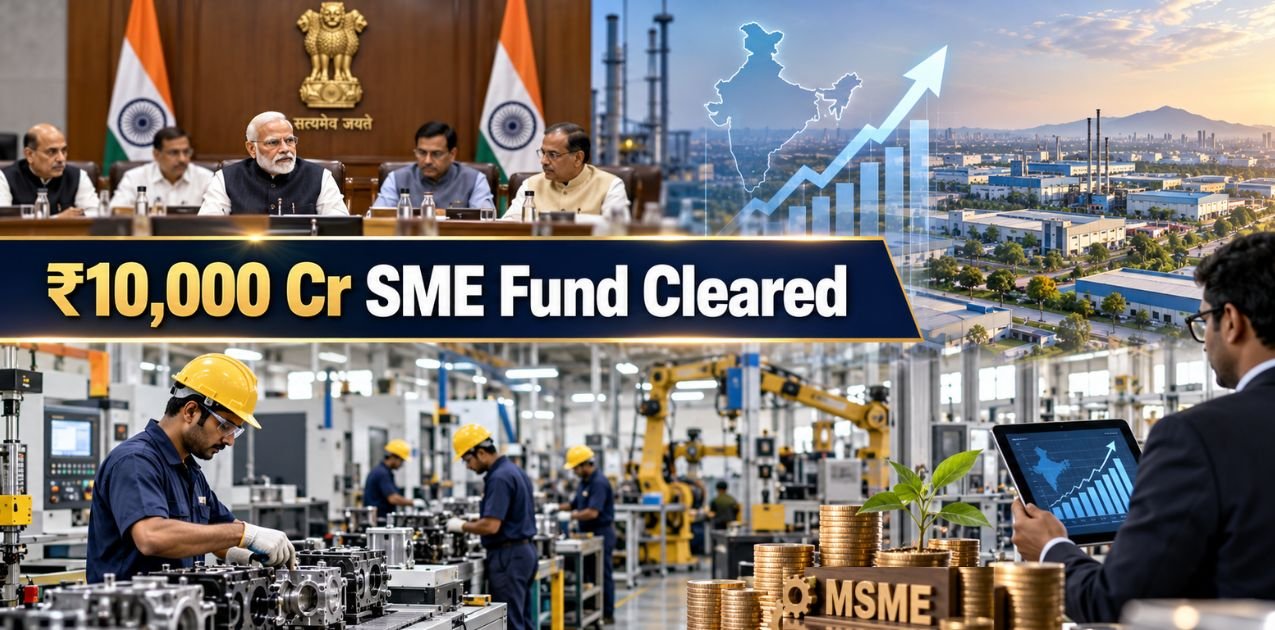
The Government of India has approved a ₹10,000 crore commitment towards the SME Growth Fund to provide equity capital to promising small and medium enterprises. The initiative aims to help businesses expand manufacturing capacity, adopt technology, improve competitiveness and enter international markets, including enterprises operating in Tier-2 and Tier-3 industrial clusters.
Government Approves ₹10,000 Crore SME Growth Fund
The ₹10,000 crore SME Growth Fund is one of the major measures announced under the Union Budget 2026-27 to strengthen India’s small and medium enterprise sector. Finance Minister Nirmala Sitharaman introduced the proposal while presenting the Budget on February 1, 2026, with the objective of helping promising businesses grow into larger and more competitive enterprises.
On October 6, 2026, the Union Cabinet approved the government’s commitment of ₹10,000 crore towards establishing the fund. The initiative is designed to address a financing gap faced by businesses that have moved beyond their initial stages but require substantial capital to expand operations.
Unlike conventional lending, the fund is structured to provide direct equity investments through an Alternative Investment Fund (AIF). This approach is intended to provide growth-oriented businesses with long-term risk capital rather than relying entirely on loans and debt financing.
The government’s focus is on identifying enterprises with demonstrated business viability and the potential to scale their operations.
How the SME Growth Fund Will Support Indian Businesses
Small and medium enterprises frequently face difficulties when they attempt to expand beyond their existing operational capacity. A business may have an established customer base, consistent demand and a functioning production unit but still lack the financial resources required to invest in advanced machinery, hire skilled employees or enter new markets.
The SME Growth Fund aims to address this challenge by providing patient equity capital to businesses with growth potential.
According to the government’s announcement, the fund will support enterprises looking to expand manufacturing capacity, adopt advanced technologies, improve productivity, undertake strategic investments and explore international markets.
For example, a manufacturing company operating in Maharashtra may want to increase its production capacity to fulfil larger orders from domestic or international customers. However, purchasing machinery, upgrading its facility and improving its supply chain may require substantial investment.
Equity financing could provide an alternative source of capital for such businesses, allowing them to pursue expansion without depending entirely on additional borrowing.
The fund is also expected to encourage companies to improve their business processes, governance standards and operational efficiency as they prepare for larger investments.
Manufacturing SMEs to Receive Major Attention
Manufacturing is expected to be one of the primary areas of focus under the SME Growth Fund.
The government’s October announcement stated that a majority of the fund’s allocation would be directed towards small and medium manufacturing-focused enterprises.
This is significant because manufacturing businesses often require considerable investment in machinery, production facilities, technology and workforce development before they can increase output.
Indian manufacturers also face competition from international companies that may have access to larger production capacities, established distribution networks and advanced technologies.
Access to growth capital could help domestic businesses modernise their facilities, improve product quality and strengthen their ability to compete in domestic and international markets.
The fund is also expected to support enterprises operating across services, technology, innovation-driven sectors and strategic value chains.
However, the manufacturing focus indicates that industrial expansion and production capabilities will remain important considerations in the initiative.
Why Tier-2 and Tier-3 Cities Could Benefit
One of the important aspects of the SME Growth Fund is its consideration of businesses operating in industrial clusters across Tier-2 and Tier-3 cities.
For years, India’s business investment ecosystem has been concentrated around major metropolitan centres such as Mumbai, Bengaluru, Delhi and Hyderabad. Smaller cities also have established industrial businesses, but many face difficulties accessing growth capital, specialised financial services and large investment networks.
Cities such as Nagpur, Indore, Coimbatore, Surat, Rajkot and Ludhiana have developed business and industrial ecosystems across different sectors.
For enterprises operating in these markets, access to long-term equity investment could create opportunities to expand production, modernise operations and connect with larger supply chains.
In Nagpur, for instance, businesses operating in manufacturing, logistics, food processing and industrial services could potentially benefit from a stronger investment ecosystem if they meet the fund’s eventual selection criteria.
The government’s emphasis on industrial clusters in smaller cities also reflects a broader effort to encourage regional industrial development.
However, the inclusion of Tier-2 and Tier-3 clusters does not mean that every business in these locations will automatically qualify for investment. Funding decisions will depend on the scheme’s final framework and individual business assessments.
Understanding Equity Funding and How It Differs From Business Loans
The SME Growth Fund is based on equity investment, which makes it different from traditional business loans.
When a business takes a loan from a bank or financial institution, it must repay the borrowed amount along with applicable interest according to the agreed repayment schedule.
Equity investment works differently. An investor provides capital in exchange for an ownership stake in the business. The investor generally participates in the potential financial returns as the company grows, while the business does not have a conventional loan repayment obligation for that investment.
For growing SMEs, this can be useful because expansion projects often require significant capital and may take time to generate returns.
However, equity financing also involves sharing ownership and potentially some decision-making influence with investors.
Businesses must therefore evaluate their financial requirements, ownership structure and long-term growth plans before considering this funding route.
The SME Growth Fund’s direct equity model is particularly relevant for established enterprises that need capital to scale rather than businesses seeking only short-term working capital.
What Businesses Should Know About Eligibility and Investment Access
Although the Union Cabinet has approved the government’s ₹10,000 crore commitment, businesses should distinguish between the fund’s approval and the availability of an application process.
The government has announced that the SME Growth Fund will operate through an Alternative Investment Fund structure. It is intended to support high-potential SMEs with demonstrated business viability and scalability.
The official announcement identifies manufacturing, services, technology, innovation-driven sectors and strategic value chains as areas of focus.
The government’s stated priority also includes manufacturing-focused SMEs and businesses operating in Tier-2 and Tier-3 industrial clusters.
However, the approval announcement does not establish that every registered MSME is eligible for funding. Detailed selection criteria, investment limits, application procedures and timelines should be confirmed through official operational guidelines before businesses make funding decisions.
Enterprises interested in future investment opportunities can begin by maintaining accurate financial statements, tax records, business registrations and information about their operational performance.
A clear expansion plan, details of existing customers, revenue visibility and evidence of business scalability may also help companies prepare for institutional investment discussions.
SME Growth Fund Is Part of a Larger MSME Support Strategy
The ₹10,000 crore commitment is not the only financial support measure introduced under the Union Budget 2026-27.
The government also announced an additional ₹2,000 crore for the Self-Reliant India Fund, which was established in 2021 to support micro enterprises through equity funding.
Alongside equity support, the Budget introduced measures to improve liquidity through the Trade Receivables Discounting System (TReDS).
These include mandating TReDS as the transaction settlement platform for purchases from MSMEs by Central Public Sector Enterprises, introducing credit guarantee support for invoice discounting and linking the Government e-Marketplace (GeM) with TReDS.
The objective is to improve access to financing against unpaid invoices and encourage quicker payments to smaller businesses.
The Budget also proposed developing a network of Corporate Mitras, particularly in Tier-2 and Tier-3 towns. These professionals are expected to help MSMEs with regulatory compliance and other business-related requirements at affordable costs.
Together, these measures address different financial challenges faced by smaller enterprises, including access to equity, working capital and professional support.
Challenges That Will Determine the Fund’s Success
While the SME Growth Fund represents a significant policy initiative, its impact will depend on how effectively the investment framework is implemented.
One important challenge will be identifying businesses that have genuine growth potential. Many smaller enterprises operate with limited financial documentation, informal management structures and inconsistent reporting systems. These factors can make institutional investment assessments difficult.
Another consideration is geographical access. Businesses in smaller cities may have fewer opportunities to connect with investment professionals, financial advisers and institutional investors compared with enterprises in major metropolitan centres.
The selection process will also need to balance growth potential with financial viability, operational capability and long-term sustainability.
The availability of capital alone cannot guarantee business expansion. Enterprises also require skilled employees, reliable infrastructure, technology, market access and efficient supply chains.
For the initiative to achieve its objectives, investment opportunities must reach capable businesses across different regions rather than remaining concentrated among a limited number of established enterprises.
What the ₹10,000 Crore SME Growth Fund Means for India’s Business Future
The SME Growth Fund signals a shift towards strengthening the growth-stage financing ecosystem for Indian businesses.
While credit facilities remain important for day-to-day operations, established enterprises often need patient equity capital to undertake larger expansion projects. The new fund is intended to address this requirement, particularly among manufacturing-focused SMEs.
Its proposed consideration of industrial clusters in smaller cities could also create opportunities for businesses outside India’s major metropolitan markets.
For entrepreneurs, the immediate priority should be improving financial transparency, strengthening business operations and preparing credible expansion plans.
The real impact of the initiative will become clearer as its operational framework, investment selection process and funding deployment take shape. Its success will ultimately depend on whether promising Indian businesses can access the capital and support required to become more productive, competitive and capable of operating in larger markets.
Key Takeaways
- The Union Cabinet approved a ₹10,000 crore government commitment towards establishing the SME Growth Fund on October 6, 2026.
- The fund will provide direct equity investments through an Alternative Investment Fund structure.
- Manufacturing-focused SMEs and industrial clusters in Tier-2 and Tier-3 cities are among its key priorities.
- Detailed investment eligibility, selection procedures and application timelines should be checked against official operational guidelines.
Frequently Asked Questions (FAQs)
1. What is the ₹10,000 crore SME Growth Fund?
The SME Growth Fund is a government-backed initiative announced in Union Budget 2026-27 to provide direct equity capital to high-potential small and medium enterprises seeking to expand their businesses.
2. Which businesses are expected to benefit from the SME Growth Fund?
The fund is designed to support viable and scalable SMEs across manufacturing, services, technology, innovation-driven sectors and strategic value chains. Manufacturing-focused enterprises are expected to receive a major share of the allocation.
3. Can businesses in Tier-2 and Tier-3 cities receive funding?
Yes. The government has specifically stated that SMEs operating in industrial clusters in Tier-2 and Tier-3 cities will also be considered under the initiative, subject to the applicable selection criteria.
4. Is the SME Growth Fund a loan or a grant?
No. It is structured as a direct equity investment fund operating through an Alternative Investment Fund. This means investment is made in exchange for an ownership stake rather than being provided as a conventional loan or grant.
(Internal Keywords: ₹10,000 crore SME Growth Fund, SME Growth Fund India, MSME funding schemes 2026, government funding for small businesses, SME equity financing, MSME growth capital, manufacturing business funding India, Tier-2 city business opportunities, Tier-3 industrial development, Alternative Investment Fund India)










Leave a comment