

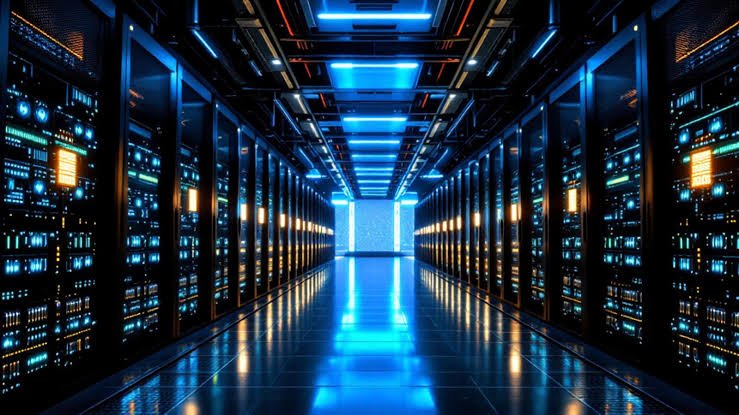
Larsen & Toubro has secured a multi-year order through its AI infrastructure subsidiary to deploy additional NVIDIA B300 GPUs at its Chennai data centre. The development highlights India’s growing demand for advanced computing, AI data centres and enterprise artificial intelligence infrastructure.
L&T Secures Large NVIDIA GPU Deployment Order
Larsen & Toubro (L&T) has strengthened its position in India’s artificial intelligence infrastructure market after its group company Vyoma.AI secured a multi-year engagement through subsidiary LTN Compute to deploy additional NVIDIA B300 graphics processing units (GPUs) at its Chennai data centre.
Announced on November 23, 2026, the order is classified as a Large order under L&T’s internal classification system, which covers contracts valued between ₹2,500 crore and ₹5,000 crore.
The deployment will support an inference infrastructure provider’s AI-native platform. The customer has not been publicly identified in the company’s announcement.
The infrastructure will enable the provider to train, fine-tune and deploy specialised AI models for high-performance inference at commercial scale. The development is part of a larger 10,000-GPU cluster being established at L&T’s Chennai campus.
The announcement is significant because it highlights the growing demand for specialised computing infrastructure as businesses increasingly move artificial intelligence applications from experimentation into commercial operations. Larsen & Toubro+2
NVIDIA B300 GPUs and Their Role in AI Computing
The NVIDIA B300 GPUs are central to the new deployment. These processors are designed for demanding artificial intelligence workloads that require substantial computing capacity.
Unlike conventional processors used for general computing tasks, GPUs can handle many calculations simultaneously. This makes them particularly useful for training and running complex AI models.
Businesses developing generative AI applications require powerful computing systems to process large volumes of information, generate responses and support multiple users simultaneously.
The infrastructure being developed by L&T will support three important AI activities.
AI model training: Training involves processing large datasets to help artificial intelligence systems recognise patterns, understand information and generate useful outputs.
Fine-tuning: Fine-tuning allows developers to adapt existing AI models for specialised applications, industries or business requirements.
AI inference: Inference refers to the process through which a trained AI model generates responses or predictions when users or applications provide new information.
The increasing demand for inference is particularly important for businesses. As more companies introduce AI-powered customer service, financial analysis, enterprise software and automation tools, they require infrastructure capable of delivering reliable results at scale.
L&T’s latest engagement reflects this shift towards commercial AI computing rather than limiting infrastructure investments to experimental research. Larsen & Toubro+2
Chennai AI Factory: L&T’s Larger Infrastructure Ambition
The new GPU deployment is connected to L&T’s broader plan to develop a large-scale AI infrastructure hub at Vyoma.AI’s Chennai campus.
The company describes the facility as a gigawatt-scale AI infrastructure hub. Its first phase is designed for a capacity of 250 megawatts, supported by 150 MVA of power infrastructure readiness.
An AI Factory is different from a conventional data centre in its infrastructure requirements. It is designed to bring together computing hardware, networking systems, storage facilities and specialised operations to support demanding AI workloads.
The planned Chennai facility will combine several components:
- Hyperscale data centre infrastructure to accommodate large computing systems.
- Accelerated computing using specialised NVIDIA hardware.
- High-performance networking to connect computing resources.
- Ultra-low-latency interconnects for faster communication between systems.
- High-throughput parallel storage to handle large datasets.
- AI infrastructure operations to support deployment and management.
These components work together to create an environment where companies can develop, train and operate AI models without building their own computing infrastructure from the ground up.
For L&T, the project also represents an expansion beyond its traditional engineering and infrastructure businesses into specialised digital infrastructure services. Larsen & Toubro+2
Why India’s AI Infrastructure Market Is Expanding
India’s artificial intelligence market is creating demand for computing infrastructure that can support businesses, government departments, research institutions and technology companies.
As organisations adopt generative AI, machine learning and automation, they need access to powerful processors, reliable data storage and high-speed networks.
Building and maintaining this infrastructure independently can be expensive, particularly for startups and medium-sized businesses. This has created opportunities for specialised data centre operators and GPU infrastructure providers.
The demand is also connected to the increasing use of AI in several industries.
Banking and financial services: Financial institutions can use AI for fraud detection, customer support, risk assessment and transaction monitoring. These applications require computing systems capable of processing large volumes of information.
Healthcare: AI applications can support medical imaging analysis, administrative automation, research and clinical data processing, subject to appropriate privacy and regulatory safeguards.
Manufacturing: Industrial companies are exploring AI for predictive maintenance, quality inspection, production planning and supply chain management.
Agriculture: AI-powered platforms can help analyse weather patterns, crop conditions and agricultural data, potentially improving decision-making for farmers.
Retail and e-commerce: Businesses are adopting AI for personalised recommendations, inventory management, demand forecasting and customer service.
These applications require infrastructure that can support consistent performance as the number of users and complexity of AI workloads increase.
India’s opportunity is not limited to developing AI software. The country also needs the physical infrastructure required to operate these technologies at scale.
L&T’s Partnership With NVIDIA and Earlier AI Factory Plans
L&T’s latest order builds on its earlier plans to enter the AI Factory business.
In February 2026, L&T announced a strategic initiative with NVIDIA to develop gigawatt-scale AI infrastructure in India. The proposed venture was aligned with the IndiaAI Mission and focused on developing scalable computing capacity for domestic enterprises, global cloud providers and other technology companies.
The initiative included plans to integrate NVIDIA’s AI computing infrastructure with L&T’s engineering and data centre development capabilities.
In August 2026, L&T announced a major order to develop an NVIDIA B300 AI Factory for US-based AI cloud company Together AI at its Chennai campus. The project was designed around a 10,000-GPU cluster for large-scale AI training, fine-tuning and inference.
The November 23 announcement represents another multi-year engagement for additional GPU deployment at the same Chennai campus. The company has not publicly named the new customer in its latest announcement.
Taken together, these developments indicate that L&T is pursuing a longer-term strategy to establish itself as an AI infrastructure provider rather than treating the GPU deployment as an isolated business opportunity.
The company’s approach combines infrastructure development, computing hardware, networking and managed AI services. Larsen & Toubro+3
What the Order Means for India’s Data Centre Industry
The L&T development highlights a change in the requirements of India’s data centre industry.
Traditional data centres primarily support cloud storage, enterprise applications, websites and conventional computing workloads. AI-focused facilities require substantially different infrastructure.
High-performance GPUs consume considerable electricity and generate significant heat. As a result, AI data centres need specialised power distribution, cooling systems, networking and facility management.
The availability of reliable electricity is particularly important. A large AI computing facility cannot operate efficiently without adequate power infrastructure and systems designed to manage high-density computing equipment.
Cooling is another major consideration. As more powerful processors are installed in data centres, operators need advanced cooling solutions to maintain performance and equipment reliability.
Networking also plays an important role. AI systems often distribute workloads across multiple GPUs. These processors must communicate efficiently to complete complex computing tasks.
For Indian infrastructure companies, these requirements create opportunities across several supporting industries, including electrical equipment, cooling technology, construction, cybersecurity and network infrastructure.
The expansion of AI data centres could therefore generate business opportunities beyond the companies directly involved in GPU deployment.
However, the sector also faces challenges involving electricity availability, capital expenditure, equipment supply, operating costs and environmental sustainability.
Opportunities for Indian Startups and Smaller Cities
The expansion of AI infrastructure could have implications beyond Bengaluru, Hyderabad, Mumbai and other established technology centres.
Tier-2 and Tier-3 cities have growing pools of engineering graduates, technology professionals and entrepreneurs. However, access to advanced computing resources remains an important consideration for startups developing sophisticated AI products.
GPU-as-a-Service models can help address this challenge by allowing businesses to access computing capacity without purchasing and maintaining expensive hardware.
LTN Compute is developing services that include AI Factory infrastructure, Bare Metal-as-a-Service, GPU-as-a-Service, sovereign cloud platforms and managed AI services.
These offerings could become relevant for startups, enterprises and public institutions that need computing resources for AI development and deployment.
Smaller cities may also benefit indirectly through demand for technical support, software development, data management, engineering services and specialised infrastructure operations.
For example, a startup operating from Nagpur, Indore or Jaipur may be able to develop an AI-powered business application without building its own GPU infrastructure, provided suitable services are accessible at commercially viable prices.
However, the development of an AI data centre in Chennai does not automatically mean that smaller cities will receive direct employment or infrastructure investment. The benefits will depend on service accessibility, pricing, connectivity and the expansion of local technology ecosystems.
The larger opportunity is to make advanced computing resources available to businesses across India, rather than concentrating AI development exclusively in a few major technology hubs.
Challenges Facing India’s AI Infrastructure Expansion
Despite growing opportunities, building large-scale AI infrastructure involves substantial financial and operational challenges.
1. High infrastructure costs
Advanced GPUs, networking equipment, cooling systems and data centre construction require significant capital investment. Operators must secure long-term customers to justify these expenses.
2. Electricity requirements
AI computing facilities consume substantial amounts of electricity. Reliable power supply and efficient energy management will be essential as computing capacity expands.
3. Dependence on advanced hardware
India’s AI infrastructure ambitions depend partly on access to globally developed semiconductor technology. GPU availability, supply chain conditions and hardware costs can influence project timelines.
4. Commercial demand
Building computing capacity does not automatically guarantee profitability. Infrastructure providers must attract customers willing to pay for GPU access, cloud services and AI computing.
5. Skilled workforce
Operating AI factories requires professionals with expertise in data centre management, networking, cybersecurity, cloud computing and advanced hardware systems.
Addressing these challenges will be important for ensuring that India’s AI infrastructure investments remain commercially sustainable.
What Lies Ahead for L&T’s AI Infrastructure Business?
L&T’s latest NVIDIA GPU deployment order strengthens its ambitions in India’s emerging AI infrastructure market.
The company’s strategy involves developing large-scale computing facilities and offering specialised services to enterprises, cloud providers, government organisations and AI innovators.
The Chennai campus could become an important part of this strategy as demand for AI training and inference infrastructure increases.
L&T Chairman and Managing Director S. N. Subrahmanyan has described the additional GPU deployment as another milestone in the company’s ambition to build world-class AI infrastructure in India.
The larger question is whether India can develop an ecosystem that combines advanced computing hardware, reliable electricity, affordable infrastructure and commercially viable AI services.
For the country’s technology industry, this transition could create opportunities in software, engineering, manufacturing, data centre operations and specialised digital services.
L&T’s order is one development within this wider transformation. Its long-term significance will depend on how effectively the company converts infrastructure investments into sustained commercial demand and accessible computing services.
Key Takeaways
- L&T’s group company Vyoma.AI, through LTN Compute, secured a multi-year NVIDIA B300 GPU deployment engagement on November 23, 2026.
- The order is classified as Large, covering a value range of ₹2,500 crore to ₹5,000 crore.
- The Chennai AI Factory is planned with a first-phase capacity of 250 MW and 150 MVA of power infrastructure readiness.
- The expansion highlights opportunities in AI computing, GPU-as-a-Service, data centres and digital infrastructure across India.
Frequently Asked Questions (FAQs)
1. What NVIDIA GPU order has L&T secured?
L&T’s group company Vyoma.AI, through its subsidiary LTN Compute, secured a multi-year engagement to deploy additional NVIDIA B300 GPUs at its Chennai data centre.
2. What is the value of L&T’s latest AI infrastructure order?
L&T classified the contract as a Large order, which falls within its ₹2,500 crore to ₹5,000 crore order category. The exact contract value has not been publicly disclosed.
3. What is an AI Factory?
An AI Factory is specialised computing infrastructure that combines GPUs, data centres, networking, storage and operational systems to support AI model training, fine-tuning and inference.
4. How could L&T’s AI infrastructure project benefit Indian startups?
The project could improve access to advanced computing through services such as GPU-as-a-Service and managed AI infrastructure, potentially helping startups develop and operate AI applications without purchasing expensive hardware.









Leave a comment