

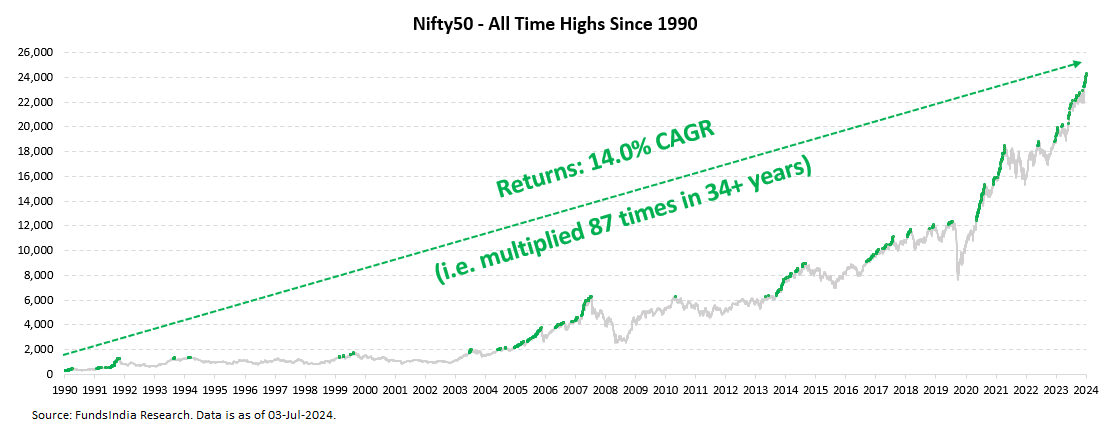
Equity markets near all time highs are prompting investors in Tier 2 cities to reassess risk, portfolio allocation, and exit timing. With benchmark indices trading close to record levels, the focus shifts from chasing returns to protecting capital and identifying disciplined hold or sell signals.
Equity markets near all time highs create a psychological test for investors. When indices approach record territory, optimism rises but so does valuation risk. For investors in Tier 2 cities who have increasingly entered equity markets through mutual funds, SIPs, and direct trading apps, the decision now is not whether to participate but how to manage exposure intelligently.
The current environment reflects strong domestic liquidity, steady retail participation, and sectoral momentum in banking, capital goods, and select manufacturing stocks. However, elevated valuations mean margin for error is thinner. Investors need practical frameworks instead of emotional reactions.
Understanding Valuations and Market Breadth Signals
When stock market indices trade near record levels, valuation metrics such as price to earnings ratios and price to book multiples become critical. If broader market valuations significantly exceed long term averages without corresponding earnings growth, caution is warranted.
Market breadth is another signal. If gains are driven by a narrow group of large cap stocks while midcaps and small caps lag, it may indicate fragility. Conversely, healthy participation across sectors suggests broader economic confidence.
Investors should also track earnings season outcomes. Sustained earnings upgrades justify higher prices. If results begin to disappoint while prices remain elevated, trimming exposure in overvalued counters becomes rational.
For Tier 2 investors who rely heavily on thematic tips or social media driven stock ideas, disciplined valuation checks are essential to avoid late cycle entry.
Practical Exit Signals for Retail Investors
Exiting does not mean liquidating the entire portfolio. It means identifying situations where risk reward becomes unfavorable. One clear exit signal is when a stock’s fundamentals weaken. Declining revenue growth, rising debt levels, or margin compression should not be ignored.
Another signal is portfolio imbalance. If one sector or stock grows to dominate a disproportionate share of holdings due to price appreciation, partial profit booking can reduce concentration risk.
Sharp vertical rallies without earnings support also warrant caution. When prices move significantly ahead of business performance, locking in gains protects capital.
For mutual fund investors, reviewing scheme performance against benchmarks is crucial. Consistent underperformance in a rising market may indicate structural issues in fund strategy.
When Holding Makes More Sense Than Selling
High markets do not automatically mean exit. Long term wealth creation in equities depends on staying invested through cycles. If the underlying business remains strong, with consistent cash flows and competitive advantage, holding through volatility can compound returns.
Systematic Investment Plans remain effective even at elevated levels because they average costs over time. Investors in Tier 2 cities who started SIPs in recent years should focus on asset allocation rather than market timing.
Macro stability also matters. If inflation remains contained, interest rates stable, and corporate earnings resilient, markets can sustain higher valuations for extended periods.
Holding makes sense when the investment thesis remains intact. Selling purely due to headlines often leads to regret if markets continue upward.
Asset Allocation and Risk Management Strategy
Asset allocation becomes critical when equity markets are near highs. Investors should review whether their equity exposure aligns with their risk profile and financial goals.
Rebalancing portfolios by shifting some gains into debt funds, fixed income instruments, or gold can reduce volatility. This is particularly relevant for first generation equity investors in smaller cities who may not have experienced deep corrections.
Emergency funds must remain separate from market investments. Equity exposure should be capital that can withstand short term fluctuations without forcing distress sales.
Diversification across sectors such as banking, consumer goods, IT services, and manufacturing reduces dependency on a single economic theme.
Avoiding Behavioral Mistakes in Bull Phases
Behavioral finance plays a large role when markets are euphoric. Fear of missing out can push investors to buy aggressively at peaks. Conversely, minor corrections may trigger panic selling.
Investors should avoid leveraging portfolios during high valuation phases. Margin trading amplifies losses if markets correct sharply.
Setting predefined exit rules helps. For example, reviewing investments quarterly instead of reacting daily to price movements prevents impulsive decisions.
Education is expanding rapidly in Tier 2 financial ecosystems through online platforms and regional advisory services. However, disciplined execution remains the differentiator between short term traders and long term investors.
The Bottom Line for Tier 2 Investors
Equity markets near all time highs demand strategy, not speculation. The goal is not to predict the exact top but to ensure portfolios are aligned with risk tolerance and long term objectives.
For investors in growing cities beyond metros, the opportunity in equities remains strong. Domestic economic expansion, infrastructure spending, and formalization trends support corporate earnings over time.
The right approach now is balanced participation. Protect gains where valuations are stretched. Stay invested where fundamentals remain strong. Maintain liquidity buffers. Above all, avoid emotional decisions driven by market noise.
Takeaways
High markets require disciplined review of valuations and earnings trends.
Partial profit booking can reduce concentration and protect gains.
Long term investments with strong fundamentals often justify holding.
Asset allocation and diversification are essential risk management tools.
FAQs
Should investors exit completely when markets hit record highs?
No. Complete exit is rarely advisable. Portfolio review and selective trimming based on valuation and fundamentals is more practical.
How can Tier 2 investors manage risk effectively?
By maintaining diversification, rebalancing periodically, and keeping emergency funds separate from equity investments.
Are SIPs safe to continue at high market levels?
Yes. SIPs average costs over time and are designed for long term investing rather than short term timing.
What is the biggest mistake investors make in bull markets?
Chasing momentum without checking fundamentals or using leverage to amplify exposure during elevated valuations.












Leave a comment