

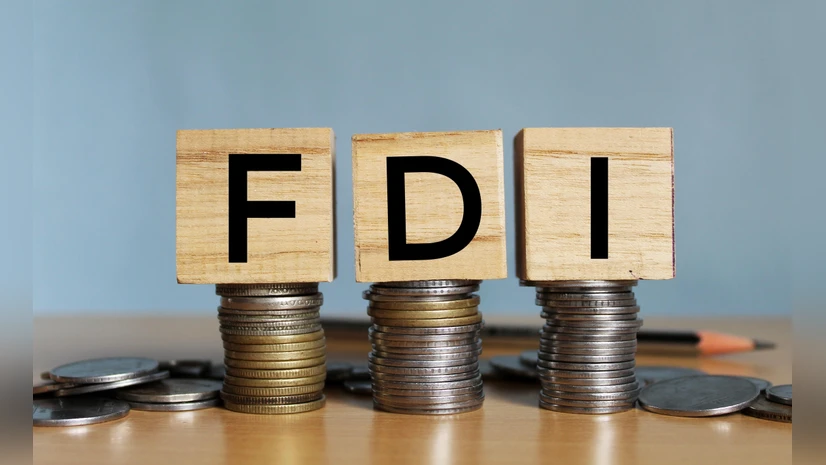
FDI inflows into India are expected to surge in 2026 as policy continuity, targeted reforms, and new trade agreements improve investor confidence. Early signals from manufacturing, services, and infrastructure indicate renewed foreign interest after a cautious global investment cycle.
FDI Momentum Builds After a Cautious Global Phase
FDI inflows into India are gaining momentum at the start of 2026 following a year of uneven global capital movement. International investors had adopted a wait-and-watch approach in 2025 due to high interest rates, geopolitical uncertainty, and slowing growth in developed markets. India has emerged as a relative outperformer in this environment.
Policy stability has been a critical factor. Unlike several emerging markets that saw regulatory reversals, India maintained consistency in foreign investment rules across key sectors. This continuity has helped restore confidence among long-term investors such as sovereign funds, pension funds, and global corporates looking to diversify supply chains.
Policy Push Driving Investor Confidence
The government’s policy push remains central to the expected FDI surge. Simplification of compliance processes, faster approvals, and digitisation of regulatory filings have reduced friction for foreign investors. Sector-specific policies in manufacturing, defence production, electronics, and renewable energy have created clearer investment pathways.
Production-linked incentive schemes continue to attract global manufacturers seeking scale and cost efficiency. Investors are not only looking at incentives but also at execution track records. Projects announced in earlier phases are moving into production, signalling that India can convert policy intent into on-ground outcomes.
Tax stability and the absence of retrospective changes also play a role. For foreign investors, predictability matters as much as incentives, especially for long-gestation projects.
Role of New Trade Deals in Boosting FDI
New and ongoing trade agreements are acting as force multipliers for FDI inflows. Trade deals reduce tariff uncertainty, improve market access, and make India a more attractive export base. This is particularly relevant for sectors like electronics, auto components, chemicals, textiles, and pharmaceuticals.
Foreign companies increasingly view India as a manufacturing and export hub rather than just a domestic consumption market. Trade agreements help lower the risk of concentration by enabling India-based production to serve multiple geographies. Analysts note that such arrangements improve project viability and return expectations for foreign investors.
The timing is also favourable as global firms reassess overdependence on single-country supply chains.
Sectoral Outlook for Foreign Investment
Manufacturing is expected to remain a top recipient of FDI in 2026, especially electronics, semiconductors, and advanced components. Infrastructure and renewable energy are also attracting long-term capital due to stable demand visibility and policy backing.
Services such as financial services, insurance, technology platforms, and global capability centres continue to draw steady inflows. India’s skilled workforce and cost advantages make it a preferred destination for backend operations, analytics, and product development.
Real estate-linked FDI, particularly in commercial and logistics assets, is also picking up as institutional investors seek yield-generating assets in a stable regulatory environment.
How India Compares with Other Emerging Markets
Compared to peer emerging economies, India is benefiting from a combination of scale, growth prospects, and policy continuity. While some markets struggle with currency volatility or political uncertainty, India offers relative macroeconomic stability.
Inflation is under control, foreign exchange reserves are adequate, and fiscal consolidation is progressing. These macro factors reduce risk premiums for foreign investors. As a result, India is increasingly positioned as a core allocation rather than a tactical bet within emerging market portfolios.
Analysts highlight that while FDI inflows may not spike uniformly across all quarters, the underlying trend remains positive.
Challenges That Could Impact FDI Growth
Despite optimism, challenges remain. Land acquisition issues, state-level regulatory differences, and infrastructure bottlenecks can slow project execution. Investors also monitor labour reforms and contract enforcement closely.
Global factors such as renewed recession fears or financial market stress could temporarily dampen capital flows. However, India’s diversified investor base reduces dependence on any single region, providing resilience against external shocks.
Execution at the state level will be crucial. States that offer faster clearances, stable policies, and investor support are likely to attract a disproportionate share of new FDI.
What to Watch Through 2026
Investors and policymakers will closely track actual capital deployment rather than headline announcements. Project implementation, job creation, and export growth will be key indicators of FDI quality.
Analysts also advise watching sectors where India can build long-term competitive advantage rather than chasing short-term inflows. Sustainable FDI contributes to productivity, technology transfer, and supply chain resilience.
Takeaways
- FDI inflows into India are expected to rise in 2026 due to policy stability
- Trade agreements are strengthening India’s role as a global manufacturing base
- Manufacturing, infrastructure, and services remain key FDI magnets
- Execution and state-level reforms will determine the pace of inflows
FAQs
Why is FDI expected to increase in India in 2026?
Policy continuity, trade deals, and India’s relative macro stability are improving investor confidence.
Which sectors will attract the most foreign investment?
Manufacturing, renewable energy, infrastructure, and services are likely to lead.
Do trade agreements directly impact FDI?
Yes. They reduce export risks and improve project viability for foreign investors.
What risks could slow FDI inflows?
Global volatility, execution delays, and regulatory complexity at the local level.












Leave a comment