

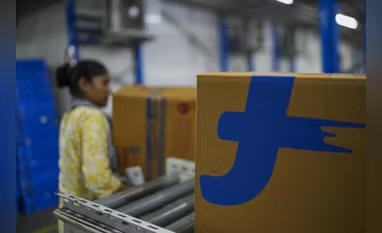
Flipkart is moving its holding company back to India as it prepares for a long anticipated domestic stock market listing. The restructuring signals a major strategic shift for the Walmart owned e commerce giant and highlights India’s growing importance as a global technology and startup hub.
Flipkart begins process to relocate holding company to India
Flipkart has started shifting its holding company structure from Singapore to India ahead of a potential domestic initial public offering. The move is widely seen as preparation for a listing on Indian stock exchanges within the next few years.
The company was originally incorporated in Singapore in 2011 when global investors preferred overseas structures for Indian startups. At that time, India had complex regulations for foreign investment and public listings, making offshore incorporation more practical.
However, the landscape has changed significantly. India has simplified listing norms, strengthened startup regulations and introduced tax clarity for technology companies. As a result, several Indian startups are reconsidering overseas structures and evaluating domestic listings.
Flipkart’s decision reflects this broader shift. The company, which dominates India’s online retail sector along with Amazon India, now sees stronger strategic value in aligning its corporate structure with its largest market.
Why a domestic IPO is strategically important
A domestic IPO would allow Flipkart to tap Indian capital markets and attract local investors who understand the country’s digital economy. India’s stock market participation has grown rapidly in recent years, with millions of new retail investors entering the market through digital trading platforms.
Listing in India also helps improve regulatory transparency and strengthens the company’s positioning as an Indian technology champion. Policymakers have increasingly encouraged homegrown startups to list locally rather than overseas.
Another advantage is valuation visibility. Companies operating primarily in India often receive better valuation understanding from domestic investors compared to foreign markets that may not fully grasp the scale of India’s digital consumption economy.
Flipkart’s potential IPO could become one of the largest tech listings in India if it proceeds. Industry estimates have previously suggested valuations exceeding 60 billion dollars, though the final valuation would depend on market conditions at the time of listing.
Walmart’s long term strategy for Flipkart
US retail giant Walmart acquired a majority stake in Flipkart in 2018 in a landmark deal worth about 16 billion dollars. Since then, Walmart has steadily expanded its investments in India’s digital commerce ecosystem through Flipkart and the fintech platform PhonePe.
Relocating Flipkart’s holding structure to India could simplify the IPO process and align with Walmart’s broader strategy of strengthening its presence in one of the world’s fastest growing consumer markets.
India’s e commerce sector continues to expand rapidly, driven by increasing internet penetration, affordable smartphones and the growth of digital payments. Smaller cities and Tier 2 and Tier 3 markets are emerging as the biggest growth drivers for online retail.
Flipkart has been actively targeting these markets through logistics expansion, regional language interfaces and partnerships with local sellers.
Startup ecosystem sees shift toward Indian listings
Flipkart’s restructuring also reflects a larger trend in India’s startup ecosystem. Several high profile startups are reconsidering offshore holding structures and exploring ways to redomicile back to India.
Historically, many Indian startups incorporated in Singapore or the United States to access foreign venture capital and simplify shareholding structures. But with India’s capital markets becoming more mature, domestic listings are increasingly viable.
Companies such as Zomato, Nykaa and Paytm have already demonstrated that large technology driven firms can list successfully on Indian exchanges. Their listings helped establish a precedent for new economy companies seeking public capital in India.
If Flipkart proceeds with a domestic IPO, it would represent one of the most significant milestones for India’s startup ecosystem. The move could encourage other unicorns to evaluate similar restructuring plans.
Implications for India’s digital economy
Flipkart’s shift back to India signals growing confidence in the country’s regulatory and financial ecosystem. It also highlights the increasing maturity of India’s startup landscape, where large technology firms are now preparing for domestic public markets.
For investors, the potential IPO could offer an opportunity to participate in the growth of India’s e commerce sector. For policymakers, the move strengthens the narrative of building global technology companies rooted in India.
While the timeline for the IPO has not been officially announced, the relocation of the holding structure indicates that preparations are underway.
Takeaways
Flipkart is shifting its holding company from Singapore to India in preparation for a possible domestic IPO.
The move reflects improved Indian capital markets and regulatory support for startup listings.
A Flipkart IPO could become one of India’s largest technology listings.
The decision signals a broader trend of Indian startups considering local stock market listings.
FAQs
Why is Flipkart moving its holding company to India?
The relocation helps simplify the process of listing on Indian stock exchanges and aligns the company’s corporate structure with its main market.
Was Flipkart always based in India?
Operationally yes, but its holding company was incorporated in Singapore in 2011 to attract foreign investment and navigate earlier regulatory challenges.
When could Flipkart launch its IPO?
No official timeline has been announced yet, but the restructuring indicates preparation for a future public listing in India.
How big could Flipkart’s IPO be?
Industry estimates have previously valued Flipkart above 60 billion dollars, meaning the IPO could become one of the largest technology listings in India.











Leave a comment