

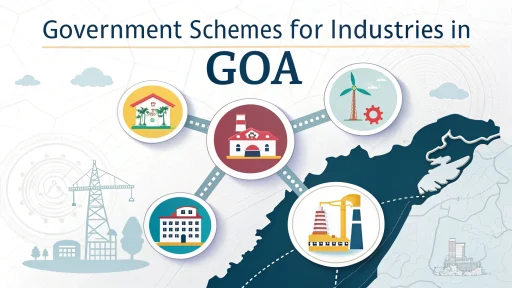
Goa’s Seed Capital Scheme picks 8 startups for incentives, marking a focused push to strengthen regional entrepreneurship. The selection signals the state’s intent to support early stage innovation, retain local talent, and create scalable businesses rooted in Goa’s economic and social landscape.
Goa’s Seed Capital Scheme picking 8 startups for incentives is a time sensitive policy development with long term implications. The tone remains news driven while explaining what the decision means for founders, investors, and the wider startup ecosystem in the state.
Why Goa’s Seed Capital Scheme Matters Now
Goa’s Seed Capital Scheme picks 8 startups for incentives at a time when early stage funding remains tight across India. For founders outside major startup hubs, access to first capital often determines whether an idea survives beyond the prototype stage.
The state government’s decision addresses this gap by offering structured financial support combined with policy backing. Goa has traditionally been seen as a tourism driven economy, but the scheme reflects a broader ambition to diversify into technology, services, and innovation led enterprises.
Secondary keywords like state startup schemes and regional startup funding are central to understanding the intent behind this move.
What the Selection of Eight Startups Signals
The selection of eight startups under the Goa Seed Capital Scheme is not about scale but about signal value. By choosing a limited number of startups, the government emphasizes quality, feasibility, and local relevance over volume.
These startups typically operate at ideation or early revenue stages, where small capital infusions can unlock product development, hiring, or pilot deployments. The incentive structure reduces early risk and allows founders to focus on execution rather than survival.
For the ecosystem, this selection creates visible role models and sets benchmarks for future applicants.
Sectors and Business Models in Focus
While Goa’s Seed Capital Scheme does not restrict itself to one sector, the focus remains on startups aligned with the state’s strengths and development priorities. Tourism tech, hospitality solutions, sustainable mobility, agri and fisheries innovation, waste management, and digital services feature prominently.
Technology enabled MSME solutions and platforms serving local businesses also align well with the scheme’s objectives. The emphasis is on practical problem solving rather than speculative consumer internet models.
Secondary keywords such as sector focused startups and local innovation models apply strongly to this approach.
How the Incentives Are Expected to Be Used
Under Goa’s Seed Capital Scheme, incentives are typically designed to support specific milestones. These may include product validation, market testing, regulatory compliance, or early customer acquisition.
Rather than unrestricted spending, the funds are expected to be used against approved business plans. This approach improves accountability and ensures public capital delivers measurable outcomes.
For startups, this structure encourages disciplined financial planning from day one, a critical skill often missing at early stages.
What Comes Next for the Selected Startups
After Goa’s Seed Capital Scheme picks 8 startups for incentives, the real work begins. Founders must convert early support into traction, whether through paying customers, partnerships, or operational proof points.
Successful execution can open doors to follow on funding from angels, incubators, or early stage venture funds. Government backing also adds credibility during fundraising and customer conversations.
Startups that fail to meet milestones risk stagnation, highlighting that incentives are an enabler, not a guarantee of success.
Impact on Goa’s Startup Ecosystem
The broader impact of Goa’s Seed Capital Scheme picking 8 startups for incentives lies in ecosystem development. It strengthens incubators, encourages entrepreneurship among local youth, and reduces dependence on metro cities.
Over time, repeated cycles of such schemes can create a pipeline of investable startups. This attracts mentors, accelerators, and private investors to the state, creating a self reinforcing ecosystem.
Secondary keywords like startup ecosystem development and tier 2 entrepreneurship growth define this long term outcome.
Implications for Other Regional Startup Policies
Goa’s approach offers a replicable model for other small states. A focused corpus, limited startup selection, and milestone linked incentives reduce waste and improve outcomes.
Instead of chasing unicorn narratives, such schemes prioritize employment generation, local problem solving, and sustainable growth. This aligns well with India’s broader push toward decentralised innovation.
If execution remains transparent and consistent, Goa’s model can influence how regional startup policies are designed nationwide.
Takeaways
- Goa’s Seed Capital Scheme selects eight startups to strengthen early stage innovation
- The focus is on quality, local relevance, and milestone based capital support
- Selected startups gain credibility and a pathway to follow on funding
- The scheme supports long term ecosystem building beyond tourism
FAQs
What is the objective of Goa’s Seed Capital Scheme?
The scheme aims to support early stage startups with initial capital, reduce funding gaps, and encourage local entrepreneurship.
Who benefits most from this scheme?
Early stage startups registered in Goa, especially those solving local or regional problems, benefit the most.
Does the incentive guarantee future funding for startups?
No. It provides initial support and credibility, but future funding depends on execution and traction.
Can this scheme attract investors to Goa?
Yes. Consistent implementation can create a pipeline of de risked startups, making Goa more attractive to investors.












Leave a comment