

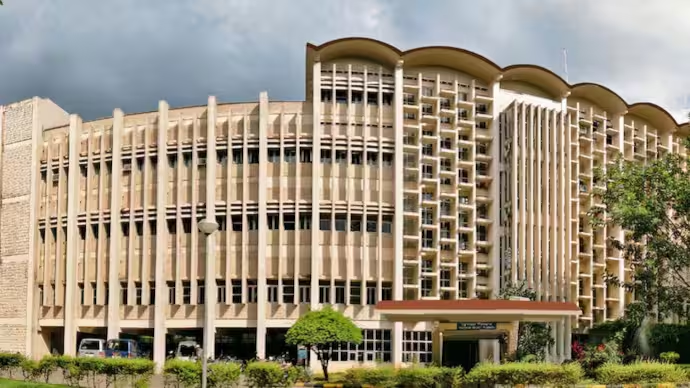
IIT Bombay 250 crore deep tech fund marks a significant shift in how India supports research driven entrepreneurship, giving academic startups a dedicated capital pipeline for the first time. The initiative strengthens commercialization efforts and accelerates deep technology development across multiple scientific disciplines.
New funding architecture and why academic startups need it
The new funding architecture addresses a long standing gap in India’s innovation ecosystem. Academic startups often emerge from laboratories that specialise in engineering, material science, biotechnology, robotics or energy research. These ventures require substantial early capital because deep tech development involves long gestation cycles, intensive prototyping and regulatory processes.
The 250 crore fund supports researchers transitioning from academic work to commercial applications. Many of these founders struggle to attract traditional venture capital because their business models require strong scientific validation before revenue generation begins. The new structure provides resources for early experimentation and offers financial resilience during lengthy development phases.
Funding of this nature also helps retain top research talent. Students and faculty who previously left academia to join corporate roles or international labs now have an incentive to build companies directly within the Indian innovation ecosystem.
Deep tech sectors gaining priority under the new fund
Deep tech sectors gaining priority include advanced materials, semiconductors, space engineering, medical devices, climate solutions and industrial robotics. These areas have high strategic relevance and require complex research infrastructure, making academic institutions ideal breeding grounds for innovation.
Medical device startups, for example, often depend on clinical testing and regulatory pathways that take years to complete. Early capital supports prototyping, certification and manufacturing scale up. Similarly, semiconductor and electronics ventures benefit from access to IIT Bombay’s fabrication facilities, high precision instruments and research partnerships.
Climate and energy startups are another focus area. Innovations in carbon capture, water purification and renewable materials align with national sustainability targets. Venture capital interest in climate tech is rising globally, and the fund positions IIT Bombay to contribute meaningfully to this sector.
Strengthening commercialization pathways through institutional support
Commercialization pathways are being strengthened as the fund integrates capital with structured support. Academic founders receive guidance on intellectual property protection, market analysis, prototype testing and business model refinement. Faculty advisors and industry mentors assist in translating scientific breakthroughs into viable products.
Incubation support includes access to laboratories, testing environments and collaboration networks. These resources reduce the cost burden on founders and improve the pace of development. Many deep tech startups struggle not due to lack of innovation but due to weak commercialization planning. The fund bridges this gap by providing specialised assistance.
Industry partnerships also play a role in accelerating market entry. Companies seeking advanced technologies collaborate with IIT Bombay labs to co develop products or fund additional research. These partnerships enhance credibility and open doorways for pilot deployments.
Impact on India’s deep tech landscape and long term competitiveness
The fund’s impact extends beyond a single institution. It signals a shift in India’s deep tech landscape by encouraging other academic institutions to explore similar funding models. A consistent challenge for Indian deep tech has been the absence of early institutional capital. With IIT Bombay taking the lead, the model may inspire nationwide replication.
Long term competitiveness increases as more academic startups reach commercialization stages. Countries with strong deep tech ecosystems typically anchor innovation within universities. India is now moving in that direction, positioning itself to compete globally in strategic technologies.
The fund also supports India’s ambition to strengthen domestic manufacturing. Deep tech companies often create IP driven hardware solutions that feed into industrial supply chains. These ventures generate high quality jobs and contribute to national technological independence.
Opportunities for students, researchers and first time founders
Students and researchers receive new opportunities through the fund as they can pursue entrepreneurship without abandoning academic pathways. Many deep tech ideas emerge from thesis work, faculty projects or interdisciplinary collaborations. The fund allows these teams to validate concepts, file patents and launch companies without searching for external investment at an early stage.
First time founders gain structured training in compliance, finance and scaling. Academic founders often excel in research but require guidance in company building. Tailored support reduces early execution risks and improves investor confidence during later funding rounds.
This shift also expands India’s startup diversity. Academic founders bring unique perspectives that differ from consumer tech focused entrepreneurs. Their contributions enrich the broader startup ecosystem and align more closely with national engineering and scientific priorities.
Takeaways
IIT Bombay launches India’s first dedicated deep tech fund for academic startups
Capital supports long gestation research ventures across high impact sectors
Commercialization pathways strengthen through institutional labs and mentorship
The initiative enhances India’s long term deep tech competitiveness
FAQs
Why is a deep tech fund important for academic startups
Deep tech ventures require long development cycles and extensive scientific testing. Early capital helps them transition from research to commercial viability.
Which sectors are expected to benefit most from the fund
Advanced materials, medical devices, climate solutions, robotics, semiconductors and energy innovations will receive significant focus.
How does IIT Bombay support commercialization efforts
The institution provides lab access, IP guidance, industry partnerships and structured incubation support to help founders refine and deploy technologies.
Will this initiative influence other academic institutions
Yes, the model is likely to inspire similar funds nationwide, expanding early stage deep tech support across India.










Leave a comment