

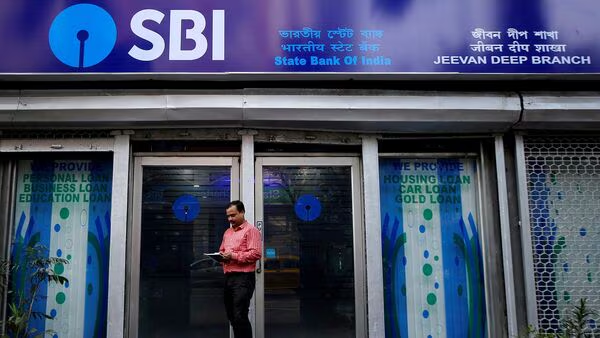
India market rally is back in focus as State Bank of India hits a record high share price, drawing fresh attention from retail investors across Tier-2 and Tier-3 cities. The move is not just a stock-specific event. It reflects deeper shifts in banking profitability, credit demand, and investor confidence in public sector banks.
Why this rally matters right now
State Bank of India’s stock reaching an all-time high during a broader India market rally signals renewed trust in large-cap banking names. This is a time-sensitive market development, and the tone here is news-driven. The rally comes amid strong quarterly performance, improving asset quality, and stable macro conditions that favour lenders with scale and reach.
For retail investors, especially those entering the market through SIPs or demat accounts in smaller cities, SBI’s price action works as a sentiment anchor. When India’s largest bank performs well, it often shapes how investors view the entire banking sector.
SBI’s fundamentals driving the record high
The immediate driver behind SBI’s record share price is earnings visibility. The bank has delivered consistent profit growth, supported by healthy net interest margins and controlled operating costs. Loan growth has remained broad-based, covering retail, MSME, and corporate segments.
Another key factor is asset quality. SBI’s gross and net non-performing asset ratios have improved steadily over recent quarters. Lower slippages and higher recoveries reduce risk perception, which directly supports valuation expansion.
Capital adequacy also plays a role. SBI’s strong capital buffer allows it to grow its loan book without aggressive equity dilution. For long-term retail investors, this reduces uncertainty around future fundraising.
What the India market rally says about PSU banks
This India market rally is not limited to private banks. Public sector banks are seeing re-rating after years of underperformance. SBI is leading this shift because it combines PSU stability with near-private-bank execution.
Government-led infrastructure spending and higher credit offtake from manufacturing and services have improved PSU bank loan pipelines. SBI, with its nationwide branch network, is a direct beneficiary of credit demand from semi-urban and rural markets.
Retail investors often use SBI as a proxy for PSU banking health. Its record high share price suggests the market expects PSU banks to remain profitable even if interest rates moderate.
Valuation signals for retail investors
At record levels, valuation becomes the central question. SBI’s price-to-book multiple has expanded but remains below long-term peaks seen during earlier market cycles. This suggests the rally is driven more by earnings growth than speculative excess.
For retail investors, this matters. A stock hitting a record high is not automatically expensive if fundamentals continue to improve. In SBI’s case, return on assets and return on equity have shown structural improvement, supporting current valuations.
However, near-term volatility cannot be ruled out. Profit booking often follows sharp rallies, especially when benchmark indices are also near highs.
What retail investors should watch next
Retail investors tracking the India market rally should focus on forward indicators rather than past returns. Credit growth trends, deposit mobilisation, and margin stability will decide whether SBI sustains its momentum.
Another area to watch is treasury income. Changes in bond yields can impact bank earnings, especially for large balance sheet lenders like SBI. Regulatory signals from the central bank on liquidity and capital norms also influence banking stocks.
For long-term investors, SBI’s scale, brand trust, and diversified loan book remain key strengths. For short-term traders, entry timing and broader market sentiment become more important at record price levels.
Broader market implications
SBI’s performance often sets the tone for banking-heavy indices. A sustained rally here supports benchmark stability, which encourages participation from first-time investors in smaller towns. This feedback loop strengthens the overall India market rally.
It also signals that investors are prioritising earnings visibility over high-risk growth stories. That shift typically favours banks, utilities, and large financial institutions during mature phases of a market cycle.
Takeaways
- SBI’s record high share price reflects strong earnings visibility and improving asset quality
- The India market rally is reinforcing confidence in PSU banks, led by SBI
- Valuations appear supported by fundamentals, not speculative excess
- Retail investors should track credit growth, margins, and policy signals next
FAQs
Why is SBI share price at a record high now?
The rally is driven by consistent profit growth, improved asset quality, and stable capital position, along with positive sentiment toward PSU banks.
Does a record high mean SBI stock is overvalued?
Not necessarily. Valuation expansion is supported by better returns and earnings growth, though short-term volatility is possible.
How does SBI impact the broader India market rally?
As the largest bank, SBI influences banking indices and overall market sentiment, especially among retail investors.
Should retail investors buy SBI at current levels?
Long-term investors may still find value based on fundamentals, while short-term investors should be cautious about entry timing.










Leave a comment