

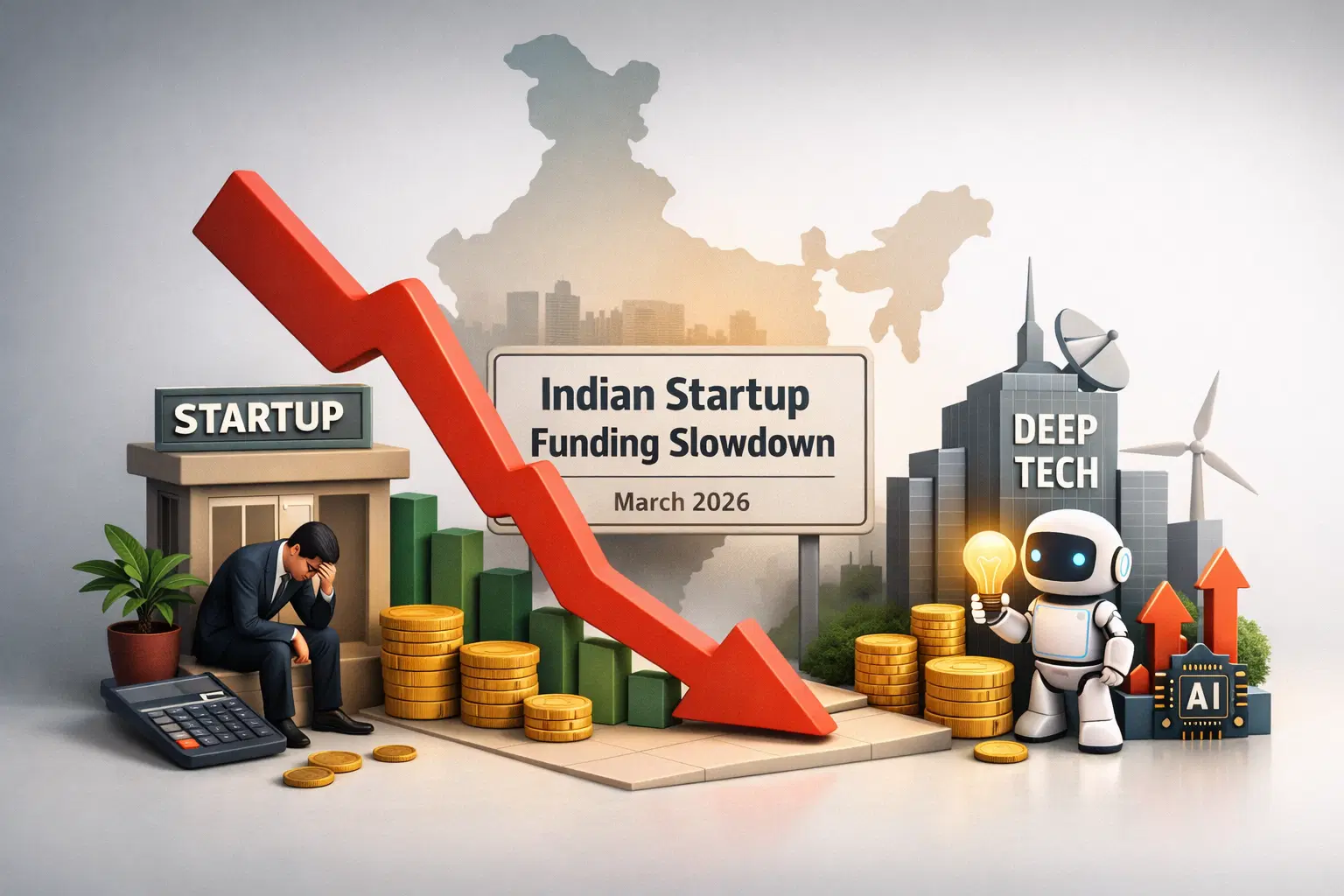
India’s startup funding landscape saw a sharp contraction in March 2026, with total funding falling 56% year-on-year. The decline reflects sustained investor caution, fewer large deals, and a continued shift toward profitability-focused investments across sectors.
The India startup funding slump deepens with 56% YoY fall in March 2026, marking one of the steepest monthly declines in recent quarters and reinforcing the ongoing reset in the venture capital ecosystem.
Sharp Decline Highlights Ongoing Funding Winter in India
The March 2026 data confirms that the funding slowdown is not a short-term fluctuation but part of a broader correction cycle. Compared to the same period last year, both total capital inflow and deal activity dropped significantly.
This trend is shaped by:
• Reduced participation from global venture capital funds
• Absence of mega funding rounds that previously boosted totals
• Tighter capital allocation amid macroeconomic uncertainty
• Continued focus on portfolio consolidation by investors
The funding winter that began in 2022 has now transitioned into a prolonged phase of selective deployment rather than a complete freeze.
Fewer Large Deals Drag Overall Funding Volumes
A key driver behind the 56% drop is the lack of large-ticket funding rounds. In previous years, late-stage investments and unicorn rounds contributed heavily to monthly funding totals.
In March 2026:
• Mega rounds above $100 million were limited or absent
• Growth-stage startups saw slower capital inflows
• Investors avoided aggressive valuation bets
Without these large deals, the aggregate funding numbers declined sharply even though early-stage activity continued in pockets.
This indicates that while capital is still available, it is not flowing into high-risk or high-valuation opportunities as freely as before.
Early-Stage and Select Sectors Still Attract Capital
Despite the overall slump, certain segments of the startup ecosystem continue to attract investor interest. Early-stage funding has shown resilience, especially for startups with strong fundamentals.
Key sectors seeing activity include:
• Fintech focused on MSME lending and digital credit
• AI-driven SaaS platforms targeting enterprise efficiency
• Climate tech and energy transition startups
• B2B platforms addressing supply chain gaps
Investors are prioritising sectors with clear revenue models and long-term demand visibility. This selective approach explains why funding value can rise in early stages even when total market funding declines.
Tier-2 and Tier-3 Startups Face Mixed Impact
Startups in Tier-2 and Tier-3 cities are experiencing a mixed impact from the funding slowdown. While investor interest in Bharat-focused models remains strong, access to capital has become more competitive.
Current dynamics include:
• Increased scrutiny of business models and execution capability
• Preference for capital-efficient startups over rapid scaling models
• Growing role of angel investors and smaller funds in early rounds
Startups solving real problems in logistics, agriculture, and financial inclusion are still able to raise funds. However, the margin for error has reduced significantly.
Investor Behaviour Shifts Toward Profitability and Discipline
The funding slump reflects a fundamental shift in investor priorities. The growth-at-all-costs approach has been replaced by a focus on sustainability and profitability.
Key behavioural changes among investors:
• Strong emphasis on unit economics and cash flow visibility
• Longer due diligence cycles before closing deals
• Preference for founders with operational discipline
• Reduced tolerance for high burn rates
This shift is reshaping how startups build and scale their businesses. Founders are increasingly aligning with realistic growth strategies rather than aggressive expansion.
What This Means for Founders Raising Capital
For founders, the current environment demands a different approach to fundraising. Capital is still available, but expectations are significantly higher.
Practical implications include:
• Need for clearer path to profitability even at early stages
• Importance of strong governance and financial discipline
• Longer timelines to close funding rounds
• Greater competition for investor attention
Startups that can demonstrate sustainable growth and efficient capital use are more likely to secure funding in this environment.
Outlook for India Startup Funding in 2026
The funding slowdown is expected to continue in the near term, but it also signals a maturing ecosystem. Corrections in valuation and capital allocation are creating a more stable foundation for long-term growth.
Looking ahead:
• Funding activity will remain selective rather than broad-based
• Valuations are expected to stabilise at realistic levels
• Strong startups will continue to attract capital despite the slowdown
• New sectors such as AI and climate tech will drive future growth
The current phase is less about contraction and more about recalibration of the startup ecosystem.
Takeaways
• India startup funding fell 56% YoY in March 2026, indicating a continued slowdown
• Lack of large funding rounds significantly impacted overall numbers
• Investors are focusing on profitability, discipline, and sector strength
• Startups with strong fundamentals can still raise capital despite the slump
FAQs
Q1. Why did India startup funding fall sharply in March 2026?
The decline is due to fewer large funding rounds, cautious investor sentiment, and tighter capital allocation strategies.
Q2. Is startup funding completely drying up in India?
No, funding is still available but is being deployed selectively into startups with strong fundamentals and clear revenue models.
Q3. Which sectors are still attracting investment?
Fintech, AI SaaS, climate tech, and B2B platforms continue to receive investor interest.
Q4. How should startups adapt to the funding slowdown?
Startups should focus on profitability, efficient capital use, and building sustainable business models to attract investors.











Leave a comment