


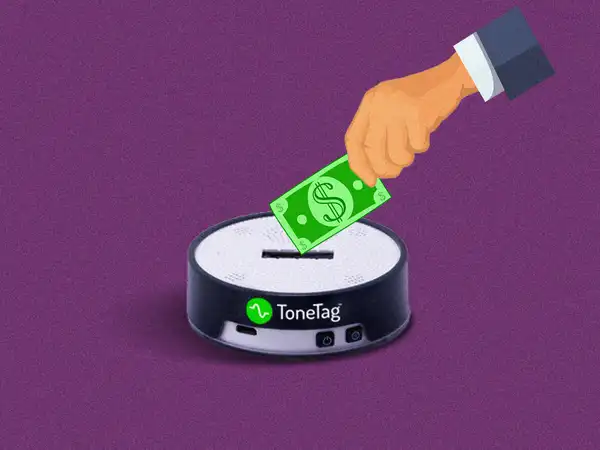
Rs 35 crore Qualcomm venture bet on sound payments has brought fresh attention to audio based transaction technology in India. ToneTag’s latest funding round signals strategic confidence in secure offline digital payments and proximity based authentication solutions.
Rs 35 crore Qualcomm venture bet on sound payments marks a focused investment in India’s evolving fintech infrastructure. ToneTag, a Bengaluru based startup, specializes in sound wave technology that enables contactless payments and device authentication without relying on traditional internet connectivity. The participation of Qualcomm Ventures indicates growing interest in hardware integrated fintech solutions that bridge software innovation with chipset level capabilities.
How Sound Payment Technology Works
Sound based payment systems use encrypted audio signals to transmit transaction data between devices. Unlike NFC or QR code systems that depend on visual scanning or near field communication hardware, audio signals can operate across standard speakers and microphones embedded in smartphones and POS terminals.
ToneTag’s platform generates secure ultrasonic or near audible sound waves that carry encrypted transaction tokens. These signals are received by a nearby device, decoded and authenticated through backend servers. The technology is particularly useful in low connectivity environments because it can function with minimal bandwidth.
Security remains central to adoption. Encryption layers, tokenization and device binding protocols reduce fraud risk. Financial institutions and merchants evaluating such systems focus on latency, failure rates and compliance with payment network standards.
Qualcomm Venture Bet and Strategic Implications
Qualcomm Ventures’ Rs 35 crore investment reflects strategic alignment rather than purely financial backing. As a global chipset manufacturer, Qualcomm has long focused on enabling secure communication at the hardware level. Investing in sound payment technology complements its broader interest in edge computing and secure device ecosystems.
For ToneTag, association with a global technology investor enhances credibility, especially when negotiating with banks, telecom operators and OEMs. The capital infusion can be deployed toward product development, integration with payment gateways and geographic expansion.
The investment also signals confidence in alternative payment rails. While UPI and QR codes dominate digital payments in India, innovation continues in areas such as tokenization, biometric authentication and device to device communication.
India’s Expanding Digital Payment Landscape
India’s digital payment ecosystem has scaled rapidly over the past decade, driven by smartphone penetration, UPI adoption and regulatory support. However, challenges remain in semi urban and rural areas where network connectivity can be inconsistent.
Sound payment solutions can complement existing methods by enabling transactions in offline or low signal zones. Retail environments such as public transport, fuel stations and small merchants may benefit from flexible authentication options.
Financial inclusion is another angle. Audio based systems can be embedded in feature rich devices without requiring advanced hardware upgrades. This reduces cost barriers for merchants in Tier 2 and Tier 3 cities.
At the same time, widespread adoption depends on ecosystem integration. Payment providers must ensure compatibility with banks, card networks and regulatory frameworks.
ToneTag’s Growth and Market Positioning
ToneTag has previously collaborated with banks and payment service providers to deploy its technology in pilot programs and live merchant environments. The company positions itself not just as a payments player but as a sound based data transfer platform that can support authentication, IoT interactions and device pairing.
The Rs 35 crore funding round strengthens its runway to invest in R and D and enterprise partnerships. Scaling enterprise technology requires rigorous testing, compliance audits and integration cycles. Capital helps accelerate these processes.
Competition in fintech remains intense. Larger payment platforms may integrate similar capabilities if demand rises. Therefore, intellectual property protection and continuous innovation will be crucial for maintaining differentiation.
Broader Impact on Fintech Innovation
Strategic investments like the Qualcomm venture bet often shape sector narratives. Hardware backed fintech solutions are gaining relevance as cybersecurity concerns increase. Integrating security at the chipset and firmware level reduces vulnerability to software only exploits.
India’s fintech ecosystem is maturing beyond wallet and lending models. Infrastructure oriented startups focusing on authentication, identity verification and secure communication are attracting institutional capital.
If sound payment technology achieves scale, it could diversify transaction methods available to merchants and consumers. Adoption will depend on ease of use, transaction speed and regulatory compliance.
The Rs 35 crore investment may appear modest compared to larger late stage rounds, but strategic capital from a technology major can catalyze long term growth. For India’s digital economy, such bets indicate confidence in deep tech driven financial infrastructure.
Takeaways
Qualcomm Ventures invested Rs 35 crore in ToneTag to support sound payment technology.
Audio based payments can function in low connectivity environments and enhance flexibility.
Strategic backing strengthens ToneTag’s enterprise credibility and product development.
Hardware integrated fintech solutions are gaining relevance in India’s evolving payment ecosystem.
FAQs
What is sound payment technology?
It uses encrypted audio signals transmitted through speakers and microphones to enable secure digital transactions between devices.
Why did Qualcomm invest in ToneTag?
The investment aligns with Qualcomm’s focus on secure communication technologies and edge device ecosystems.
How does this impact digital payments in India?
It introduces an alternative transaction method that can complement QR and NFC based systems, especially in low connectivity areas.
Is sound payment widely adopted yet?
It is still in growth stages, with pilot deployments and enterprise integrations, but strategic funding could accelerate adoption.











Leave a comment