

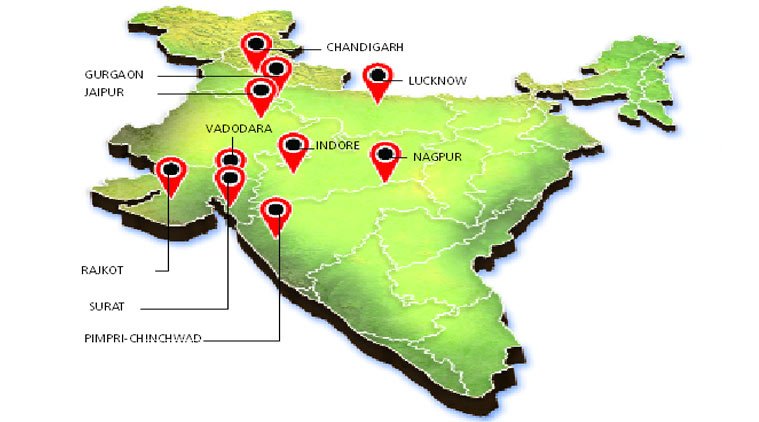
India’s manufacturing landscape is undergoing a structural shift as regional and Tier-3 cities emerge as new industrial growth centers. The rise of smaller city manufacturing clusters signals a diversification of India’s business map beyond traditional hubs like Pune, Chennai, and Gurugram, aligning with both government policy and private-sector decentralization.
The quiet rise of regional manufacturing clusters
Over the past five years, India’s industrial expansion has started moving away from its metro strongholds toward smaller, strategically located Tier-3 cities. This shift is being driven by three clear forces: better infrastructure, lower operating costs, and government incentives promoting localized industrialization.
Cities like Aurangabad, Belagavi, Rajkot, Hosur, Coimbatore, Indore, and Vapi are becoming specialized manufacturing bases. Aurangabad has become an automotive and engineering hub. Rajkot is known for machine tools and casting. Hosur has attracted electronics and EV component units, while Coimbatore and Indore are drawing textile and machinery investments.
This geographical diversification is no accident. India’s Production Linked Incentive (PLI) schemes, industrial corridor programs, and freight network expansion have made it economically feasible for companies to set up units in smaller cities without compromising logistics or talent access.
Policy and infrastructure are enabling Tier-3 growth
The Indian government’s “Make in India 2.0” push and regional industrial corridor plans have provided a strong foundation for Tier-3 clusters. The Delhi–Mumbai Industrial Corridor (DMIC), Bengaluru–Chennai corridor, and the emerging East Coast Economic Corridor have strategically connected non-metro cities to ports, airports, and consumption centers.
Additionally, the Gati Shakti plan, integrating multi-modal transport, has reduced logistics costs by an estimated 15 to 20 percent for manufacturing operations in smaller cities. State-level policies in Tamil Nadu, Gujarat, and Maharashtra now include targeted incentives for Tier-3 industrial zones, focusing on MSME participation, warehousing, and export-linked clusters.
In practical terms, this means a manufacturer in Hosur can access Chennai’s port network without facing metropolitan real estate or labor costs. Similarly, industrial estates in Madhya Pradesh and Rajasthan now serve as feeder bases for northern and western markets.
Why Tier-3 clusters are gaining investor attention
For private investors and companies, Tier-3 cities offer a unique blend of advantages. Land and labor costs are significantly lower than in traditional metro hubs, reducing the capital intensity of new projects. These locations also provide proximity to raw material sources, especially for sectors like textiles, agro-processing, and engineering goods.
The rise of plug-and-play industrial parks, regional skill development centers, and digitized single-window clearances has made smaller cities investor-friendly. For example, Tamil Nadu’s Hosur industrial region attracted multiple EV component suppliers post-2022, feeding into OEMs in Chennai and Bengaluru. Similarly, Gujarat’s Rajkot and Morbi clusters have witnessed a surge in ceramic and machinery exports to West Asia and Africa.
The availability of local technical talent from polytechnic and regional engineering institutions further reduces dependency on metro migration, creating a sustainable workforce base.
Small-town entrepreneurs and MSMEs drive resilience
One of the strongest indicators of the Tier-3 manufacturing rise is the surge in MSME registrations from these cities. According to government data, more than 55 percent of new MSME units registered in FY2024 were from non-metro districts. Many of these enterprises serve as ancillary units for larger manufacturers or operate independently in niche export markets.
These small-town manufacturers are leveraging digitization, government e-marketplace (GeM) platforms, and export promotion councils to scale beyond local boundaries. For instance, textile manufacturers in Tiruppur and knitwear exporters from Ludhiana have integrated digital inventory management and e-commerce to reach global buyers directly.
This distributed model of industrialization reduces concentration risk for the national economy. It ensures that growth is not limited to a few metro clusters but spread across hundreds of smaller towns, creating employment where it is most needed.
Challenges and what must come next
Despite rapid progress, Tier-3 manufacturing still faces challenges. Power reliability, last-mile connectivity, and access to working capital remain inconsistent in many regions. Additionally, environmental clearances and land approvals can be slower outside established corridors.
However, policy momentum is catching up. The government’s ongoing investment in logistics parks, renewable energy linkages, and digital compliance tools will likely ease these bottlenecks. Private sector collaboration through industry associations and cluster development programs will be critical to sustaining long-term competitiveness.
Takeaways
- Tier-3 cities like Aurangabad, Hosur, and Rajkot are emerging as India’s new manufacturing hotspots due to policy support and lower costs.
- Infrastructure investments and industrial corridors are connecting smaller towns to national and global supply chains.
- MSMEs and local entrepreneurs are central to this growth, driving job creation and export-oriented production.
- Sustained investment in logistics, power, and capital access will determine how far these regional clusters can scale.
FAQs
Q: Why are companies setting up manufacturing units in Tier-3 cities?
A: Lower costs, improving infrastructure, and government incentives make smaller cities attractive while helping companies reduce dependency on overcrowded metro hubs.
Q: Which industries are expanding fastest in Tier-3 manufacturing clusters?
A: Automotive components, textiles, ceramics, electronics, and food processing are seeing the fastest expansion due to regional specialization.
Q: How does this shift benefit the overall economy?
A: It decentralizes industrial growth, creates employment in smaller towns, and strengthens India’s resilience against regional economic shocks.
Q: What are the key risks for Tier-3 manufacturing clusters?
A: Infrastructure gaps, financing limitations, and uneven logistics access are still hurdles that need sustained public and private collaboration to address.










Leave a comment