

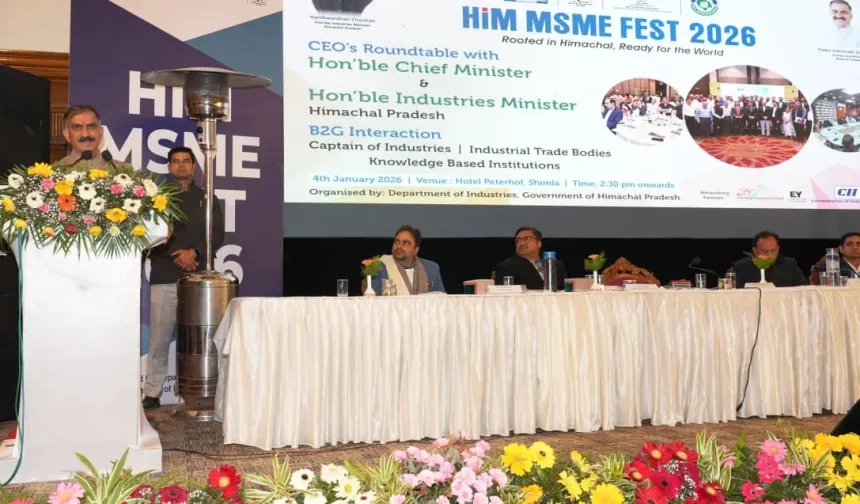
Rural MSME momentum took center stage at Himachal’s MSME Fest 2026 startup awards gala, reflecting how small businesses in hill and non metro regions are moving from survival to structured growth. The event offered clear signals on funding access, policy alignment, and execution gaps that business owners must address.
The MSME Fest was not a showcase of big valuations but a snapshot of grassroots enterprise readiness. For entrepreneurs and local manufacturers, the takeaways were practical, grounded, and directly linked to operating realities in rural and semi urban India.
MSME Fest 2026 signals shift in rural enterprise priorities
Rural MSME momentum at the Himachal MSME Fest 2026 was driven by a visible shift in how small businesses define success. The focus has moved away from scale at any cost toward profitability, compliance, and long term sustainability. Award winning startups were largely those that demonstrated consistent revenues, disciplined cost structures, and clear market demand.
Unlike earlier years where innovation narratives dominated, this edition highlighted execution depth. Enterprises in food processing, handicrafts, agri allied manufacturing, tourism services, and local logistics stood out. These businesses were not dependent on heavy venture funding but showed strong unit economics and regional demand strength.
For rural entrepreneurs, this reflects a maturing mindset. Growth is increasingly tied to operational clarity rather than pitch decks. The awards reinforced that viable business models, not just ideas, are now the benchmark for recognition and support.
Access to credit and formalization emerged as key themes
One of the strongest signals from the MSME Fest was the emphasis on formalization and access to institutional credit. Rural MSME momentum remains closely linked to how effectively businesses can move into the formal system without disrupting operations.
Several discussions at the event highlighted that MSMEs with GST compliance, proper bookkeeping, and digital payment adoption found it easier to access working capital. Banks and NBFC representatives reinforced that lending appetite for rural enterprises has improved, but documentation quality remains a bottleneck.
For business owners, the takeaway is clear. Formal processes are no longer optional. Even small units operating in remote areas are expected to maintain financial discipline. Those who have already transitioned are seeing faster credit approvals and better terms, directly impacting their ability to scale.
Tier 2 and Tier 3 market demand driving rural MSME momentum
Demand signals from Tier 2 and Tier 3 markets were a recurring theme at the gala. Many award winning enterprises serve regional markets rather than metros, tapping into localized demand patterns. This includes food brands catering to regional tastes, tourism ventures aligned with domestic travel, and manufacturing units supplying nearby urban clusters.
Rural MSME momentum is increasingly supported by proximity to these markets. Lower logistics costs, faster turnaround times, and better understanding of customer preferences give rural businesses a competitive edge. Entrepreneurs shared examples of how localized branding and direct to retailer models improved margins.
This trend matters for aspiring founders. Expansion does not always require national presence. Strengthening a regional footprint can deliver stable cash flows and reduce operational risk, especially in uncertain macro conditions.
Skill development and workforce stability remain challenges
Despite positive momentum, workforce issues surfaced as a consistent challenge. Skilled labor availability, especially for manufacturing and processing units, remains uneven in rural regions. While employment generation is rising, productivity gaps persist.
The MSME Fest highlighted the importance of in house training and skill development partnerships. Businesses that invested in training local workers reported lower attrition and better output quality. This approach also aligns with community based growth, which is critical for rural enterprise sustainability.
For MSME owners, this reinforces the need to view workforce development as a strategic investment rather than a cost. Stable teams reduce operational disruptions and support consistent quality, which is essential when serving repeat customers and institutional buyers.
What policymakers and support ecosystems are signaling
Policy messaging at the event focused on continuity rather than new announcements. The emphasis was on better utilization of existing schemes, faster approvals, and simplified compliance at the local level. This indicates a shift from policy creation to policy execution.
Support institutions stressed that rural MSME momentum depends on coordination between local authorities, financial institutions, and industry bodies. Entrepreneurs who actively engage with district level MSME offices and industry associations tend to navigate processes more efficiently.
For business owners, this means proactive engagement matters. Waiting for top down support is less effective than building relationships within the local ecosystem and leveraging available platforms.
Strategic lessons for rural entrepreneurs and MSMEs
The Himachal MSME Fest 2026 offered clear strategic lessons. Rural MSME momentum is real, but it favors disciplined operators. Businesses that combine local market insight with formal systems are gaining faster traction.
Scaling slowly but steadily emerged as a recurring theme. Entrepreneurs who focused on one product line or service and refined it before expanding were more resilient. This approach reduces capital strain and execution risk, especially in regions with infrastructure constraints.
Ultimately, the event underscored that rural entrepreneurship is no longer peripheral to India’s growth story. It is becoming a central pillar, provided businesses adapt to evolving expectations.
Takeaways
- Rural MSME momentum is shifting toward profitability and execution discipline
- Formalization and clean financial records are critical for credit access
- Tier 2 and Tier 3 market demand is driving sustainable growth
- Workforce training and local ecosystem engagement remain key success factors
FAQs
What was the key focus of Himachal MSME Fest 2026?
The event focused on recognizing execution driven rural MSMEs with sustainable business models rather than high growth projections.
Which sectors stood out at the startup awards gala?
Food processing, handicrafts, agri allied manufacturing, tourism services, and regional logistics enterprises received significant recognition.
How does this event reflect rural MSME momentum?
It highlights improved business readiness, better access to credit, and growing demand from nearby urban and semi urban markets.
What should rural entrepreneurs prioritize after this event?
Formalization, financial discipline, workforce training, and strengthening regional market presence.












Leave a comment