

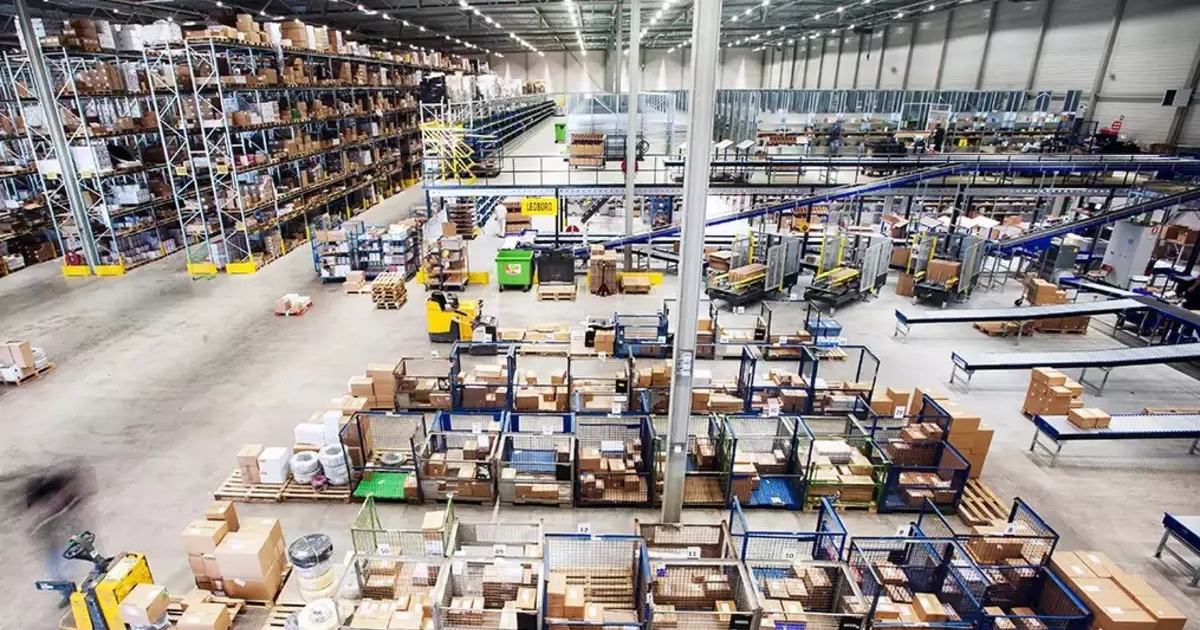
Tier 2 manufacturing hubs across India are emerging as major drivers of industrial growth as companies expand beyond traditional metro centers. Rising infrastructure investment, government incentives, and lower operating costs are helping smaller cities attract new factories and supply chain networks.
Tier 2 manufacturing hubs are playing an increasingly important role in India’s industrial expansion as companies shift production to emerging cities. Locations such as Coimbatore, Indore, Surat, Rajkot, and Aurangabad are becoming attractive alternatives to traditional industrial clusters like Mumbai, Chennai, and Bengaluru. With better logistics connectivity, skilled workforce availability, and supportive state policies, these cities are now central to India’s manufacturing growth strategy.
Infrastructure Investments Strengthen Tier 2 Manufacturing Hubs
Infrastructure development is one of the most significant factors behind the rise of Tier 2 manufacturing hubs in India. Over the past decade, large public investments in highways, freight corridors, industrial parks, and logistics networks have improved connectivity between smaller cities and major markets.
Projects such as the Dedicated Freight Corridors and expanding national highway networks have reduced transportation costs and improved supply chain efficiency. Industrial corridors including the Delhi Mumbai Industrial Corridor and the Chennai Bengaluru Industrial Corridor have also helped develop manufacturing clusters in emerging regions.
Better connectivity allows companies to move goods faster while maintaining lower operational costs compared to congested metropolitan areas. As a result, companies in sectors such as automotive components, textiles, engineering goods, and electronics are expanding production facilities in these regions.
Lower Operating Costs Attract Manufacturing Investments
Lower operating costs remain one of the biggest advantages of Tier 2 cities for manufacturing companies. Industrial land prices, labor costs, and utility expenses are often significantly lower compared to large metro regions.
Manufacturers that operate on tight margins benefit from these cost advantages while still maintaining access to skilled labor pools. Cities such as Coimbatore and Pune have long been known for their engineering and automotive ecosystems, while Surat and Rajkot have developed strong capabilities in textiles and machine components.
Lower costs also allow small and medium enterprises to scale operations more efficiently. As supply chains expand, clusters of suppliers, logistics providers, and service companies naturally form around these manufacturing centers.
This clustering effect strengthens regional industrial ecosystems and encourages further investment.
Government Incentives Boost Regional Industrial Growth
Government policies are another major factor supporting the growth of Tier 2 manufacturing hubs. Both central and state governments have launched several programs to attract manufacturing investments into smaller cities.
The Production Linked Incentive scheme has encouraged companies in sectors such as electronics, pharmaceuticals, and solar equipment to expand domestic manufacturing capacity. States such as Gujarat, Maharashtra, Tamil Nadu, and Uttar Pradesh have also introduced industrial policies offering incentives including land subsidies, tax benefits, and infrastructure support.
Many state governments are developing specialized industrial parks focused on sectors such as electronics manufacturing, automotive components, and renewable energy equipment. These parks provide ready infrastructure including power supply, transportation access, and logistics support.
Such initiatives make it easier for companies to establish new production facilities without facing the infrastructure limitations often associated with smaller cities.
Skilled Workforce Availability Supports Manufacturing Expansion
Access to skilled labor is critical for industrial growth, and many Tier 2 cities are benefiting from strong educational ecosystems. Engineering colleges, technical institutes, and vocational training centers in these regions supply trained workers to manufacturing industries.
Cities such as Indore, Coimbatore, and Nagpur have developed strong talent pools in engineering and technical disciplines. This availability of skilled workers reduces recruitment challenges for companies establishing new plants.
At the same time, workers in smaller cities often face lower living costs compared to major metros. This improves employee retention while helping companies maintain competitive wage structures.
Over time, these labor advantages strengthen the long term sustainability of manufacturing clusters in emerging regions.
Role of Supply Chains and Logistics in Regional Manufacturing
Efficient supply chains are essential for modern manufacturing, and improvements in logistics infrastructure have made Tier 2 hubs more viable for large scale production.
India’s logistics sector has undergone significant modernization through digital freight systems, warehousing expansion, and multimodal transportation networks. The implementation of the Goods and Services Tax also simplified interstate logistics, allowing companies to optimize distribution networks across regions.
Many manufacturers are now adopting hub and spoke supply chain models where production occurs in smaller cities while distribution networks connect to large consumption markets.
This approach allows companies to combine cost efficiency with faster market access.
Long Term Outlook for India’s Manufacturing Growth
India aims to increase the contribution of manufacturing to its economy over the coming decade. Tier 2 manufacturing hubs are expected to play a central role in achieving this goal.
As infrastructure improves and industrial policies evolve, more companies are likely to expand operations in these regions. Global supply chain shifts, including diversification away from single country sourcing, also create opportunities for India to attract additional manufacturing investments.
For smaller cities, this growth can generate employment, strengthen local economies, and encourage urban development.
The rise of Tier 2 manufacturing hubs reflects a broader shift in India’s industrial geography where growth is no longer concentrated only in major metropolitan regions.
Takeaways
Tier 2 manufacturing hubs are becoming key drivers of India’s industrial expansion
Improved infrastructure and logistics connectivity support manufacturing growth
Lower operating costs make smaller cities attractive for factory investments
Government incentives and skilled workforce availability strengthen regional clusters
FAQs
What are Tier 2 manufacturing hubs in India?
Tier 2 manufacturing hubs are emerging industrial centers located in smaller cities that support large scale production across sectors such as automotive components, textiles, and engineering goods.
Why are companies moving manufacturing to Tier 2 cities?
Companies are attracted by lower land costs, affordable labor, improving infrastructure, and government incentives that support new industrial investments.
Which Indian cities are emerging as manufacturing hubs?
Cities such as Coimbatore, Indore, Surat, Rajkot, Aurangabad, and Nagpur are increasingly attracting manufacturing investments.
How do Tier 2 hubs benefit India’s economy?
These hubs create employment, strengthen regional supply chains, and support the government’s goal of expanding manufacturing output.












Leave a comment