

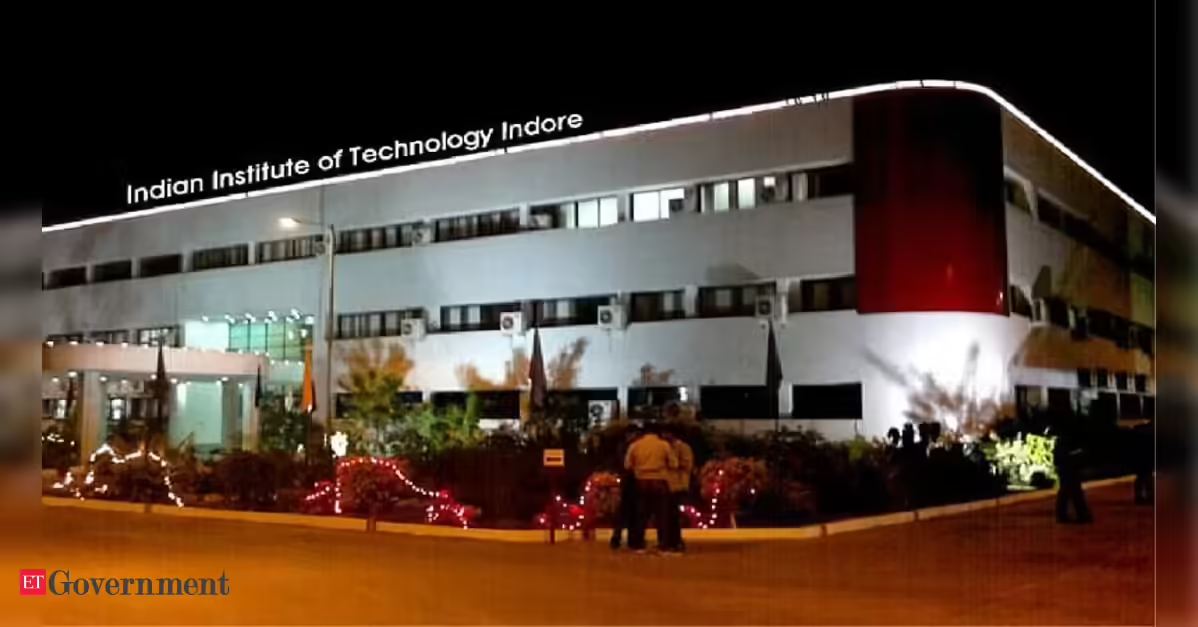
A new deep-tech incubation centre at Indian Institute of Technology Indore backed by an investment of approximately Rs 10 crore signals a strategic shift in strengthening innovation ecosystems in smaller cities, with implications for regional startups, manufacturing hubs and talent flows.
A regional move into deep-tech incubation
The main keyword “deep-tech incubation” appears as the centre opens at IIT Indore, making this clearly a news-style piece. The facility is located at Sinhasa IT Park in Indore and is operated by the institute’s Drishti CPS Foundation in collaboration with the Madhya Pradesh State Electronic Development Corporation. With 10,000 square feet of space and about 5,000 square feet dedicated to incubation infrastructure, the centre is designed to cater to emerging deep-tech startups. The investment of around Rs 10 crore provides for initial infrastructure including an intelligent manufacturing lab valued around Rs 5 crore that allows prototyping and validation for hardware-focused ventures.
Why smaller city hubs matter for deep-tech
Secondary keyword “smaller city hubs” applies as the article shifts focus onto how Tier-2 cities like Indore gain from this development. India’s deep-tech ecosystem has been largely metro-centric but the emergence of incubation centres in non-metro locations is part of a broader push. Proximity to institutions, lower operational costs, and growing engineering talent make places like Indore attractive for innovation beyond software. For hardware, manufacturing and product-oriented startups, this kind of facility helps overcome previous barriers like lack of access to prototyping and lab space.
What this means for startups, talent and investment
Using “startups” and “investment” as secondary keywords, this facility helps shrink the gap between ideation and commercialisation for early-stage ventures in regional markets. Startups in sectors like IoT, robotics, advanced manufacturing or digital healthcare now have access to physical infrastructure, mentorship and support outside of major hubs. Talent who might otherwise relocate to Bengaluru or Delhi may now find credible pathways in their home region. On the investment side, a dedicated hardware lab signals to investors that the region is serious about deep-tech, which may stimulate follow-on funding or anchor partnerships with industry.
Infrastructure, ecosystem and execution challenges
With “ecosystem challenges” as a secondary keyword, the article acknowledges that setting up the facility is only the first step. For meaningful impact, the centre needs to build strong industry linkages, ensure supply-chain support (for hardware) and maintain skilled mentorship. Regional firms must still contend with connectivity to global markets, logistics for hardware scaling and access to serial investors. The challenge for smaller city hubs is to build an environment where incubation leads to commercialization, not just idea generation.
Implications for India’s deeper tech strategy
Framing “India’s deep-tech strategy” as a keyword, this move at IIT Indore reflects how policy and institutional strategy are converging toward distributed innovation. Government schemes increasingly emphasise deep-tech, hardware, and regional inclusivity. Building such centres in Tier-2 and Tier-3 cities can decentralise innovation and create new growth nodes, aligning with national objectives of manufacturing, self-reliance and technology sovereignty.
Takeaways
• The new deep-tech incubation facility at IIT Indore marks a strategic shift toward regional innovation hubs outside metro cities.
• Access to dedicated prototyping and lab infrastructure empowers hardware and deep-tech startups in smaller cities.
• For regional talent, the centre offers an opportunity to participate in high-value innovation without relocation to major metros.
• Execution will depend on ecosystem linkages, investor readiness and sustained operational support to translate incubation into growth.
FAQ
Q: Does the centre only support software startups?
A: No. The facility emphasises deep-tech and hardware-oriented ventures, evident from the inclusion of an advanced manufacturing lab intended for prototyping and validation.
Q: Why is it significant that the facility is in a smaller city like Indore?
A: Because it shifts innovation capacity away from only major metros, enabling regional talent, lower operating cost and localised ecosystems to participate in high-value tech.
Q: Will investment immediately flow to startups at the centre?
A: Not automatically. While infrastructure is in place, startups still need to demonstrate product readiness, market fit and attract investors. The facility creates a platform but execution remains key.
Q: What type of startups are best suited to this incubation facility?
A: Hardware-, prototype- and product-oriented ventures — for example in IoT, robotics, advanced manufacturing, sensors, digital health — where physical lab access is important.








Leave a comment