

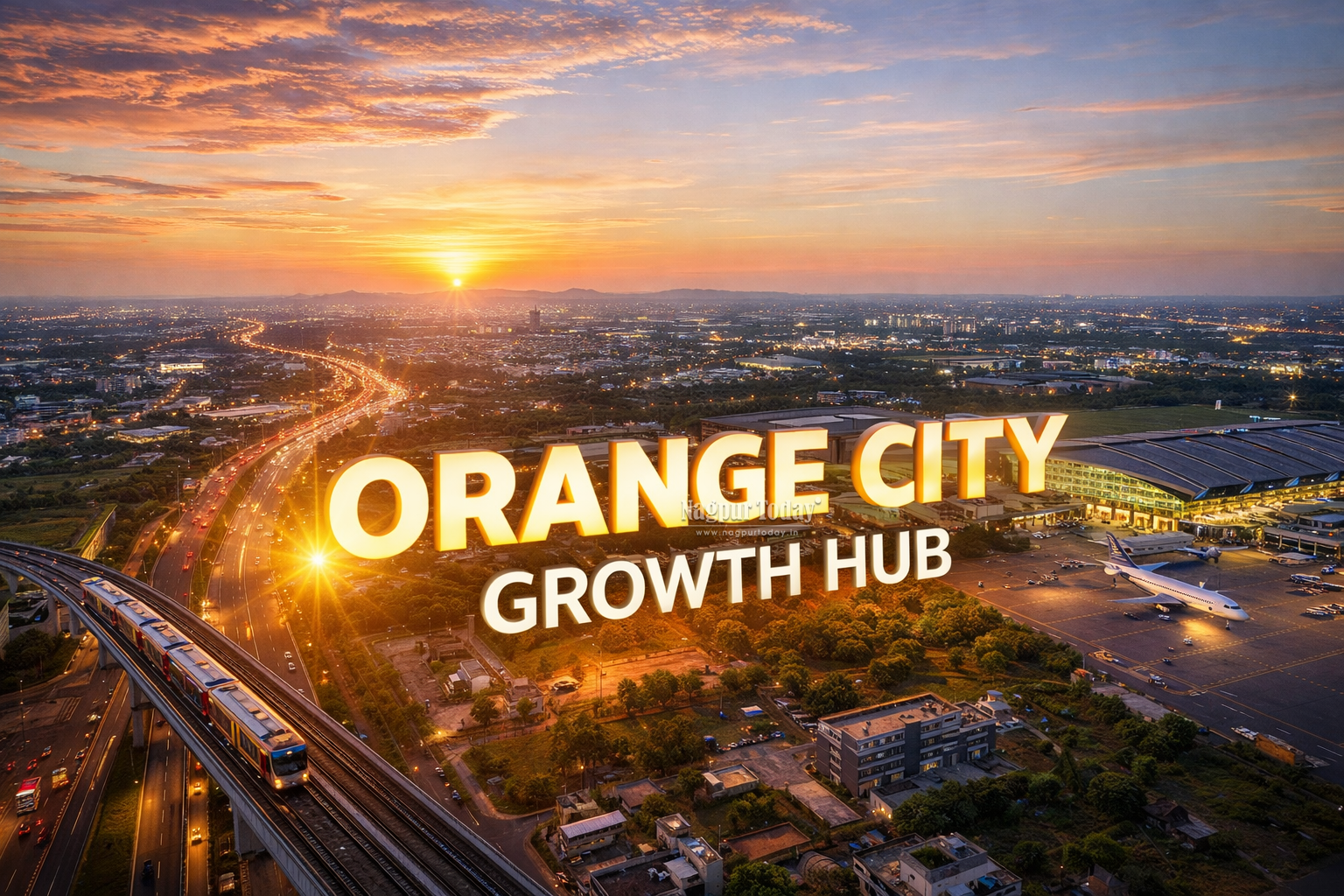
Nagpur’s new ₹5,000 crore Growth Hub is a time-sensitive business development story with long-term implications. The project positions Nagpur as a strategic industrial and logistics centre for central India, driven by infrastructure investment, manufacturing focus and regional decentralisation under current economic policy priorities.
Intent and nature of the topic
This is a time-sensitive news-led analysis. The tone is factual and explanatory, focusing on immediate policy impact and medium-term industrial outcomes.
Strategic location makes Nagpur a natural industrial anchor
The Nagpur ₹5,000 crore Growth Hub is built around one core advantage: geography. Located near the geographic centre of India, Nagpur already serves as a major rail, road and air logistics junction. The new Growth Hub formalises this advantage by integrating industrial zones, logistics parks and urban infrastructure into a single planned economic ecosystem.
For central India, which has historically lagged behind western and southern corridors, this hub provides a manufacturing and distribution base that reduces dependency on Mumbai, Pune and Ahmedabad. Industries can move goods faster across north-south and east-west routes, lowering freight costs and delivery timelines. This logistics efficiency is critical for sectors such as agro-processing, engineering goods and consumer manufacturing.
Secondary keywords like central India industrial development and Nagpur logistics hub reflect how location-led planning drives the project’s relevance.
Manufacturing clusters target scalable industries
A major component of the Growth Hub is the creation of sector-focused manufacturing clusters. The project prioritises industries that align with regional strengths and national supply chain needs, including agro-based processing, defence ancillaries, light engineering and renewable energy components.
Nagpur’s surrounding districts offer access to raw materials, land availability and a semi-skilled workforce. The Growth Hub leverages this by offering plug-and-play industrial infrastructure, faster approvals and shared utilities. For small and mid-sized manufacturers, this significantly lowers setup costs compared to saturated metro regions.
By clustering suppliers, manufacturers and logistics providers, the hub improves productivity and reduces operational friction. This cluster-based model has proven effective in other regions and is central to reshaping central India’s industrial base.
Employment generation beyond metro migration cycles
One of the most direct impacts of the Nagpur Growth Hub is employment generation at scale. Industrial projects of this size typically create a mix of direct factory jobs and indirect employment across logistics, services and urban support systems.
For central India, this reduces migration pressure toward metros. Skilled and semi-skilled workers can find opportunities closer to home, stabilising regional economies. Ancillary services such as housing, retail, transport and maintenance also expand alongside industrial growth.
This employment multiplier effect strengthens local consumption markets, which in turn attracts more private investment into the region. Secondary keywords like regional job creation and industrial employment growth capture this broader economic cycle.
MSME participation strengthens supply chains
Unlike earlier industrial zones that primarily catered to large corporations, the Nagpur Growth Hub places strong emphasis on MSME participation. Dedicated zones, credit facilitation mechanisms and compliance support allow small businesses to integrate into larger supply chains.
Local MSMEs gain access to anchor manufacturers within the hub, enabling steady demand and predictable cash flows. This improves business sustainability and encourages capacity expansion. Over time, these MSMEs can scale into national suppliers rather than remaining regionally constrained players.
This inclusive approach is critical for central India, where MSMEs form the backbone of the industrial economy but often lack access to formal markets and infrastructure.
Urban infrastructure upgrades support industrial scale
Industrial growth at this scale requires parallel urban development. The Growth Hub includes planned investments in roads, power, water management and digital connectivity. These upgrades improve ease of doing business and quality of life for workers and management teams.
Nagpur’s existing metro connectivity, airport capacity and educational institutions complement the hub’s expansion. Improved urban planning reduces congestion risks and prevents the unstructured sprawl seen in older industrial towns.
Secondary keywords such as industrial urban planning and infrastructure-led growth highlight how physical and civic infrastructure underpin industrial success.
Long-term impact on central India’s economic balance
The ₹5,000 crore Growth Hub positions Nagpur as a counterbalance to western India’s industrial concentration. Over the next decade, it has the potential to anchor satellite industrial zones across Vidarbha, Madhya Pradesh and parts of Chhattisgarh.
This decentralisation improves national supply chain resilience and reduces regional inequality. As investment flows stabilise, central India can emerge as a competitive manufacturing and logistics corridor rather than a transit region.
If execution remains aligned with planning objectives, the Growth Hub could redefine how industrial development is distributed across India.
Takeaways
• Nagpur’s Growth Hub leverages central geography to lower logistics and distribution costs
• Manufacturing clusters focus on scalable, region-aligned industries
• MSME integration strengthens local supply chains and employment
• Urban infrastructure investment supports long-term industrial sustainability
FAQs
What is the Nagpur ₹5,000 crore Growth Hub?
It is a planned industrial and logistics development designed to create manufacturing clusters, generate employment and position Nagpur as a central India industrial anchor.
Which industries benefit most from the Growth Hub?
Agro-processing, light engineering, defence ancillaries, renewable energy components and logistics-driven manufacturing benefit the most.
How does this impact central India’s economy?
The hub reduces dependence on metro regions, creates local jobs and strengthens regional supply chains across multiple states.
Is this a short-term or long-term project?
While initial benefits are near-term, the full economic impact is expected to play out over the next decade.












Leave a comment