

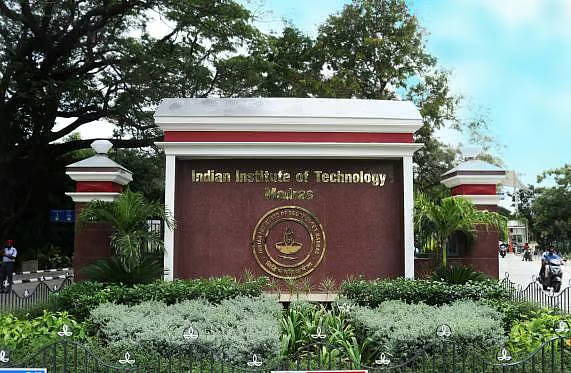
Deep tech fund mobilization through IIT Madras and Unicorn India Ventures’ ₹600 crore vehicle marks a significant moment for India’s innovation financing landscape. The initiative reflects growing institutional confidence in science-led startups and signals a shift toward long-term capital backing for high-impact technology ventures.
Why this deep tech fund mobilization matters now
Deep tech fund mobilization via a ₹600 crore vehicle is a time sensitive development rooted in current policy, capital, and innovation trends. India’s startup ecosystem is gradually moving beyond consumer internet models toward complex, research-driven technologies that require patient capital and institutional backing.
This fund launch comes at a point where deep tech founders face a structural funding gap. Early research often receives grants or incubator support, but scaling scientific ideas into commercial products remains difficult. By stepping in at this stage, the IIT Madras and Unicorn India Ventures partnership addresses a critical bottleneck in the innovation pipeline.
The timing also aligns with increased national focus on technology self-reliance, advanced manufacturing, and applied research.
Structure and intent of the ₹600 crore fund
The ₹600 crore fund is designed to back startups emerging from deep science and engineering domains. These include sectors such as semiconductors, aerospace, climate technology, advanced materials, robotics, and artificial intelligence infrastructure.
Unlike traditional venture funds that prioritise rapid revenue growth, this vehicle is structured to support longer development cycles. Capital deployment is expected to be milestone-based, with emphasis on product validation, pilot deployments, and early commercial traction.
The involvement of an academic institution alongside a venture firm adds credibility and technical depth to investment decisions. It allows for stronger evaluation of scientific feasibility before capital is committed.
Role of IIT Madras in deep tech funding
IIT Madras has built a strong reputation as a hub for deep tech innovation. Its research ecosystem, incubation infrastructure, and alumni founder base provide a steady pipeline of commercially viable technologies.
By anchoring this deep tech fund mobilization, IIT Madras moves beyond incubation into active capital formation. This reduces the gap between laboratory research and market-ready solutions.
The institute’s participation also reassures investors that portfolio companies will have access to technical mentorship, testing facilities, and talent. This ecosystem advantage lowers execution risk in sectors where failure rates are traditionally high.
Unicorn India Ventures’ strategy behind the fund
Unicorn India Ventures brings venture execution experience and portfolio scaling expertise to the partnership. Its involvement signals that deep tech is no longer being treated as a niche experiment but as a viable venture category.
The firm’s strategy focuses on building companies with defensible intellectual property and global relevance. Rather than chasing quick exits, the fund is expected to support companies through longer value creation cycles.
This approach reflects a broader shift among Indian venture firms toward building durable technology businesses instead of prioritising speed alone.
What this means for deep tech startups
For founders, deep tech fund mobilization at this scale changes the fundraising narrative. Startups working on hardware, core technology, or scientific innovation often struggle to fit into conventional venture timelines. This fund offers an alternative aligned with their realities.
Access to ₹600 crore in dedicated capital reduces dependence on fragmented funding sources. It also improves founder bargaining power by offering institutional support that understands technical risk.
Importantly, this fund encourages founders to build in India rather than relocating to ecosystems with stronger deep tech funding histories. That has long-term implications for domestic innovation capacity.
Implications for India’s innovation economy
At an ecosystem level, the fund strengthens India’s deep tech stack. Capital is a key missing layer between research excellence and global competitiveness. By mobilising significant capital, this initiative helps close that gap.
It also sends a signal to other institutional investors. Pension funds, insurance players, and family offices often wait for validation before entering new asset classes. A ₹600 crore vehicle backed by credible institutions provides that signal.
Over time, this can unlock larger pools of patient capital for technology-heavy sectors.
Risks and execution challenges
While the fund represents progress, deep tech investing remains complex. Long gestation periods, regulatory hurdles, and market adoption risks persist. Even well-funded startups can struggle to commercialise breakthrough technologies.
Fund managers will need strong governance, realistic timelines, and sector-specific expertise. Capital alone does not guarantee success. Active involvement, strategic partnerships, and market access will be critical.
Managing expectations around returns will also be important, especially when dealing with institutional capital accustomed to faster cycles.
What to watch going forward
The success of this deep tech fund mobilization will be judged by deployment pace, portfolio quality, and follow-on funding outcomes. Early indicators will include the number of startups backed, sectors targeted, and ability to attract co-investors.
Another key signal will be whether portfolio companies can secure pilot customers and global partnerships. That will determine whether the fund delivers impact beyond symbolic value.
If executed well, this vehicle could become a template for future academia venture collaborations across India.
Takeaways
- ₹600 crore deep tech fund bridges a critical gap between research and scale
- IIT Madras adds technical credibility and innovation pipeline strength
- Unicorn India Ventures brings execution and venture discipline
- The fund signals growing confidence in India’s deep tech potential
FAQs
What is the focus of the ₹600 crore deep tech fund?
It targets startups in science-led sectors such as semiconductors, climate tech, robotics, and advanced engineering.
Why is IIT Madras involved in a venture fund?
To help convert research and innovation into scalable commercial ventures and support founders beyond incubation.
How is this fund different from regular venture capital funds?
It supports longer development cycles and prioritises technical validation over rapid revenue growth.
What does this mean for deep tech founders in India?
It improves access to patient capital and reduces pressure to move abroad for funding.












Leave a comment