

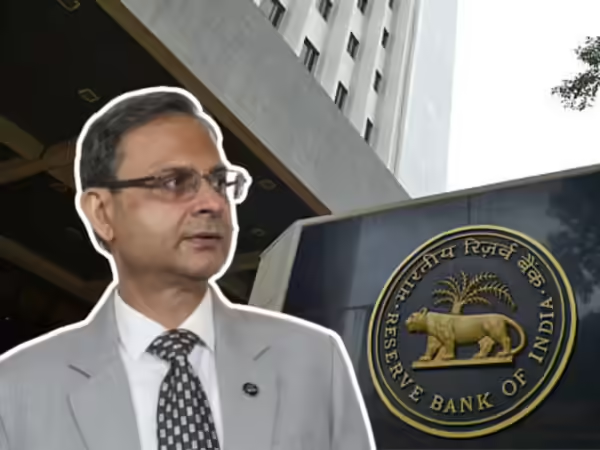
The RBI policy outlook 2026 signals a stable but cautious monetary stance as growth expectations remain strong. Businesses in Tier 2 and Tier 3 cities must prepare for evolving interest rates, liquidity conditions and credit trends that will directly influence expansion, borrowing costs and consumer demand.
The RBI policy outlook 2026 comes at a time when India’s macroeconomic fundamentals remain relatively strong compared to many global peers. GDP growth is projected to stay robust, inflation has moderated from previous highs, and banking system liquidity remains adequate. For businesses operating in smaller cities, monetary policy decisions will influence working capital costs, loan accessibility and overall demand conditions. Understanding how repo rates, inflation trends and credit flows interact is critical for planning capital expenditure and managing balance sheets.
Interest Rate Trajectory and Borrowing Costs
One of the central elements of the RBI monetary policy outlook is the trajectory of interest rates. After a phase of tightening to control inflation, the central bank has signalled a calibrated approach focused on price stability while supporting growth. For MSMEs and mid sized enterprises in non metro markets, even a small change in the repo rate affects term loans, cash credit limits and EMI structures.
Banks typically transmit policy rate changes gradually. Businesses should assess whether their loans are linked to external benchmark lending rates, which adjust faster, or marginal cost based lending rates, which may respond with a lag. If rate stability continues, firms may see predictability in borrowing costs. However, companies planning expansion in 2026 should stress test projections against potential rate fluctuations, especially if global commodity prices rise.
Inflation Trends and Input Cost Management
Inflation outlook remains a key pillar of RBI decision making. Retail inflation has eased compared to previous peaks but remains sensitive to food prices, fuel costs and supply chain disruptions. For businesses in smaller cities, volatility in agricultural output and transport costs can directly impact margins.
Manufacturers and traders should closely monitor wholesale price trends and build pricing flexibility into contracts. Service providers must evaluate wage pressures, particularly as urban migration patterns shift and skilled labour costs increase. If inflation stays within the central bank’s target band, it creates a more predictable demand environment. Stable prices support consumer purchasing power in semi urban markets, benefiting retail, housing and automobile sectors.
Credit Growth and MSME Lending Environment
Credit growth has remained healthy, particularly in retail loans and select corporate segments. For Tier 2 and Tier 3 enterprises, access to credit depends on both bank appetite and regulatory guidance. The RBI has been cautious about unsecured retail lending growth, encouraging prudent risk management among banks and non banking financial companies.
MSMEs should strengthen financial documentation, maintain healthy credit scores and diversify funding sources. Government backed credit guarantee schemes continue to support smaller businesses, but lenders are tightening due diligence standards. Companies with transparent cash flows and digital transaction records are better positioned to negotiate competitive rates.
Banking sector stability is another positive factor. Gross non performing asset ratios have improved over recent years, strengthening balance sheets and increasing banks’ capacity to lend. This environment supports expansion for businesses that demonstrate operational discipline.
Liquidity Conditions and Market Signals
Liquidity management remains an important tool for the RBI. Through open market operations and variable rate repos, the central bank ensures that systemic liquidity stays aligned with policy goals. Adequate liquidity reduces funding stress for banks and indirectly benefits businesses through smoother credit flow.
Equity markets have responded positively to stable macro signals, reflecting investor confidence in growth prospects. Strong domestic institutional flows have supported indices even during global volatility. For businesses, buoyant markets can translate into improved fundraising conditions, especially for companies exploring SME listings or private equity partnerships.
Currency stability is another macro factor to track. A stable rupee helps import dependent industries manage costs and reduces uncertainty in trade planning. Export oriented firms in smaller cities should hedge currency exposure when possible.
Strategic Planning for 2026
Businesses in smaller cities should treat the RBI policy outlook as a framework for disciplined planning rather than a short term trigger. Capital expenditure decisions should align with realistic demand projections. Firms in infrastructure linked sectors may benefit from continued public spending momentum.
Retail businesses can leverage steady consumer confidence, particularly in housing, electronics and two wheelers. Manufacturing units should evaluate automation and efficiency upgrades if financing remains affordable. Service enterprises can explore digital expansion to widen customer reach beyond local markets.
Risk management remains essential. Companies must maintain adequate cash buffers and avoid over leveraging during optimistic cycles. Diversifying supplier networks and strengthening compliance systems will improve resilience against external shocks.
Takeaways
RBI policy outlook 2026 indicates a stable but cautious monetary stance supporting growth
Interest rate stability can aid borrowing predictability for MSMEs in smaller cities
Inflation control remains central to sustaining consumer demand and margin stability
Disciplined credit management and liquidity planning will be critical for business expansion
FAQs
Q1. Will interest rates fall significantly in 2026?
The outlook suggests a cautious approach focused on balancing inflation and growth. Sharp rate cuts appear unlikely unless inflation remains consistently subdued.
Q2. How does RBI policy affect small businesses directly?
Policy rates influence loan costs, credit availability and overall demand conditions, which impact expansion plans and working capital management.
Q3. Is credit easily available for MSMEs in smaller cities?
Credit growth is healthy, but lenders are more selective. Strong financial records and transparent operations improve approval chances.
Q4. What sectors may benefit most from stable policy conditions?
Banking, infrastructure, manufacturing, housing related industries and consumer focused businesses in semi urban areas may see sustained demand.












Leave a comment