

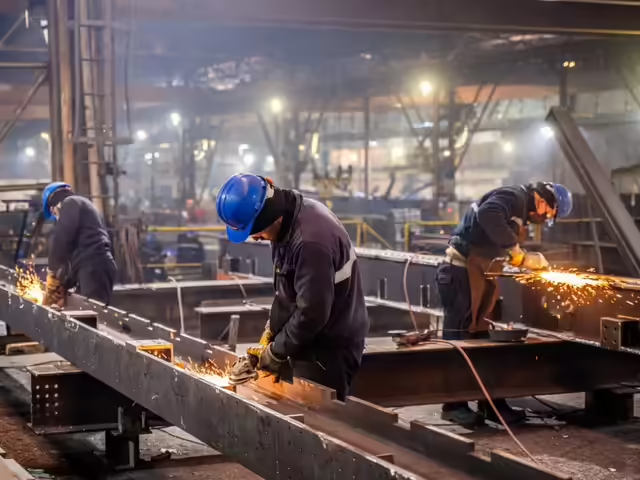
India’s Tier-2 manufacturing boom is accelerating as companies increasingly move operations beyond metro cities to reduce costs, improve logistics, and tap into emerging talent pools. Cities like Coimbatore, Indore, Surat, Nagpur, Rajkot, and Bhubaneswar are now becoming major investment hubs for industrial expansion.
India’s Tier-2 manufacturing boom has become one of the biggest industrial trends shaping the country’s economic growth in 2026. Rising land prices in metro cities, government incentives, improved highways, and faster logistics networks are pushing manufacturers toward smaller cities that offer lower operational costs and growing infrastructure support.
Several sectors including auto components, electronics, textiles, renewable energy equipment, food processing, and precision engineering are now expanding aggressively into Tier-2 and Tier-3 regions. This shift is not only changing India’s industrial map but also creating jobs and business opportunities outside traditional metropolitan hubs.
Why Companies Are Moving Manufacturing Beyond Metro Cities
Large industrial cities such as Mumbai, Bengaluru, Chennai, and Delhi NCR continue to dominate manufacturing activity, but operational challenges are becoming harder for businesses to ignore. High land costs, traffic congestion, expensive labor markets, and infrastructure pressure are increasing production expenses for companies.
Tier-2 cities offer a different equation. Industrial land is more affordable, local governments are actively attracting investments, and logistics connectivity has improved significantly through projects like Bharatmala, Dedicated Freight Corridors, and industrial corridor developments.
Cities such as Coimbatore and Rajkot already have strong engineering ecosystems, while Indore and Nagpur are emerging as logistics-driven manufacturing centers due to their strategic central locations. Smaller cities are also benefiting from better airport connectivity, improved warehousing, and access to national highways.
Manufacturers are now focusing on cost efficiency rather than only prestige locations. For many businesses, expanding into Tier-2 regions has become a practical long-term strategy.
Government Policies Fueling Industrial Expansion
India’s production-linked incentive schemes and state-level industrial policies are playing a major role in accelerating manufacturing growth in smaller cities. Several state governments are competing aggressively to attract investors by offering subsidies, tax benefits, electricity support, and easier land approvals.
States including Gujarat, Maharashtra, Tamil Nadu, Uttar Pradesh, Telangana, and Odisha are seeing strong investment proposals in industrial parks and manufacturing clusters. Many states are also building plug-and-play industrial zones to reduce setup delays for companies.
The “Make in India” initiative and focus on reducing import dependency have further encouraged domestic manufacturing investments. Electronics manufacturing, defense production, and renewable energy equipment are among the sectors seeing faster regional expansion.
In addition, smaller cities are becoming attractive because they provide access to semi-skilled workers at lower wage costs compared to metro regions. Technical institutes and polytechnic colleges in Tier-2 areas are also supplying trained manpower to industries.
MSMEs and Local Businesses Benefit from Manufacturing Growth
The manufacturing shift is not only helping large corporations. Small and medium enterprises are also seeing major benefits from industrial expansion in regional cities.
As larger factories open operations, demand rises for local suppliers, transport companies, packaging businesses, maintenance providers, and warehousing operators. This creates an entire ecosystem of supporting businesses around manufacturing hubs.
For example, auto component clusters in cities like Aurangabad and Pune’s surrounding belts have created opportunities for hundreds of smaller engineering firms. Textile and apparel businesses in Surat and Tiruppur continue to generate employment for local populations while supporting export activity.
The rise in manufacturing activity is also increasing real estate demand in smaller cities. Residential housing, retail markets, educational institutions, and healthcare infrastructure often expand alongside industrial growth.
Many Tier-2 cities are now witnessing stronger migration from nearby rural regions as employment opportunities improve locally.
Challenges That Could Slow the Tier-2 Manufacturing Boom
Despite strong momentum, several challenges remain. Infrastructure quality still varies significantly between cities, and many regions continue to face issues related to power reliability, water supply, and skilled workforce availability.
Manufacturers also need stable policy implementation and faster regulatory clearances to maintain investment momentum. In some areas, industrial land acquisition remains a complicated process.
Another challenge is supply chain readiness. While logistics infrastructure has improved nationally, last-mile connectivity in smaller industrial areas still requires upgrades.
Experts also believe that sustainable manufacturing practices will become increasingly important. As industrial activity expands into smaller cities, environmental management and urban planning will play a critical role in ensuring balanced growth.
Still, the broader trend remains clear. India’s manufacturing growth story is no longer limited to metro cities alone.
What This Means for India’s Economic Future
The rise of Tier-2 manufacturing hubs could help India create a more balanced economic model over the next decade. Instead of concentrating opportunities in a few major cities, industrial growth is spreading into regional markets.
This diversification can reduce pressure on overcrowded metros while improving employment generation across multiple states. It may also strengthen domestic supply chains and increase India’s competitiveness as a global manufacturing destination.
For businesses, smaller cities are no longer viewed as secondary markets. They are becoming central to expansion plans, especially for industries focused on long-term scalability and cost optimization.
If infrastructure development continues at the current pace, Tier-2 cities could become the backbone of India’s next manufacturing growth cycle.
Key Takeaways
- Tier-2 cities are attracting manufacturing investments due to lower operational costs and better infrastructure.
- Government incentives and industrial policies are accelerating regional industrial growth.
- MSMEs and local businesses are benefiting from expanding manufacturing ecosystems.
- Infrastructure gaps and supply chain challenges still need long-term attention.
FAQ
Why are companies shifting manufacturing to Tier-2 cities in India?
Companies are moving to Tier-2 cities because land and labor costs are lower, logistics infrastructure is improving, and state governments are offering investment incentives.
Which Indian cities are emerging as manufacturing hubs?
Cities such as Coimbatore, Indore, Nagpur, Rajkot, Surat, Bhubaneswar, and Aurangabad are seeing increased industrial investment activity.
Which sectors are driving Tier-2 manufacturing growth?
Auto components, electronics, textiles, renewable energy equipment, food processing, and engineering industries are among the fastest-growing sectors.
How does manufacturing growth help smaller cities?
Manufacturing creates jobs, boosts local businesses, increases infrastructure development, and attracts further investment into regional economies.









Leave a comment