

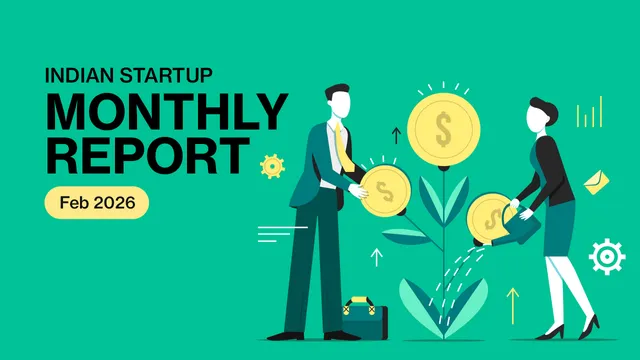
India’s startup funding market has recovered in 2026, but the recovery is not broad-based. Funding has increased, while investors are showing greater interest in AI, deeptech, strong early-stage businesses and startups with clearer paths to revenue, scale and eventual exits.
India Startup Funding Shows Signs of Recovery
India’s startup funding market entered 2026 after a period of tighter capital availability, lower valuations and greater investor scrutiny. The latest data suggests that funding activity has improved, but the nature of that recovery matters as much as the headline amount.
Indian startups raised about $6.9 billion in venture capital funding during the first half of 2026, up 21% from $5.7 billion in the same period of 2025, according to YourStory Research. The increase was helped by a late surge in large deals during June.
The first quarter had already provided an early indication of improvement. Startups raised $3.2 billion across 315 deals between January and March, compared with $2.5 billion across 312 deals in the first quarter of 2025. That means the increase came despite almost no change in the number of deals.
This distinction is important. More funding does not necessarily mean money is becoming easier for every founder to access. Instead, larger transactions appear to be contributing significantly to the overall recovery.
Why Investor Selectivity Still Matters in 2026
The current funding environment is different from the capital-heavy period of 2020 to 2022, when startups could often raise substantial amounts based on rapid user growth and ambitious expansion plans.
By 2025, investors had become more cautious. India’s total venture funding fell to about $12.1 billion from $13.6 billion in 2024, according to a review published by YourStory. Funding had previously peaked at around $44 billion in 2021 before falling sharply over the following two years.
That reset has changed what investors expect from founders.
Revenue growth, customer retention, unit economics, capital efficiency and a credible route to profitability have become more important in investment discussions. The fundraising process itself has also become longer. YourStory reported in January that Indian founders were increasingly taking six to nine months or longer to complete fundraising rounds as investors spent more time evaluating risk.
So, while capital is returning, it is not returning indiscriminately.
Larger Deals Are Lifting Overall Funding Numbers
One of the clearest features of the 2026 recovery is the contribution from larger funding rounds.
YourStory’s first-quarter data showed that the increase in VC funding was driven largely by a steady flow of deals in the $30 million to $90 million range. Funding reached $3.2 billion from 315 deals in Q1 2026, compared with $2.5 billion from 312 deals in Q1 2025.
This suggests that established startups with demonstrated traction continue to have access to meaningful amounts of capital.
At the same time, smaller startups can face a different fundraising environment. A founder with limited revenue, weak customer retention or an unclear business model may have to spend considerably more time convincing investors.
The result is a two-speed market. Companies that have already reduced some of their execution risk can attract sizeable rounds, while startups without sufficient proof may find fundraising considerably harder.
AI Has Become a Major Investor Preference
Artificial intelligence is one of the strongest themes shaping venture capital allocation in India.
In 2025, 16 venture capital funds with an exclusive or significant focus on AI raised about $1.87 billion, compared with five such funds that raised $358 million in 2024, according to Venture Intelligence data reported by Moneycontrol.
That trend has continued into 2026.
Accel, for example, raised $550 million for its ninth India-focused fund in August. The fund is targeting startups across AI, consumer businesses, fintech, software and advanced manufacturing, with AI expected to remain a theme across these sectors.
The significance is broader than the number of AI-specific funds. Investors are increasingly evaluating whether startups can use AI to build differentiated products, reduce operating costs or create technology-led advantages.
However, the presence of AI in a startup’s pitch does not automatically make it investable. Investors still need evidence that the technology solves a real problem and can generate sustainable commercial value.
Deeptech Funding Is Expanding Beyond Conventional Software
Another important shift is the growing interest in deeptech and industrial technology.
The Indian deeptech sector has attracted $11.4 billion in cumulative funding between 2015 and mid-2026, according to the Bharat DeepTech Report 2026 from the Indian Venture and Alternate Capital Association. In 2025 alone, deeptech startups raised $2.96 billion across 189 deals.
Investors are looking at areas including semiconductors, space technology, defence technology, robotics, advanced manufacturing, energy transition and enterprise AI.
Several funds have also raised dedicated capital for these areas. Aum Ventures, for instance, announced a ₹225 crore first close for a planned ₹750 crore India Innovation Fund II focused on early-stage deeptech startups across sectors such as space, semiconductors, defence, AI, robotics and advanced manufacturing.
This reflects a broader change in investor preferences. Capital is increasingly being directed toward businesses with technological or intellectual-property advantages rather than only consumer internet models.
Venture Capital Funds Are Raising More Capital
There is another side to the funding story: venture capital firms themselves are raising significant amounts of money.
India-focused VC funds raised more than $3.2 billion in the first half of 2026, with 10 India-focused funds announced, launched or closed during the period, according to Moneycontrol’s tracking. Another $1.3 billion was being raised across funds including Accel, Mettle Capital and Ambition Capital at the time of the report.
This indicates that limited partners continue to see India as an important venture market.
The recovery also follows a strong fundraising year in 2025. India-focused VC fundraising reached about $5.4 billion that year, almost double the $2.7 billion recorded in 2024, according to the Bain and IVCA report cited by Moneycontrol. Larger fund closures were a major contributor.
More available fund capital does not mean every startup will receive funding. Venture firms still have to decide which companies offer the strongest potential returns.
Early-Stage Startups Are Still Attracting Capital
Investor selectivity does not mean that early-stage funding has disappeared.
The first-quarter 2026 funding numbers show that deal activity remained relatively high even as the average amount varied significantly. Investors continue to place bets on early-stage businesses, particularly when founders demonstrate strong product-market fit, technical capabilities or a large addressable market.
The difference is that early-stage investors are increasingly looking for evidence earlier in a company’s development.
For founders, this can mean demonstrating customer adoption, pilot conversions, retention, early revenue or technical milestones before attempting a large institutional round.
This approach can also affect startups outside Bengaluru, Mumbai and Delhi-NCR. Smaller-city founders may have access to talent and lower operating costs, but they often need stronger networks and more compelling proof points to attract national and international investors.
What This Means for Tier-2 and Tier-3 Startups
The funding shift has particular relevance for startups emerging from smaller Indian cities.
A more selective market can create difficulties because founders outside established startup hubs may have less access to investors, mentors and large corporate customers.
But there are also opportunities.
Startups solving regional problems in areas such as logistics, agriculture, financial services, healthcare delivery, manufacturing and local commerce can potentially build businesses around large underserved markets.
Government-backed capital is also becoming an increasingly important part of India’s startup ecosystem. SIDBI’s Fund of Funds scheme had made gross commitments of ₹11,808 crore across 153 alternative investment funds, which had invested approximately ₹25,548 crore into 1,371 startups by the end of 2025, according to YourStory.
The availability of such capital can help expand funding beyond traditional startup centres, although access still depends on the investment strategies of individual funds.
What Investors Are Likely To Prioritise
The evidence from 2026 points toward a more disciplined investment environment rather than a simple return to the funding boom of previous years.
Investors are showing interest in startups with strong technology, measurable customer demand, efficient capital deployment and credible paths toward large-scale businesses.
The focus on AI and deeptech also suggests that investors are willing to fund ambitious companies when they believe the technology can create defensible advantages.
For founders, the message is straightforward: raising money is increasingly becoming an outcome of building a convincing business rather than the primary measure of startup progress.
That does not mean profitability is required at the earliest stage. But investors increasingly want evidence that the company understands its customers, controls its costs and has a realistic plan for turning capital into durable growth.
Funding Recovery Does Not Mean Easy Money
India’s startup funding market is clearly showing signs of recovery in 2026. The first-half funding figure of $6.9 billion is higher than the corresponding figure for 2025, while venture capital firms themselves are raising billions of dollars for new India-focused funds.
Yet the recovery is selective.
Large deals, AI, deeptech and companies with stronger fundamentals are attracting significant attention. At the same time, founders are facing longer fundraising cycles and more detailed investor scrutiny.
The biggest change, therefore, is not simply how much money is available. It is how investors decide where that money should go.
For India’s startup ecosystem, that could mean fewer companies chasing growth at any cost and more emphasis on technology, revenue quality, efficient execution and sustainable scale.
Key Takeaways
- Indian startups raised about $6.9 billion in VC funding in H1 2026, up 21% year-on-year.
- Larger funding rounds are playing an important role in the recovery, while investors continue to scrutinise fundamentals.
- AI and deeptech have emerged as major areas of venture capital interest, alongside fintech, software, consumer businesses and advanced manufacturing.
- Funding is available, but founders increasingly need evidence of customer demand, execution capability, capital efficiency and long-term business potential.
Frequently Asked Questions
Is Indian startup funding recovering in 2026?
Yes. Indian startups raised about $6.9 billion in venture capital during the first half of 2026, 21% more than the $5.7 billion raised in H1 2025, according to YourStory Research.
Are investors becoming more selective in India?
Yes. The market has shifted toward greater scrutiny of revenue, unit economics, customer retention, capital efficiency and execution. Fundraising can also take longer as investors spend more time assessing risk.
Which startup sectors are attracting investor interest?
AI and deeptech are major themes in 2026. Investors are also backing fintech, software, consumer businesses, advanced manufacturing, space technology, semiconductors, defence technology and energy-transition startups.
Does more VC funding mean it is easier for startups to raise money?
Not necessarily. Overall funding has increased, but much of the recovery is being driven by larger transactions and stronger companies. Startups without sufficient traction or a clear business model may still face lengthy fundraising processes and tougher investor scrutiny.










Leave a comment