

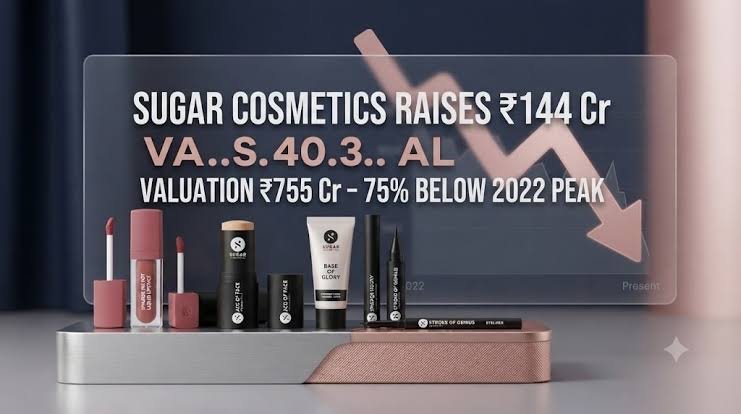
SUGAR Cosmetics has raised ₹144.47 crore from existing investor A91 Partners in a funding round that sharply resets the direct-to-consumer beauty brand’s valuation. The deal comes after falling revenue and widening losses, highlighting the tougher funding environment facing India’s D2C brands.
SUGAR Cosmetics raises ₹144.5 crore from A91 Partners
SUGAR Cosmetics has secured ₹144.47 crore in fresh equity funding from A91 Partners, according to regulatory filings reported by Inc42 and Moneycontrol. A91 subscribed to the entire issue through A91 Emerging Fund III, making it an investment by an existing backer rather than a new investor entering the company.
The company allotted 1,12,248 Series D7 compulsorily convertible preference shares at an issue price of ₹12,871 each. The transaction was approved by SUGAR’s board on September 1, 2026.
The headline funding amount, however, is not the only reason the transaction is attracting attention.
The more significant development is the valuation attached to the round.
Moneycontrol estimated an implied post-money valuation of about ₹755 crore, while Inc42’s calculation placed the valuation closer to ₹550 crore to ₹600 crore. The difference comes from the valuation methodology and capital structure used by different publications. Both estimates point to a substantial decline from SUGAR’s earlier valuation levels.
SUGAR’s valuation has fallen sharply
SUGAR’s latest funding comes after a period of considerable expansion and a subsequent deterioration in financial performance.
The company was valued at roughly ₹3,000 crore during its 2022 funding round, when L Catterton led a $50 million Series D investment. In November 2024, reports placed the company’s valuation around ₹2,600 crore to ₹2,700 crore following another funding transaction.
Against those earlier benchmarks, the latest transaction represents a major valuation reset.
Using Moneycontrol’s estimated ₹755 crore post-money valuation, the company is valued roughly 75% below its 2022 peak. Inc42’s estimate of ₹550 crore to ₹600 crore would imply an even steeper reduction from the company’s previous valuation.
It is important to distinguish between a company’s reported valuation and estimates derived from a particular share issuance. The ₹755 crore figure is an implied valuation, not a publicly traded market capitalisation, because SUGAR Cosmetics remains a private company.
Falling revenue adds pressure on the D2C brand
The valuation reset comes against a difficult financial backdrop.
SUGAR Cosmetics’ operating revenue fell around 20% to ₹404.4 crore in FY25 from approximately ₹505.1 crore in FY24, according to regulatory data cited by multiple reports.
At the same time, the company’s net loss nearly doubled to ₹135 crore from ₹68.4 crore in the previous financial year. Its EBITDA loss also widened substantially.
That combination matters for investors.
A company can attract a high valuation while operating at a loss if investors believe revenue growth will eventually produce scale and profitability. But when revenue itself begins declining while losses widen, investors have less evidence to support aggressive valuation assumptions.
For a mature D2C brand, the question increasingly becomes whether its existing customer base, distribution network and brand recognition can translate into sustainable profits.
Why the D2C beauty model is under pressure
SUGAR’s experience highlights a broader challenge for consumer startups.
The D2C model initially offered brands a way to reach consumers without depending entirely on traditional retail distribution. Online marketplaces, social media and a direct website allowed young companies to build brands quickly.
But as these companies grow, their cost structures can become more complicated.
Beauty brands need to spend on product development, marketing, inventory, warehousing, logistics and customer acquisition. Once they expand offline, they also take on additional costs related to stores, staff and physical distribution.
This creates a difficult balancing act.
A brand needs enough physical presence to reach consumers who still prefer shopping offline, while keeping store-level economics healthy. At the same time, online advertising and customer acquisition remain competitive.
SUGAR’s financial performance shows what can happen when expansion does not translate into sufficient revenue growth and profitability.
Offline expansion changed the cost equation
SUGAR started as an online-first beauty brand but subsequently built a substantial offline presence.
That shift is significant because physical retail can provide greater visibility and access to consumers, especially in India’s smaller cities and towns. But it also requires capital and adds fixed operating expenses.
The company’s move toward an omnichannel model was part of a wider trend among Indian D2C brands. Many consumer startups that initially relied on websites and marketplaces began opening stores or entering large retail chains to reach a broader audience.
For Tier-2 and Tier-3 markets, offline distribution can be particularly important because consumers may still prefer trying beauty products in person before purchasing them.
The challenge is making that expansion economically viable.
If store sales do not grow quickly enough to justify the associated costs, an offline footprint can increase the company’s cash requirements without producing the expected improvement in profitability.
What the down round means for D2C brands
A down round occurs when a startup raises new capital at a valuation lower than its previous funding round.
For founders and existing shareholders, this can have several consequences.
The most obvious is dilution. New investors receive shares at a lower price, which can reduce the relative value of existing holdings.
A lower valuation can also affect employee stock options. If employees were granted options based on a much higher previous valuation, the economic value of those options may become less attractive.
There is also a reputational effect.
A lower valuation does not automatically mean that a company is failing. It can reflect changing market conditions, revised investor expectations or a need to prioritise capital preservation. But repeated down rounds can make future fundraising more difficult if investors believe the business has not yet stabilised.
For D2C founders, this makes the quality of growth more important than growth alone.
Investors are demanding stronger business fundamentals
SUGAR’s latest funding illustrates a broader shift in startup investing.
During the high-growth funding cycle of the previous decade, consumer startups could command large valuations based on rapid customer acquisition, market potential and expectations of future scale.
Investors today are more focused on measurable operating performance.
Revenue growth, gross margins, customer retention, repeat purchases, cash burn and contribution margins are becoming more important in fundraising discussions.
For consumer brands, another critical measure is customer acquisition cost.
If a company has to spend heavily on advertising to acquire each customer, revenue growth may not translate into sustainable profitability.
The ability to generate repeat purchases can therefore become a major competitive advantage.
This is particularly relevant in beauty, where consumers have many alternatives and new brands continue to enter the market.
Competition is making beauty harder to scale
India’s beauty and personal care market has become increasingly crowded.
Traditional companies continue to have large distribution networks and established brands. At the same time, newer D2C companies are targeting specific consumer segments with specialised products.
Online marketplaces have also made it easier for consumers to compare prices, products and reviews.
For a brand such as SUGAR, differentiation therefore needs to extend beyond social media visibility.
Product performance, pricing, distribution, customer loyalty and repeat purchases all matter.
The challenge becomes even greater when a brand is trying to grow across multiple channels at the same time.
A D2C company can no longer assume that adding more stores or spending more on digital advertising will automatically produce proportional revenue growth.
What this means for India’s D2C ecosystem
SUGAR’s down round is not evidence that the entire Indian D2C sector is in trouble.
The beauty and personal care market continues to attract entrepreneurs, investors and consumers. Several newer brands are still raising capital and expanding.
What the SUGAR transaction demonstrates is that investors may no longer be willing to assign premium valuations simply because a consumer startup has a recognisable brand.
The bar for late-stage funding is higher.
Startups that can demonstrate strong unit economics, efficient customer acquisition and sustainable revenue growth are likely to have more negotiating power when raising capital.
Companies with high fixed costs and weak profitability may have to raise smaller rounds, cut expenses or delay expansion.
What founders can learn from SUGAR’s valuation reset
For D2C founders, the clearest lesson is that capital-intensive expansion needs to be supported by strong operating economics.
Opening stores, increasing advertising expenditure and entering new markets can boost visibility. But investors will ultimately look at whether those investments produce profitable growth.
A startup preparing for a funding round therefore needs to understand its cash runway and have a realistic plan for reaching profitability.
The latest SUGAR transaction also shows the importance of existing investors during difficult periods.
A91 Partners, which was already an investor, subscribed to the entire ₹144.47 crore issue. That gives SUGAR access to fresh capital while avoiding the need to find an entirely new lead investor during a challenging period.
For other D2C companies, maintaining strong relationships with existing investors could become increasingly important when external funding conditions tighten.
The next test will be profitable growth
The latest funding gives SUGAR additional capital, but the larger question is what the company does with it.
The immediate challenge is likely to be stabilising revenue while improving profitability and controlling operating costs.
The company’s future valuation will ultimately depend less on its previous peak and more on whether it can demonstrate a credible recovery.
For India’s D2C sector, that is the broader message from this down round.
The market is not necessarily turning away from consumer brands. It is becoming more demanding about the economics behind those brands.
The next generation of D2C winners may therefore be defined not by how quickly they can raise money, but by how efficiently they can turn every rupee of investment into durable revenue and profit.
Key Takeaways
- SUGAR Cosmetics has raised ₹144.47 crore from existing investor A91 Partners through a fresh equity issue.
- The latest transaction implies a substantially lower valuation than the company’s previous funding benchmarks, with estimates ranging from roughly ₹550 crore to ₹755 crore depending on methodology.
- SUGAR’s FY25 operating revenue fell about 20% to ₹404.4 crore, while its net loss nearly doubled to ₹135 crore.
- The down round highlights the growing importance of profitability, unit economics and disciplined expansion for India’s D2C brands.
FAQ
What is a down round in startup funding?
A down round occurs when a startup raises new capital at a lower valuation than in an earlier funding round. It can result in dilution for existing shareholders and may affect the value of employee stock options.
Why did SUGAR Cosmetics’ valuation fall?
The valuation reset comes amid weaker financial performance. SUGAR’s operating revenue fell around 20% in FY25, while its net loss nearly doubled. Investors are therefore placing greater emphasis on financial performance and profitability.
Does SUGAR’s down round mean India’s D2C sector is failing?
No. The transaction is specific to SUGAR and should not be treated as a measure of the entire D2C market. However, it does show that investors are becoming more cautious about high-cost expansion and are demanding stronger business fundamentals.
What should D2C brands focus on to attract investors?
D2C companies need to demonstrate sustainable revenue growth, healthy unit economics, customer retention, efficient acquisition costs and a credible path to profitability. Strong brand awareness alone is increasingly unlikely to justify a premium late-stage valuation.
(Internal keywords: SUGAR Cosmetics funding, SUGAR Cosmetics valuation, SUGAR Cosmetics down round, D2C brands India, D2C funding India, Indian beauty startups, startup valuation India, SUGAR Cosmetics A91 Partners, D2C beauty market India, Indian startup funding 2026)










Leave a comment