

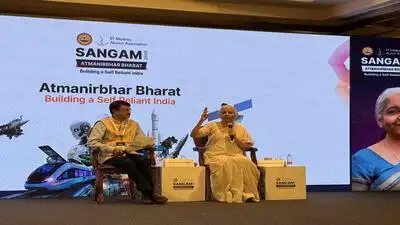
India’s startup ecosystem could make an economic contribution comparable to some established industries in the coming years, Finance Minister Nirmala Sitharaman said at IITMAA Sangam 2026 in Bengaluru. She also called for wider adoption of startup technologies, deeper funding and more public listings.
Finance Minister Highlights India’s Startup Potential
Indian startups are entering a phase where their contribution to economic growth could extend well beyond individual companies and technology sectors. Finance Minister Nirmala Sitharaman said startups could, over the next few years, contribute as much to the economy as some established industries.
She made the remarks while speaking at the seventh edition of the IIT Madras Alumni Association’s Sangam 2026 in Bengaluru on September 26. The event brought together policymakers, technology companies, entrepreneurs, investors and academic institutions to discuss India’s technology and self-reliance ambitions.
Sitharaman said the startup ecosystem has changed significantly since 2015 and argued that innovations developed by young companies need to move into wider parts of the economy.
Agriculture and drones were among the examples she cited, highlighting how startup technologies can potentially be applied across traditional sectors rather than remaining confined to technology-focused businesses.
Startup Innovation Needs Wider Economic Adoption
The Finance Minister’s comments point to an important shift in how the startup sector is viewed. The economic impact of startups is not limited to the amount of venture capital they raise or the number of unicorns they create.
A technology startup can have a wider economic effect when its products are adopted by established businesses, farmers, manufacturers, logistics companies, financial institutions and public agencies.
For example, drone technology can be used for agricultural monitoring, surveying and other industrial applications. Similarly, artificial intelligence, semiconductor technologies and quantum computing can support businesses across multiple industries.
Sitharaman said innovations emerging from startups would have to reach every sector of the economy. The broader objective is to turn research and technology into commercially useful products and services that can operate at scale.
This is particularly relevant for smaller Indian cities, where startups increasingly work on agriculture, manufacturing, logistics, healthcare and local business problems rather than only consumer internet products.
AI Growth Is Not Measured Only by Stock Listings
The Finance Minister also addressed concerns that India may have fallen behind in artificial intelligence.
She said the relatively small number of Indian AI companies listed on stock exchanges should not be treated as a measure of the country’s progress in the sector. India already has AI startups that have reached unicorn status or are approaching that level, according to her remarks.
The distinction is important because a startup can create technology, attract customers and generate employment long before becoming a publicly listed company.
Sitharaman nevertheless encouraged technology startups to think beyond early-stage and later-stage private funding as they grow. She suggested that suitable companies should consider public-market listings, which could provide another route to capital while increasing the visibility of India’s technology sector.
A larger number of successful public listings could also give investors in India more opportunities to participate directly in the growth of technology businesses.
Deeptech Startups Face a Different Funding Challenge
One of the major issues discussed at Sangam 2026 was the availability of patient capital for deeptech and hardware startups.
Unlike many software businesses, companies developing hardware, semiconductors, space technologies or other research-intensive products can take several years before reaching commercial revenue. Sitharaman noted that some deeptech hardware startups can take five to seven years to generate revenue.
This creates a funding challenge. Investors may have to wait longer for commercial returns, while founders need substantial capital for research, prototypes, testing, manufacturing and regulatory requirements.
During the discussion, Sitharaman asked the startup ecosystem to provide specific suggestions on what should qualify as early-stage funding and how much capital would be considered sufficient. She asked for such proposals within 10 days and indicated that the government could work on the issue.
The discussion comes as India seeks to strengthen its domestic capabilities in areas such as semiconductors, AI, quantum technology, defence and space.
New Deeptech Fund Adds to Startup Funding Push
The discussion on startup financing coincided with the launch of the IITM Unicorn Frontier Fund-I at the same event.
The fund, established by Unicorn India Ventures along with IIT Madras and IIT Madras Research Park, targets a corpus of ₹1,000 crore. It announced a first close of ₹450 crore and has already deployed around ₹55 crore across four deeptech startups, according to reports.
The fund is intended to support early-stage companies working in areas including space, quantum technology and energy. This kind of specialised capital is particularly relevant to startups whose development timelines are longer than those of conventional software businesses.
The development also illustrates the growing role of universities and research institutions in India’s startup ecosystem. IIT Madras said its startup network has expanded considerably, while the institution’s leadership has outlined an ambition to reach around 1,000 startups by 2032.
Opportunities Could Expand Beyond Major Startup Hubs
The next stage of India’s startup growth could also have implications for Tier-2 and Tier-3 cities.
Startup activity has historically been concentrated in major technology and business centres, but government and industry initiatives have increasingly focused on expanding innovation beyond the largest metropolitan markets.
Agriculture, manufacturing, healthcare, logistics and climate technology are areas where startups can address problems specific to smaller cities and regional economies.
NITI Aayog has previously highlighted the growing startup ecosystem outside India’s largest cities while also identifying gaps in seed funding and mentorship for ventures located beyond major metropolitan centres.
For regional entrepreneurs, access to capital remains an important factor. Deeptech businesses in particular may require specialised laboratories, technical talent, incubation facilities and investors willing to support longer development cycles.
Established Industries and Startups Could Work Together
The Finance Minister’s comments also underline the importance of cooperation between startups and established businesses.
Large companies already have customers, distribution networks, manufacturing capabilities and industry expertise. Startups, meanwhile, can bring new technologies and specialised solutions.
Combining these strengths can help technologies move from laboratories and pilot projects into commercial applications.
Recent policy discussions around India’s space sector provide one example. Private companies are increasingly participating in satellite development, launch systems and space-based applications following reforms that opened greater opportunities for non-government players.
Similar models could emerge in areas such as defence, agriculture, energy, healthcare and advanced manufacturing.
What the Startup Economy Could Mean for India
The central question is no longer simply how many startups India creates. The larger issue is whether these companies can build sustainable businesses, create employment, develop commercially viable technologies and contribute across different parts of the economy.
Government support, private investment, academic research and corporate partnerships will all influence that transition.
Sitharaman’s remarks indicate that the government sees startups as potential contributors to India’s broader economic expansion rather than as a separate technology segment. At the same time, the discussion around patient capital shows that significant challenges remain, particularly for businesses working on complex technologies with long development cycles.
If more Indian startups successfully move from innovation to large-scale commercial adoption, their economic footprint could extend well beyond the startup ecosystem itself.
Key Takeaways
- Finance Minister Nirmala Sitharaman said Indian startups could contribute to the economy at a scale comparable to some established industries in the coming years.
- She called for startup innovations to be adopted across sectors including agriculture, drones and advanced technology.
- Deeptech and hardware startups face funding challenges because some require five to seven years to generate revenue.
- The ₹1,000-crore IITM Unicorn Frontier Fund-I has announced a ₹450-crore first close to support early-stage deeptech companies.
FAQs
What did Nirmala Sitharaman say about Indian startups?
Finance Minister Nirmala Sitharaman said Indian startups could contribute as much to the economy as some established industries in the coming years. She also called for startup technologies to be adopted across different sectors.
Why is patient capital important for deeptech startups?
Deeptech and hardware companies often require several years of research, product development and testing before generating significant revenue. Longer-term funding can therefore be important for their survival and growth.
What is the IITM Unicorn Frontier Fund-I?
The IITM Unicorn Frontier Fund-I is a deeptech-focused Alternative Investment Fund established by Unicorn India Ventures with IIT Madras and IIT Madras Research Park. It is targeting a ₹1,000-crore corpus and announced a ₹450-crore first close.
Can startups outside major cities benefit from this growth?
Potentially, particularly in sectors such as agriculture, manufacturing, healthcare, logistics and climate technology. However, access to early-stage capital, specialised infrastructure and skilled talent remains an important challenge for startups outside major metropolitan centres.











Leave a comment