

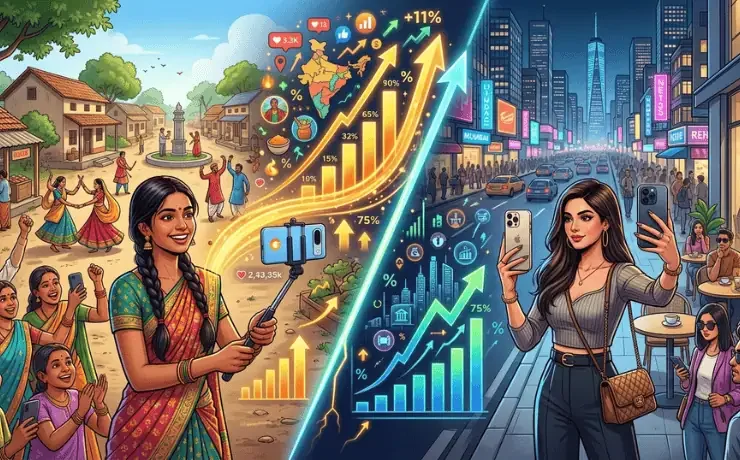
Creator marketing in India is moving beyond metro-focused Instagram campaigns as brands increasingly work with regional and smaller creators to reach consumers in Tier-2, Tier-3 and Tier-4 cities. Vernacular content, local cultural references and micro-influencers are becoming important parts of this shift.
Regional creators are changing India’s marketing strategy
For years, influencer marketing in India was closely associated with major Instagram creators based in Mumbai, Delhi, Bengaluru and other large cities. That model is changing as brands look for more targeted ways to reach consumers outside the biggest urban markets.
Recent industry data points to a growing role for non-metro creators. Moneycontrol reported in August that smaller cities accounted for roughly two-thirds of India’s creator base, with nano and micro creators making up more than 80% of the non-metro creator pool. (moneycontrol.com)
The change is not simply about finding cheaper influencers.
Brands are increasingly interested in creators who understand the language, humour, shopping habits and cultural references of their own communities. For a campaign targeting consumers in Bihar, Maharashtra, Assam or Tamil Nadu, a locally recognised creator can offer context that a national celebrity may not have.
That makes regional influence a marketing asset rather than simply a lower-cost alternative.
Why Tier-2 and Tier-3 audiences matter to brands
India’s consumption story is increasingly extending beyond metropolitan markets.
Marketers are paying greater attention to Tier-2 and Tier-3 cities as internet access, digital payments, ecommerce and consumer aspirations expand. Exchange4Media reported in July that marketers were increasingly tracking consumers with higher purchasing power outside major metros, including professionals moving to smaller cities because of improved infrastructure and changing work patterns. (exchange4media.com)
For brands, this creates a different advertising challenge.
Consumers in smaller cities are not necessarily looking for completely different products. They may want the same smartphones, beauty products, financial services, fashion, appliances or food brands available in metropolitan markets.
What can differ is how those products need to be presented.
A national advertisement may create awareness, but a local creator can demonstrate how the product fits into everyday life in a particular community.
Vernacular content is becoming a bigger part of campaigns
Language is one of the clearest changes in creator marketing.
A 2026 report cited by Exchange4Media found that regional-language creators represented 58% of India’s creator ecosystem, compared with 42% for Hindi creators. The same report said non-metro creators accounted for 66% of the creator base. (exchange4media.com)
The numbers illustrate the scale of India’s linguistic diversity.
A consumer in Nagpur, Patna, Guwahati or Coimbatore may understand Hindi or English, but content in Marathi, Bhojpuri, Assamese, Tamil or another familiar language can feel more natural and locally relevant.
Brands are therefore moving beyond simply translating a national campaign.
The more sophisticated approach involves allowing creators to adapt the message to local humour, expressions, festivals, traditions and consumer behaviour.
That distinction is becoming increasingly important as brands compete for attention in crowded social feeds.
Instagram is still important, but it is no longer enough
The shift beyond Instagram does not mean brands are abandoning the platform.
Instagram remains a major channel for creator marketing, particularly for fashion, beauty, food, lifestyle, travel and consumer technology.
The change is that brands are increasingly treating creator marketing as a broader ecosystem rather than an Instagram-only activity.
YouTube Shorts, YouTube long-form videos, Facebook, ShareChat, Moj and other platforms can play different roles depending on the target audience.
Regional platforms are particularly relevant because they have built audiences around local-language content.
ShareChat and Moj, for example, have highlighted the growing importance of hyperlocal creators and cultural communities. Their 2026 reporting points to creators in Tier-2 and Tier-3 cities becoming increasingly important for brands looking to understand local audiences rather than simply translate national campaigns. (exchange4media.com)
For advertisers, the practical implication is simple: the best platform depends on where the intended consumer actually spends time.
Micro creators are gaining an advantage
The rise of smaller creators is one of the biggest changes in India’s influencer economy.
Moneycontrol reported that more than half of non-metro creators are nano influencers with between 1,000 and 10,000 followers, while another 28% are micro creators with 10,000 to 100,000 followers. Together, these groups represent more than 80% of the non-metro creator base. (moneycontrol.com)
For brands, follower count is therefore becoming only one measure of a creator’s value.
A creator with 20,000 followers in a particular district may have stronger relevance for a regional retail campaign than a national influencer with several million followers.
This is particularly useful for businesses that need local action rather than national awareness.
A jewellery retailer, restaurant chain, consumer electronics brand or financial service provider may want people to visit a store, download an app, use a local offer or make a purchase. A smaller creator with a highly concentrated audience can sometimes be better positioned for that objective.
Hyperlocal campaigns are moving closer to retail
Creator marketing is also becoming more connected to physical stores and local commerce.
One example came from Stovekraft’s 2026 India’s Choice Sale campaign, which used more than 160 creators across regional markets. The campaign included creators from states such as Tamil Nadu, West Bengal, Uttar Pradesh, Odisha, Maharashtra, Karnataka and Kerala, with activations across metro, Tier-2 and Tier-3 markets. (business-standard.com)
The campaign is notable because creators were not being used only to publish awareness posts.
They visited general trade stores and exclusive outlets, created product demonstrations and communicated offers relevant to local markets.
This model brings influencer marketing closer to traditional retail.
Instead of treating social media as a separate awareness channel, brands can connect creator content with store visits, product discovery and purchases.
For smaller cities, where general trade and local retail remain important, that connection can be particularly valuable.
Creator commerce is expanding beyond sponsored posts
Another change is the movement from creator advertising toward creator-led commerce.
Brands are increasingly giving creators tools to generate sales through affiliate links, product recommendations and trackable content.
Myntra’s Ultimate Glam Clan affiliate programme is one example. The company said more than six million users had signed up, with 100,000 nano and micro creators earning through the programme. Nearly 70% of those creators were from Tier-2 and Tier-3 markets, according to Exchange4Media. (exchange4media.com)
This model changes the relationship between brands and creators.
Instead of paying only for a post or video, brands can connect creator activity with measurable consumer actions.
Creators can also build a business around recommendations rather than depending entirely on one-off sponsorships.
For regional creators, this could become especially important because their audience may be smaller but more commercially relevant within a particular category or geography.
Festive marketing is accelerating the regional shift
Festivals provide another strong reason for brands to work with regional creators.
India does not have a single uniform festive calendar. Diwali, Holi, Onam, Pongal, Bihu, Ganesh Chaturthi, Durga Puja and numerous local celebrations create different cultural and commercial moments across states.
Exchange4Media reported in March that marketers were increasingly moving toward regional creator-led storytelling during Holi rather than relying only on broad national campaigns. The industry publication cited estimates that regional creators could deliver stronger engagement and lower campaign costs in non-metro markets. (exchange4media.com)
This approach becomes more relevant during festivals because cultural details matter.
A campaign built around a generic festive message can feel disconnected from a consumer’s actual experience. A local creator can incorporate regional food, clothing, traditions, family behaviour and language into the same brand message.
That gives advertisers more versions of the same campaign without forcing every market into one creative format.
The Northeast shows the opportunity and the gap
The expansion of creator marketing is also opening opportunities in markets that have historically received less advertising attention.
Moneycontrol reported in June that creators from India’s Northeast remain relatively underused by brands despite strong audience engagement. Travel, food, photography and hospitality were among the categories already showing activity, while beauty, fashion and gaming were identified as areas with potential for greater investment. (moneycontrol.com)
This illustrates a larger issue with India’s creator economy.
The supply of regional creators is growing faster than brand budgets are reaching every region.
Many creators may have engaged audiences but receive few paid campaigns. Moneycontrol reported that around 85% of non-metro creators do not complete any brand campaign annually, highlighting the gap between audience growth and monetisation. (moneycontrol.com)
For agencies and brands, this means there is still considerable untapped talent outside the established influencer hubs.
Brands also face a measurement problem
The regional creator boom does not automatically mean every campaign will work.
Kantar’s analysis of more than 1,500 Indian advertising creatives found that creator content had become a stronger influence in campaign planning, with creator impact rising 77%. However, only 27% of creator content effectively linked back to the brand, according to Moneycontrol’s report on the findings. (moneycontrol.com)
That is an important warning for advertisers.
High engagement does not necessarily mean strong brand recall or sales.
A Reel may generate thousands of views but fail to communicate what the brand is selling. Similarly, a creator may have strong engagement but an audience that does not match the product.
Brands therefore need to evaluate more than follower numbers and views. Audience location, language, category relevance, engagement quality, brand integration and measurable conversions all matter.
What this means for India’s advertising market
The rise of regional creators reflects a broader change in how brands view India’s consumer market.
The old model treated the country as a handful of large urban centres surrounded by smaller markets. The newer approach is increasingly fragmented, with brands identifying specific audiences by language, geography, culture and purchasing behaviour.
That creates more work for marketers but also more opportunities for creators.
A campaign for a national brand can now involve dozens or hundreds of local voices instead of one celebrity or a small group of metro influencers.
For Tier-2 and Tier-3 creators, this could turn local knowledge into a genuine commercial advantage.
For brands, the challenge will be maintaining consistent messaging while allowing enough flexibility for local creators to make the content feel natural.
The creator economy is therefore moving toward a model where influence is not determined only by follower count or city. Relevance, community trust and cultural understanding are becoming equally important.
Takeaways
- Regional and non-metro creators are becoming a larger part of India’s creator economy, with smaller-city creators accounting for a significant share of the ecosystem. (moneycontrol.com)
- Brands are increasingly using vernacular content and hyperlocal storytelling to reach Tier-2, Tier-3 and Tier-4 consumers.
- Creator marketing is expanding beyond sponsored Instagram posts into YouTube, regional platforms, affiliate commerce, retail activations and performance-led campaigns.
- Strong engagement alone is not enough. Kantar’s 2026 findings highlight the need for better brand integration and measurable outcomes. (moneycontrol.com)
FAQs
Why are brands increasingly working with regional creators?
Regional creators understand local languages, cultural references and community behaviour. This can help brands make campaigns more relevant to consumers in Tier-2, Tier-3 and Tier-4 cities.
Are brands moving away from Instagram?
Not entirely. Instagram remains a major creator-marketing platform, but brands are increasingly using multiple platforms, including YouTube, Facebook, ShareChat, Moj and other regional or short-form video channels.
Why are micro influencers becoming important?
Micro and nano creators can have smaller but more concentrated audiences. For a campaign targeting a particular city, state or consumer group, that relevance can sometimes matter more than a large national follower count.
Can regional creators earn more from brand campaigns?
The opportunity is growing, but monetisation remains uneven. Recent reporting indicates that a large majority of non-metro creators still do not receive regular brand campaigns. The expansion of affiliate commerce and regional advertising could create more recurring revenue opportunities over time. (moneycontrol.com)
(Internal keywords: creator marketing India, regional creators India, influencer marketing Tier 2 cities, influencer marketing Tier 3 cities, regional influencer marketing, Indian creator economy 2026, vernacular creators India, micro influencers India, nano influencers India, Bharat creator economy, regional advertising India, influencer marketing trends India, creator commerce India, hyperlocal marketing India, Tier-2 advertising market, Tier-3 advertising market)







Leave a comment