

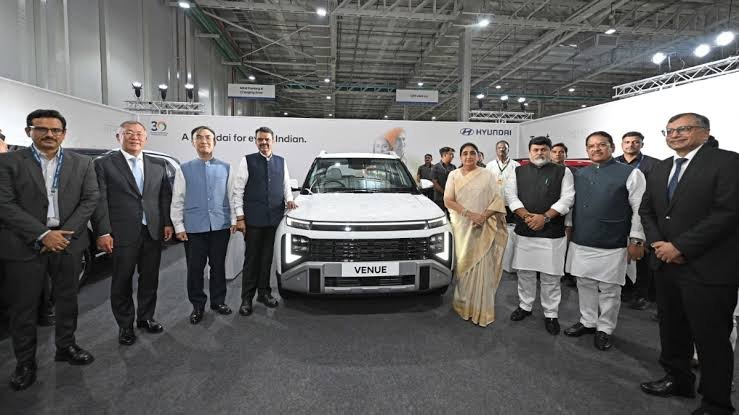
Hyundai Motor India has announced a phased investment of ₹11,000 crore at its Talegaon manufacturing facility in Pune, Maharashtra, following the plant’s inauguration on October 14, 2026. The expansion aims to increase production capacity, strengthen the local supplier network and create opportunities across the state’s automotive industry.
Hyundai Pune Plant: A Major Manufacturing Expansion
Hyundai Motor India Limited (HMIL) has inaugurated its manufacturing facility at Talegaon in Pune district, marking a significant step in the company’s expansion strategy. The automaker plans to invest ₹11,000 crore in phases at the facility, with the objective of increasing its annual production capacity from 1.7 lakh vehicles to 3.2 lakh vehicles by 2030.
The inauguration took place in the presence of Maharashtra Chief Minister Devendra Fadnavis and senior Hyundai Motor Group executives. The development comes as Hyundai marks 30 years of operations in India and looks to strengthen its manufacturing presence in one of the world’s largest passenger vehicle markets.
The Pune facility is expected to play an important role in Hyundai’s future production plans. Along with its manufacturing operations in Chennai, the company aims to achieve a combined annual production capacity of approximately 11.4 lakh vehicles by 2030.
According to the company’s announcement, the investment will support manufacturing expansion, industrial development, innovation and employment generation in Maharashtra. The actual economic impact will depend on how quickly the planned expansion is implemented and how demand develops over the coming years.
How the Investment Could Benefit Maharashtra’s Auto Industry
Maharashtra has an established automotive manufacturing ecosystem, with Pune and its surrounding industrial areas serving as important centres for vehicle production, engineering and component manufacturing.
Hyundai’s planned investment could strengthen this ecosystem by increasing demand for automotive components, logistics services, industrial equipment and other manufacturing-related activities. As production expands, the company may require additional support from suppliers, transport operators, warehousing businesses and service providers.
This could create opportunities for businesses already operating in the region and encourage other companies to consider investments in Maharashtra.
However, the benefits will not be limited to large manufacturers. Small and medium enterprises that supply components, packaging materials, maintenance services and industrial solutions could also find opportunities if they meet the automaker’s requirements for quality, cost and delivery.
For the state, the investment represents an opportunity to deepen its position in India’s passenger vehicle manufacturing industry. Sustained growth will depend on infrastructure, skilled labour availability, supplier competitiveness and the ability to attract further investments into the region.
Employment Opportunities and the Supplier Network
One of the most significant aspects of Hyundai’s expansion is the potential impact on employment and supporting industries.
Hyundai Motor India has stated that 55 supplier partners have already invested nearly ₹4,600 crore in Maharashtra. Together with tier-two vendors, this supplier ecosystem has created more than 18,000 employment opportunities in the state.
These figures relate to the wider supplier ecosystem and should not be interpreted as the number of new jobs directly created by the latest ₹11,000 crore investment.
As the Talegaon facility expands, additional activity could emerge across manufacturing, quality control, maintenance, logistics, engineering and supply-chain management. The scale of any new employment will depend on production growth, automation and the requirements of individual suppliers.
For job seekers in Pune and neighbouring industrial areas, the expansion could increase demand for technical skills, including automotive engineering, industrial maintenance, robotics, quality assurance and production management.
Industrial training institutes, engineering colleges and vocational education providers may also have an opportunity to strengthen industry partnerships and prepare students for manufacturing-related roles.
At the same time, workers will need to adapt to changing factory requirements as automation and digital manufacturing become more common.
What the Pune Plant Means for Small Businesses
Large automotive investments often generate economic activity beyond the factory itself. Suppliers and service providers can benefit from the additional demand created by vehicle manufacturing, although the opportunities vary according to the nature of each business.
For small businesses in Maharashtra, Hyundai’s expansion could create openings in transportation, equipment maintenance, industrial safety, packaging, facility management and workforce training.
Automotive component manufacturers may also explore opportunities to join the company’s supply chain. However, entering an established automotive supply network generally requires compliance with technical specifications, quality standards, delivery schedules and commercial terms.
Small and medium enterprises should therefore view the investment as a potential business opportunity rather than a guarantee of new contracts.
Businesses located near Talegaon and other industrial clusters could also benefit from increased demand for supporting services if the expansion leads to sustained growth in manufacturing activity.
For Tier-2 and Tier-3 entrepreneurs, the wider lesson is that industrial development can create opportunities for businesses that serve manufacturers, even when they do not produce vehicles themselves.
Smart Manufacturing and the Shift Towards New Technology
Hyundai’s Talegaon facility also reflects the growing role of digital technology in automobile manufacturing.
According to the company, the plant uses its E-FOREST digital factory platform, incorporating technologies such as artificial intelligence-based quality checks, predictive maintenance, digital simulations and augmented reality-based worker training.
These systems are designed to support manufacturing efficiency, quality control and equipment management. Predictive maintenance, for example, can help identify potential equipment problems before they result in costly production interruptions.
The facility is designed to support multiple internal combustion engine and hybrid vehicle models. This flexibility could help Hyundai respond to changing consumer demand and evolving product requirements.
For Maharashtra’s automotive ecosystem, the growing use of digital manufacturing may increase demand for engineers, software specialists, automation technicians and workers with expertise in industrial technology.
It may also encourage component suppliers to modernise their operations to remain competitive.
However, the adoption of advanced manufacturing technology brings its own challenges. Businesses must invest in equipment, employee training, cybersecurity and process improvements to use these systems effectively.
Hyundai’s Investment and India’s Automotive Growth Strategy
The Pune expansion forms part of Hyundai Motor Group’s broader investment strategy for India. On October 13, 2026, the group announced a commitment to invest $15.5 billion in India from 2026 through 2032.
The wider plan covers manufacturing expansion, research and development infrastructure, supplier localisation and future automotive technologies. It also includes the establishment of a dedicated investment entity in India to coordinate investments across these areas.
The group’s strategy reflects India’s importance as a manufacturing base and consumer market. Growing domestic demand, export opportunities and the development of new automotive technologies are among the factors shaping investment decisions across the industry.
Hyundai has also highlighted its export capabilities. The company announced that it had reached four million cumulative passenger vehicle exports from India, underlining the role of Indian manufacturing facilities in its international operations.
The Talegaon plant is intended to strengthen this position. Hyundai has said the facility will manufacture the new Hyundai Venue for export to more than 35 markets.
For Maharashtra, the combination of manufacturing expansion, supplier investment and export activity could support a broader industrial growth strategy. Nevertheless, the results will depend on execution, global demand, competition and the company’s ability to expand production profitably.
Challenges That Could Influence the Investment’s Impact
Despite the scale of the announcement, the long-term impact of Hyundai’s investment will depend on several factors.
First, the company must expand production capacity in line with market demand. Higher manufacturing capacity does not automatically translate into higher sales or profits.
Second, the automotive industry is undergoing a transition involving electric vehicles, hybrids, software-enabled features and stricter expectations around efficiency. Manufacturers and suppliers must continually adapt to these changes.
Third, infrastructure and workforce development will remain important. Reliable transport links, utilities, industrial land and access to skilled employees can influence the competitiveness of a manufacturing location.
Finally, smaller suppliers may need financial support and technical assistance to meet the requirements of large manufacturers. Without sufficient preparation, some businesses could find it difficult to participate in the expanding supply chain.
The investment therefore represents a significant opportunity for Maharashtra, but its broader benefits will emerge over time rather than immediately.
Key Takeaways
- Hyundai Motor India plans to invest ₹11,000 crore in phases at its Talegaon plant in Pune.
- The facility’s annual production capacity is expected to increase from 1.7 lakh to 3.2 lakh vehicles by 2030.
- The expansion could create opportunities for suppliers, small businesses, skilled workers and logistics providers, although additional employment figures have not been established for this investment alone.
- The plant forms part of Hyundai Motor Group’s broader $15.5 billion investment commitment for India through 2032.
Frequently Asked Questions
1. How much is Hyundai investing in Pune?
Hyundai Motor India has announced plans to invest ₹11,000 crore in phases at its Talegaon manufacturing facility in Pune, Maharashtra.
2. When will Hyundai’s Pune plant reach its planned production capacity?
The company aims to increase the facility’s annual production capacity from 1.7 lakh vehicles to 3.2 lakh vehicles by 2030.
3. How could Hyundai’s investment benefit Maharashtra?
The investment could support manufacturing, component suppliers, logistics, technical services and employment opportunities. The actual impact will depend on the pace of expansion and demand for vehicles.
4. Is Hyundai’s Pune investment part of a larger India strategy?
Yes. Hyundai Motor Group announced a broader investment commitment of $15.5 billion in India from 2026 through 2032, covering manufacturing, research and development, supplier localisation and future technologies.










Leave a comment