

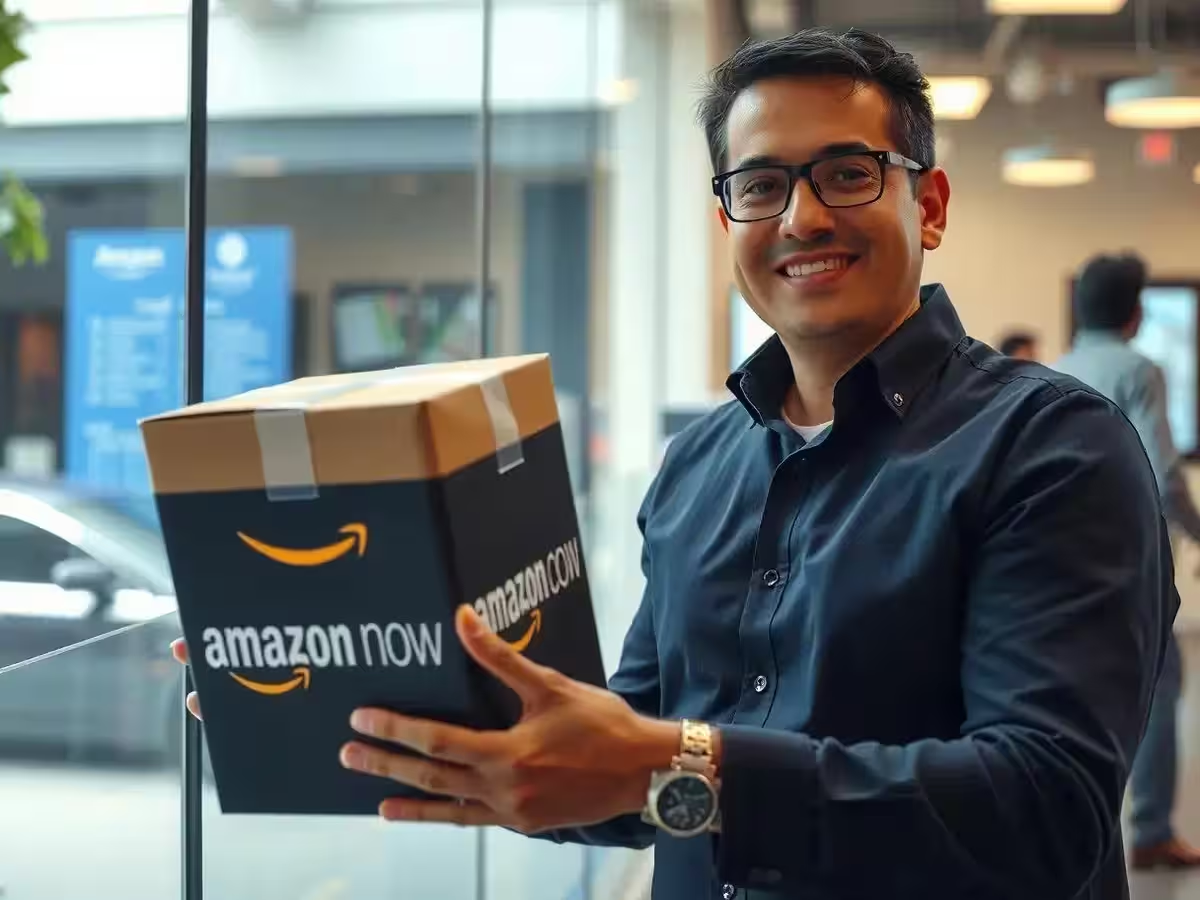
Amazon is accelerating its quick-commerce push in India, with Amazon Now planning to expand to around 300 cities. The move could reshape online shopping in Tier-2 and Tier-3 markets, where faster delivery, local demand and logistics economics will determine how far quick commerce can scale.
Amazon Now plans 300-city expansion across India
Amazon Now is preparing for a major expansion of its quick-commerce network, with the company saying it has a path to reach around 300 Indian cities. The latest update was shared by Nishant Sardana, Director of Amazon Now, on September 1, 2026. Amazon Now currently operates in about 30 cities, meaning the proposed rollout would represent a significant increase in its geographic footprint.
The service was launched in January 2025 and has since become an important part of Amazon India’s strategy to compete in the rapidly expanding quick-commerce market.
Amazon’s latest target is also larger than the 100-city expansion plan announced in April. At that time, the company said it would take Amazon Now to 100 cities and build more than 1,000 micro-fulfilment centres.
The acceleration shows that Amazon sees quick commerce as a long-term part of India’s online retail market rather than a limited urban experiment.
Quick commerce moves deeper into Tier-2 India
For years, quick commerce in India was largely associated with dense metropolitan neighbourhoods. Services from Blinkit, Zepto, Swiggy Instamart and other platforms depended on high order density, short delivery distances and large pools of customers.
That model is now moving into smaller cities.
Amazon’s 300-city ambition comes as quick-commerce companies increasingly look beyond India’s biggest metros. Flipkart Minutes, for example, has also been expanding its dark-store network and targeting Tier-2 and Tier-3 markets. Moneycontrol reported that smaller cities are becoming an increasingly important part of the industry’s next growth phase.
The opportunity is significant, but smaller markets do not automatically offer the same economics as Bengaluru, Mumbai or Delhi-NCR. Companies need enough orders in each service area to justify fulfilment centres, inventory and delivery infrastructure.
Why smaller cities could become the next growth market
Tier-2 and Tier-3 cities have seen wider adoption of online shopping, digital payments and app-based services. Consumers in these markets are already familiar with ecommerce, but quick commerce introduces a different proposition: buying everyday products and receiving them within a short period rather than waiting for conventional ecommerce delivery.
This could be particularly useful for grocery top-ups, personal-care products, household essentials, medicines where legally permitted, small electronics accessories and last-minute purchases.
Local events and festivals could create another opportunity. Demand for products such as puja items, snacks, household goods and personal-care products can rise sharply around specific occasions.
Amazon Now’s experience in Hyderabad provides an early example. The company said the city was recording almost 35 per cent month-on-month growth around six months after launch, while products such as toys, puja items and fitness-related products were showing stronger demand than expected.
Amazon’s micro-fulfilment strategy will be crucial
Quick commerce depends heavily on proximity. A delivery cannot be genuinely fast if the product is stored far away from the customer.
Amazon said Amazon Now currently has around 650 micro-fulfilment centres across 30 cities and plans to increase that number to more than 1,000 shortly. The company is also using an omnichannel approach that combines its own fulfilment infrastructure with partner stores.
This model could become particularly important in smaller cities.
Instead of building a large network of standalone facilities in every location, companies can potentially use existing retail infrastructure and local partnerships to improve product availability and reduce the distance between inventory and customers.
However, the economics will depend on order volumes. A dark store or micro-fulfilment centre needs enough demand to justify rent, inventory, staff and delivery operations.
The competition is getting tougher
Amazon is entering a market where established players have already built substantial consumer awareness.
Blinkit, Zepto and Swiggy Instamart have spent years developing dense delivery networks in major cities. Flipkart Minutes is also expanding aggressively, giving the sector another large ecommerce-backed competitor.
Amazon has one major advantage: its existing ecommerce ecosystem and customer base. The company can potentially use its Prime membership, logistics capabilities and broad product catalogue to encourage customers to use Amazon Now.
The company has also reported strong engagement among Prime users. Earlier this year, Amazon said Prime members who started using Now increased their shopping frequency threefold. Amazon has also said orders on the service have been doubling every quarter since its launch.
Those figures indicate that quick commerce could influence how customers interact with the wider Amazon platform.
Amazon Now is moving beyond groceries
Another important change is the expansion of quick commerce beyond basic grocery products.
Amazon has been pushing Amazon Now into fashion and lifestyle categories, targeting situations where customers need products quickly. ET Retail reported in August that Amazon was using the service to explore time-sensitive fashion purchases as part of its wider 300-city ambition.
This could make the business model more attractive if customers begin using quick commerce for more than milk, vegetables and snacks.
For smaller cities, this may create an interesting retail shift. A consumer who previously had to visit a local market for a specific item could potentially order it through an app if the required inventory is available nearby.
But that does not mean traditional retailers will disappear. Local stores have advantages in familiarity, credit relationships, immediate availability and neighbourhood-level knowledge.
Can quick commerce work in Tier-2 and Tier-3 cities?
The answer will depend on unit economics rather than simply the number of cities covered.
A successful quick-commerce operation needs sufficient order frequency, suitable product assortment, efficient inventory management and delivery routes that keep costs under control.
The challenge becomes harder when population density is lower. In a metro neighbourhood, one fulfilment centre can potentially serve thousands of households within a compact area. In a smaller city, the same facility may need to cover a wider geographic area with fewer orders.
Amazon’s partner-store strategy could help address this problem. The company says it plans to combine its own micro-fulfilment centres with partner stores as part of its omnichannel model.
This approach could allow the company to test demand before making heavier infrastructure investments.
Profitability remains the bigger question
Rapid expansion does not necessarily mean quick commerce is already a highly profitable business.
Amazon Now’s leadership has acknowledged that the business is still at an early stage and said the current focus is on selection, value and delivery speed, with profitability expected over time.
That distinction matters as the industry expands.
Companies may have to spend heavily on warehouses, technology, inventory, delivery operations and customer acquisition before achieving sustainable margins. Swiggy, for instance, continues to invest heavily in Instamart while targeting significant improvements in earnings over the coming years.
For investors and the wider retail sector, the important question is therefore not simply who can reach the most cities. It is who can build a model that works profitably across different city sizes.
What Amazon’s expansion means for local markets
If Amazon Now successfully reaches 300 cities, the impact could extend beyond online shoppers.
Local sellers, farmers and small businesses could gain another route to customers if Amazon’s marketplace and partner models are integrated effectively. Amazon previously said its quick-commerce expansion could enable more than 16,000 farmers to use its technology and operations to sell fresh produce directly to customers.
Consumers could benefit from greater choice and faster delivery, while traditional retailers may face stronger competition.
At the same time, the expansion could increase demand for local delivery workers, warehouse staff and supply-chain services. The actual employment impact will depend on how Amazon structures its fulfilment and partner network in each city.
The 300-city target therefore represents more than an expansion of delivery coverage. It is a test of whether India’s quick-commerce model can move from densely populated metros into a much broader set of markets.
Key Takeaways
- Amazon Now plans to expand its quick-commerce footprint to around 300 Indian cities, up sharply from its current presence in about 30 cities.
- Amazon is scaling its micro-fulfilment network beyond 1,000 centres and plans to combine its own infrastructure with partner stores.
- Tier-2 and Tier-3 cities could become the next major growth market, but lower order density may make profitability more difficult.
- The success of Amazon Now will depend not only on delivery speed, but also on inventory, local demand, infrastructure and sustainable unit economics.
Frequently Asked Questions
What is Amazon Now?
Amazon Now is Amazon India’s quick-commerce service designed to deliver products to customers within a short time through nearby fulfilment infrastructure. It launched in January 2025 and has expanded across multiple Indian cities.
How many cities does Amazon Now plan to reach?
Amazon has said Amazon Now has a path to expand to around 300 cities. The company was operating in about 30 cities as of September 1, 2026, when the latest expansion update was given.
Can quick commerce work in Tier-2 and Tier-3 cities?
It can, but the economics may be different from major metros. Companies need enough local demand to support fulfilment centres, inventory and delivery costs. Partner stores and flexible fulfilment models could help companies expand into smaller markets.
Will Amazon Now compete with Blinkit, Zepto and Instamart?
Yes. Amazon’s expansion puts it in more direct competition with established quick-commerce companies including Blinkit, Zepto and Swiggy Instamart, while Flipkart Minutes is also expanding its network.
(Internal keywords: Amazon Now 300 cities, Amazon quick commerce India, quick commerce Tier 2 cities, quick commerce Tier 3 cities, Amazon Now expansion, Amazon India news, Amazon quick delivery, quick commerce India 2026, Amazon micro fulfilment centres, Blinkit Zepto Instamart competition, ecommerce in Tier 2 India, quick commerce business model)








Leave a comment