

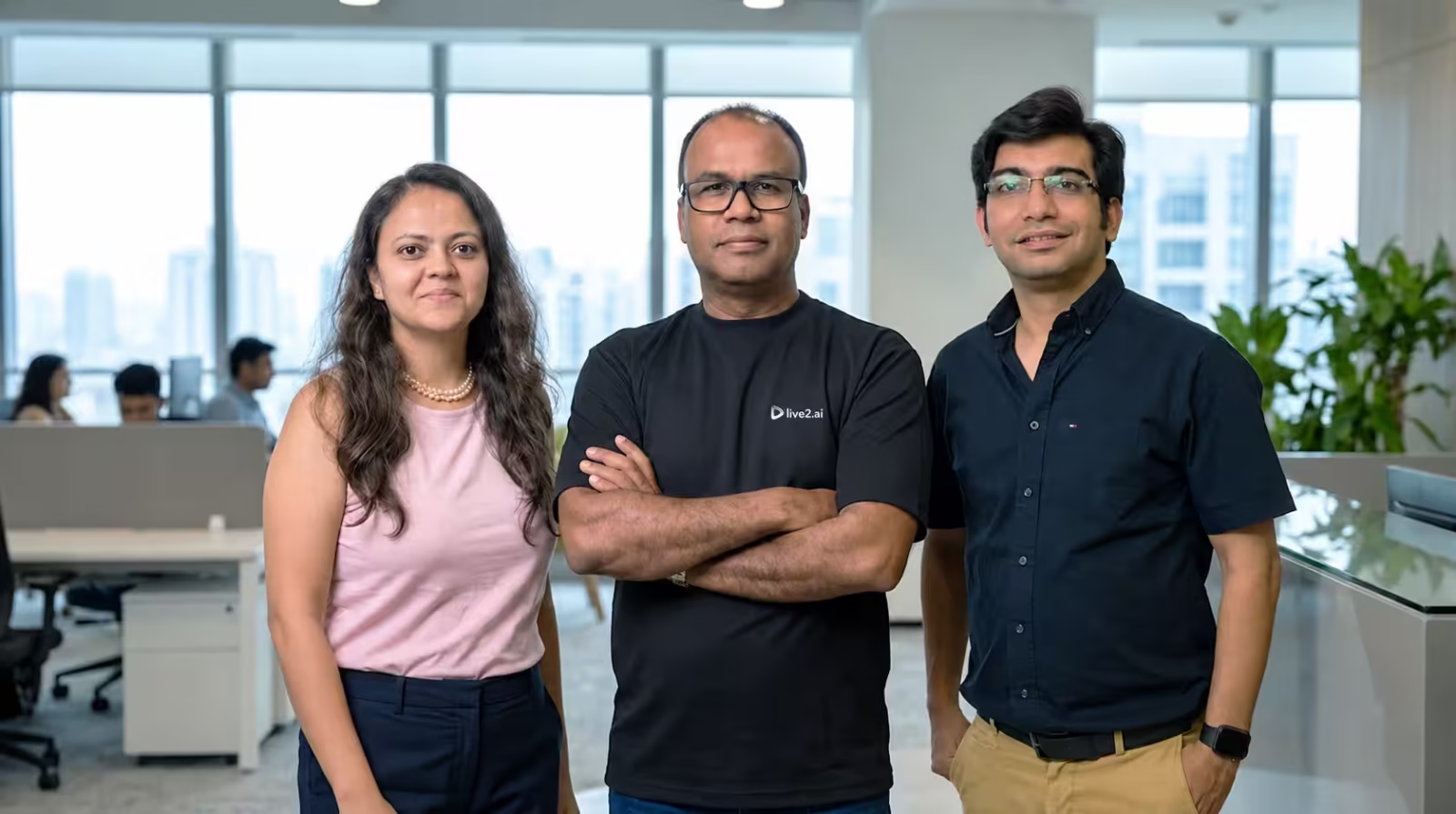
Bengaluru-based Live2.ai has raised ₹130 crore in a Pre-Series B funding round led by IvyCap Ventures. The investment will support its AI platform, enterprise expansion and international operations as brands increasingly use artificial intelligence to connect social media engagement with commerce.
Live2.ai Secures ₹130 Crore in IvyCap Ventures-Led Funding
India’s artificial intelligence and social commerce sectors have attracted another significant investment. Bengaluru-based startup Live2.ai announced on October 27, 2026, that it had raised ₹130 crore, approximately $14 million, in a Pre-Series B funding round led by IvyCap Ventures.
The funding round includes both primary capital for business expansion and a secondary component that provides partial liquidity to early shareholders. This distinction is important because the entire ₹130 crore will not necessarily enter the company’s balance sheet as fresh operating capital.
The company plans to use the investment to accelerate the development of its AI agent platform, strengthen enterprise deployments and expand its presence across North America, Europe and the Asia-Pacific region.
The announcement comes at a time when businesses are exploring ways to use artificial intelligence beyond basic content creation and customer support. Companies increasingly want technology that can analyse consumer behaviour, identify emerging trends and help convert online engagement into measurable business outcomes.
For Live2.ai, the funding represents an opportunity to expand its enterprise technology offering and compete in the growing market for AI-powered marketing and social commerce solutions. ETEntrepreneur.com+2
What Does Live2.ai Actually Do?
Live2.ai operates in the enterprise software and social commerce technology space. Its platform is designed to help brands monitor social media conversations, understand consumer interests, manage influencer campaigns and convert approved content into shopping experiences.
The platform monitors conversations across several digital channels, including Instagram, TikTok, YouTube, Reddit, X and online review platforms.
Instead of treating these channels as separate marketing tools, Live2.ai aims to bring social intelligence, content management, campaign auditing and commerce activation into a connected system.
For example, a fashion brand may notice an increasing number of social media conversations about a particular clothing style. Its marketing team can use social intelligence tools to identify the trend, evaluate relevant creator content and develop a campaign around the product.
The platform can also help brands manage influencer content compliance and track campaign performance.
Another feature is the ability to turn rights-cleared user-generated and creator content into shoppable experiences across websites, stores, customer relationship management systems and marketplaces.
This model is different from a conventional social media scheduling tool. It attempts to connect the entire process, from understanding online conversations to activating content and measuring commercial outcomes. Inc42 Media+2
How AI Is Changing India’s Social Commerce Market
Social commerce refers to the buying and selling of products through social media platforms and content-driven digital experiences.
Traditional e-commerce generally depends on product searches, category pages and online marketplaces. Social commerce adds another layer by allowing consumers to discover products through videos, influencer recommendations, community discussions and interactive content.
In India, this approach has relevance across fashion, beauty, electronics, food, lifestyle products and personal care.
A consumer watching a product demonstration on social media may become interested in purchasing the item without actively searching for it on an e-commerce platform.
Artificial intelligence can make this process more efficient for brands.
AI-powered systems can analyse large volumes of social media conversations, identify frequently discussed products and detect changes in consumer preferences. They can also help companies understand which content formats generate engagement and which campaigns are more likely to attract potential customers.
For businesses, this can reduce the time required to identify market trends and coordinate marketing activities.
However, AI does not automatically translate social engagement into sales. Product quality, pricing, consumer trust, delivery services and the overall shopping experience continue to influence purchasing decisions.
The opportunity lies in using AI to improve the connection between product discovery, customer engagement and purchasing.
Eight AI Agents Aim to Connect Marketing With Commerce
One of Live2.ai’s important product features is its use of multiple AI agents to manage different marketing and social intelligence activities.
According to the company and funding coverage, its platform operates eight AI agents covering functions such as crisis detection, trend identification, campaign auditing and automated responses.
These capabilities can help businesses manage large volumes of digital information without depending entirely on manual monitoring.
Consider a consumer brand facing negative conversations across multiple social media platforms. An AI-powered monitoring system can identify unusual changes in online discussions and alert the relevant team.
Similarly, trend intelligence can help marketing departments identify emerging consumer interests before they become mainstream.
Campaign auditing can assist brands in checking influencer content and identifying potential compliance issues.
The company also incorporates governance controls and human review mechanisms into its platform. This is important because automated systems can misunderstand context, misinterpret consumer sentiment or generate inaccurate responses.
For large enterprises, the objective is not simply to automate every marketing activity. It is to combine AI-driven analysis with human decision-making so that teams can respond faster while maintaining oversight.
This approach is becoming increasingly relevant as brands manage campaigns across multiple platforms, creators and geographical markets. Inc42 Media+2
Why IvyCap Ventures Is Investing in AI-Powered Marketing Technology
The ₹130 crore investment was led by IvyCap Ventures, an Indian venture capital firm that invests in technology-driven businesses.
The investment reflects growing interest in enterprise AI solutions that address specific operational problems.
Many companies already use separate tools for social media monitoring, influencer marketing, content publishing, customer engagement and campaign reporting. Managing these systems independently can create fragmented information and additional operational work.
Platforms that connect these activities could help enterprises improve coordination and gain a more complete understanding of their customers.
For investors, the opportunity is linked to the increasing importance of digital customer engagement.
Businesses are spending on digital advertising, influencer partnerships and online commerce. However, measuring the actual business impact of these activities remains a challenge.
Technology that can connect consumer intelligence with marketing execution and sales outcomes may become more valuable to large brands.
IvyCap’s investment also gives Live2.ai an opportunity to strengthen its international operations and expand its enterprise customer base.
The funding should not be interpreted as proof that the company has already established market leadership. Its long-term performance will depend on customer adoption, revenue growth, product reliability and its ability to compete with established marketing technology providers. ETEntrepreneur.com+1
Live2.ai’s International Expansion and Business Growth Plans
Live2.ai is positioning itself as a business-to-business technology provider serving global consumer brands.
The company was founded by J Venkat, Neha Suyal and Yash Arora. It operates from Bengaluru and was previously associated with the Woovly business before adopting the Live2.ai identity.
According to company disclosures reported by ET Entrepreneur, the platform serves more than 200 brands across the United States, Europe and Southeast Asia.
Its reported customers include Henkel’s Schwarzkopf, Salonory, Titan Brands and Shiseido.
The company has stated that its revenue grew fourfold over the previous 12 months, with approximately 90% of revenue coming from outside India.
These figures are company-reported and should be considered in that context. They indicate that Live2.ai is targeting international enterprise demand rather than depending exclusively on the Indian market.
The fresh funding is expected to support the development of its AI capabilities, enterprise sales operations and cloud infrastructure across North America, Europe and Asia-Pacific.
The company also plans to expand hiring across engineering, data science and customer success functions in India and international markets.
This expansion could create opportunities for technology professionals, particularly in AI development, enterprise software, data science and cloud infrastructure. ETEntrepreneur.com+2
What Live2.ai’s Funding Means for Indian Startups
The investment highlights an important development in India’s startup ecosystem. Artificial intelligence is increasingly becoming a business infrastructure opportunity rather than simply a consumer-facing technology trend.
Earlier generations of startups often focused on building standalone digital products for consumers. The current enterprise AI opportunity also involves developing specialised software that helps established businesses improve their operations.
For Indian founders, this creates opportunities across several areas.
Retail and e-commerce: AI can help retailers understand shopping preferences, identify product trends and improve product discovery.
Healthcare: Technology companies can develop systems to improve patient communication, analyse service feedback and support administrative processes.
Manufacturing: AI-powered monitoring can help manufacturers analyse customer feedback, supplier information and changing market demand.
Financial services: Banks and financial technology companies can use AI to monitor customer conversations, identify service problems and improve communication.
Small businesses: Affordable AI tools could help smaller companies manage social media engagement and marketing activities without building large internal teams.
However, enterprise AI is not an easy market to enter. Startups must demonstrate measurable value, protect customer data, integrate with existing business systems and maintain reliable technology.
The challenge for emerging companies will be to move beyond impressive demonstrations and deliver solutions that businesses are willing to pay for over the long term.
For Tier-2 and Tier-3 entrepreneurs, the development is particularly relevant because cloud-based AI tools can reduce the need for large in-house technology teams.
A small retail brand in Nagpur, for example, could potentially use AI-powered social intelligence to understand customer preferences and identify which products receive attention online. The practical value would depend on affordability, ease of use and the quality of insights provided.
Challenges That Could Affect AI-Driven Social Commerce
Despite the growth opportunity, AI-powered social commerce faces several challenges in India.
1. Consumer data privacy
AI platforms process large volumes of information from social media conversations, customer interactions and digital campaigns. Companies must ensure that their data collection and processing practices comply with applicable privacy requirements, including India’s Digital Personal Data Protection framework.
2. Dependence on social media platforms
Businesses depend on platforms such as Instagram, YouTube and other digital networks for consumer engagement. Changes in platform algorithms, API access policies and advertising rules can affect how third-party technology providers operate.
3. Accuracy of AI-generated insights
AI systems may misinterpret sarcasm, regional languages, cultural references and consumer sentiment. Human oversight remains necessary, particularly when companies use automated responses or make decisions based on social media analysis.
4. Cost of enterprise adoption
Large businesses may have budgets for advanced AI solutions, but smaller companies often operate with limited resources. Pricing, integration costs and employee training could influence adoption among MSMEs.
5. Measuring actual sales impact
High engagement does not always result in purchases. AI platforms must demonstrate that their recommendations and campaign tools contribute to measurable business outcomes rather than simply increasing views, likes or comments.
These challenges will influence how quickly AI-powered social commerce solutions gain acceptance across different industries.
Can AI Make Social Commerce More Accessible to Smaller Indian Businesses?
One of the biggest opportunities for AI-powered social commerce lies beyond India’s major metropolitan markets.
Businesses in cities such as Nagpur, Indore, Jaipur, Surat, Lucknow and Coimbatore increasingly use Instagram, WhatsApp and other digital channels to connect with customers.
However, many smaller businesses do not have dedicated marketing teams or the resources to monitor multiple platforms.
Affordable AI tools could help them understand customer preferences, identify popular products, organise creator collaborations and evaluate marketing campaigns.
For example, a local clothing retailer could analyse which products attract the most online attention before deciding what inventory to purchase.
A food business could monitor customer feedback to identify popular menu items and improve its marketing strategy.
Similarly, a regional beauty brand could identify relevant creators and understand which types of content generate meaningful customer interest.
However, enterprise platforms such as Live2.ai are currently positioned primarily towards brands and larger organisations. Their availability does not automatically mean that small retailers can afford or directly adopt them.
The wider opportunity will depend on whether AI companies develop simpler, affordable solutions for smaller businesses.
If that happens, AI could become an important tool for improving the competitiveness of regional businesses.
What Comes Next for Live2.ai and India’s AI Commerce Industry?
Live2.ai’s ₹130 crore funding round comes at a time when businesses are reassessing how they use social media, digital advertising and artificial intelligence.
The company’s strategy focuses on connecting social intelligence, influencer content management, campaign execution and commerce activation through a unified AI platform.
Its international customer base and reported revenue growth provide a foundation for further expansion. However, the next phase will require the company to demonstrate that its technology can deliver consistent commercial value for enterprise customers.
Competition will also remain an important factor. Established marketing technology companies and emerging AI startups are developing tools for customer intelligence, automated marketing and content management.
For India’s startup ecosystem, the funding represents another example of venture capital moving towards specialised enterprise AI solutions.
Whether AI can transform social commerce will ultimately depend on its ability to improve product discovery, strengthen customer relationships and generate measurable sales.
The technology has significant potential, but its success will be determined by practical business results rather than funding announcements alone.
Key Takeaways
- Live2.ai raised ₹130 crore in a Pre-Series B funding round led by IvyCap Ventures on October 27, 2026.
- The company plans to expand its AI agent platform, enterprise operations and international cloud infrastructure.
- Its technology connects social media monitoring, influencer campaign auditing, content publishing and commerce activation.
- AI could create new opportunities for Indian retailers and regional businesses, but affordability, data privacy and measurable sales impact remain important challenges.
Frequently Asked Questions (FAQs)
1. How much funding did Live2.ai raise in October 2026?
Live2.ai raised ₹130 crore, approximately $14 million, in a Pre-Series B funding round led by IvyCap Ventures. The round includes both primary investment and a secondary component providing partial liquidity to early shareholders.
2. What does Live2.ai do?
Live2.ai is a Bengaluru-based enterprise AI startup that helps brands monitor social media conversations, identify trends, manage influencer campaigns, audit content and convert rights-cleared content into shoppable experiences.
3. How can artificial intelligence transform social commerce in India?
AI can help businesses understand consumer preferences, identify emerging trends, personalise product discovery, manage influencer campaigns and analyse marketing performance. These capabilities can improve the connection between social media engagement and online sales.
4. Can small businesses in Tier-2 and Tier-3 cities benefit from AI-powered social commerce?
Yes. Affordable AI tools could help smaller retailers and regional brands analyse customer feedback, identify popular products and improve digital marketing. However, enterprise platforms may require simpler and more affordable versions before becoming accessible to smaller businesses.








Leave a comment