

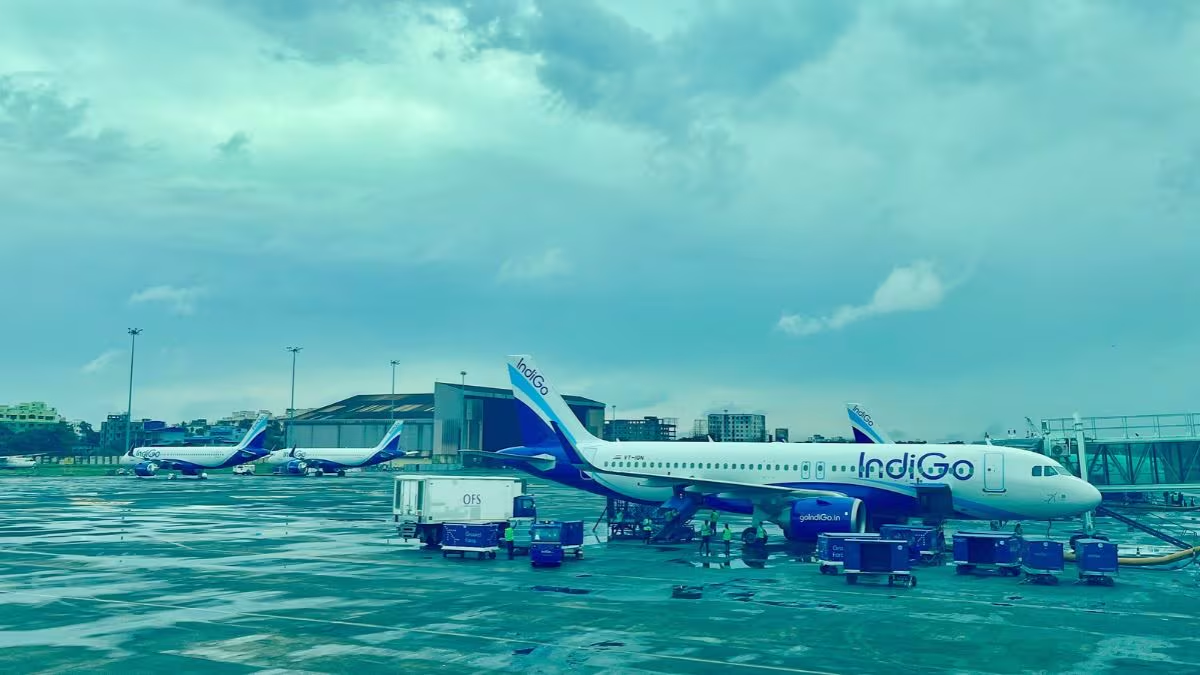
IndiGo’s Q2 FY27 results show improving revenue but continued pressure on airline profitability. The airline’s September-quarter net loss narrowed 27.2% year-on-year to ₹1,878.6 crore, as higher ticket prices and capacity management helped offset rising aviation fuel costs and rupee depreciation.
IndiGo Q2 Results Show Revenue Growth Despite Losses
India’s aviation industry is facing a difficult cost environment, and IndiGo’s latest quarterly results highlight the challenge of maintaining profitability while passenger demand and operating expenses continue to fluctuate.
InterGlobe Aviation, the parent company of IndiGo, reported a consolidated net loss of ₹1,878.6 crore for the second quarter of FY2027, covering July to September 2026. The loss was 27.2% lower than the ₹2,581.7 crore recorded during the corresponding quarter of the previous financial year.
However, the improvement in annual comparisons does not mean the airline has returned to profitability. Its loss widened significantly compared with the ₹237.6 crore loss reported in the June 2026 quarter.
Revenue from operations increased 25.9% year-on-year to ₹23,363.8 crore, compared with ₹18,555.3 crore in Q2 FY2026.
The results indicate that stronger ticket revenue and pricing measures helped the airline manage some of the pressure from higher fuel and operating expenses. However, the overall financial performance remains affected by external cost factors.Company Results – Business Standard+3
Aviation Fuel Costs Rise 67% During September Quarter
Aviation turbine fuel (ATF) is one of the largest operating expenses for airlines. Changes in international crude oil prices, refining costs, currency movements and domestic fuel pricing can directly influence airline profitability.
For IndiGo, fuel expenses increased approximately 67.2% year-on-year to ₹9,966.8 crore during Q2 FY2027, compared with ₹5,962 crore in the same quarter last year.
Fuel accounted for approximately 37.8% of the airline’s total expenses, making it a major factor behind the continued financial pressure.
The increase reflects elevated aviation fuel prices and the impact of geopolitical uncertainty on international energy markets. According to company executives, the Singapore Jet Fuel Index was approximately 60% higher than a year earlier.
The depreciation of the Indian rupee added another layer of pressure. Since aviation fuel and several aviation-related expenses are linked to the US dollar, a weaker rupee increases the amount airlines must spend in domestic currency.
IndiGo’s average rupee-dollar exchange rate weakened to ₹95.09 during the quarter from ₹87.06 in the corresponding period last year, according to Business Standard.
For airlines operating large fleets and extensive domestic and international networks, even relatively small currency movements can translate into substantial additional expenses.Company Results – Business Standard+2
Higher Operating Costs Continue to Affect Airline Profitability
Fuel is not the only expense affecting IndiGo’s financial performance. Airlines also need to manage aircraft leasing, airport charges, employee salaries, maintenance, insurance, ground handling and other operational requirements.
IndiGo’s total expenses increased 18.6% year-on-year to ₹26,188.4 crore during the September quarter, compared with ₹22,081 crore in Q2 FY2026.
The airline’s cost per available seat kilometre (CASK), excluding fuel and foreign exchange effects, increased 14.6% to ₹3.45. CASK is an important aviation industry metric that measures how much an airline spends to operate one seat over one kilometre.
An increase in this figure indicates that operating capacity is becoming more expensive, even after excluding major fuel and currency-related movements.
This creates a difficult situation for low-cost carriers. Their business models depend on controlling expenses while offering competitive ticket prices. When multiple cost components increase simultaneously, airlines have limited room to protect margins without adjusting fares or reducing capacity.
The latest results also show why revenue growth alone cannot provide a complete picture of an airline’s financial health. Although IndiGo reported stronger revenue, its underlying profitability remained under pressure.
Its loss excluding foreign exchange effects stood at ₹723.7 crore, compared with a profit of ₹103.9 crore in the corresponding quarter last year.Company Results – Business Standard+2
How Higher Ticket Prices Are Helping IndiGo Manage Costs
One of the main strategies adopted by IndiGo has been improving passenger yields through pricing adjustments.
Passenger yield refers to the average revenue an airline earns for every passenger kilometre travelled. It helps measure how effectively an airline generates revenue from its available passenger capacity.
During Q2 FY2027, IndiGo’s passenger yield increased 34.3% year-on-year to ₹6.30.
This improvement helped the airline increase revenue despite carrying fewer passengers than in the previous year’s September quarter.
IndiGo carried approximately 27.5 million passengers during the quarter, representing a 4.7% decline year-on-year. Its passenger load factor, which measures the percentage of available seats occupied, declined from 82.5% to 80.3%.
The airline has also increased fuel charges on domestic and international routes as part of its response to rising aviation fuel prices.
However, increasing ticket prices is not a risk-free strategy. If fares become too expensive, price-sensitive travellers may postpone trips, select alternative transport options or choose competing airlines.
This is particularly relevant in India, where a large section of domestic air travellers remains sensitive to ticket prices.
The challenge for IndiGo is to maintain sufficient passenger demand while recovering a reasonable portion of its higher operating expenses through fares and additional revenue streams.
Reuters reported on October 29 that IndiGo considered fare increases necessary in the prevailing fuel-cost environment. Moneycontrol+2
Capacity Management Becomes Important for Indian Airlines
Another strategy airlines can use during periods of high operating costs is capacity management.
Instead of expanding flight operations aggressively, carriers can review routes, adjust schedules and prioritise services that offer better financial returns.
IndiGo reduced its capacity, measured through available seat kilometres (ASK), by approximately 1% year-on-year during Q2 FY2027.
ASK measures the number of seats an airline makes available multiplied by the distance flown. It is commonly used to assess an airline’s operating capacity.
The airline has indicated that it expects low single-digit capacity growth in Q3 FY2027, reflecting a more cautious approach to expansion.
Management has also discussed reviewing individual routes and maintaining a focus on cost discipline.
For the December quarter, IndiGo expects revenue per available seat kilometre to grow by more than 25% year-on-year based on trends observed in October. This metric, known as RASK, measures the revenue generated for every seat kilometre offered.
The festive season and year-end holiday period could support passenger demand. However, stronger seasonal bookings will need to translate into sustainable revenue to offset higher expenses.
Capacity discipline can help airlines avoid operating flights that are commercially unattractive, but excessive reductions can also limit growth and affect network connectivity.Company Results – Business Standard+2
Can Indian Airlines Pass Higher Fuel Costs to Passengers?
The ability to transfer higher operating expenses to customers is one of the biggest questions facing India’s aviation sector.
Airlines generally have several options when fuel prices increase. They can revise ticket prices, introduce or adjust fuel charges, improve operational efficiency, reduce unprofitable capacity and generate additional revenue through services such as baggage, seat selection and onboard sales.
However, the extent to which these measures work depends on market conditions.
India’s domestic aviation market has several competing airlines, and passengers often compare fares before booking. This makes it difficult for individual carriers to increase prices without considering the response from competitors.
The country’s railway network also provides an alternative for passengers travelling between many major cities and smaller destinations.
For Tier-2 and Tier-3 travellers, affordability remains particularly important. A substantial increase in airfares could affect the decision to travel by air, especially for families, students and small business owners.
Airlines therefore need to balance revenue recovery with passenger affordability.
The pressure could also affect travel agents, airport service providers, tourism businesses and companies that depend on regular employee travel.
If operating costs remain elevated, the impact may extend beyond airline balance sheets to the wider travel and hospitality industry.
IndiGo’s Cash Position and Cost-Control Strategy
Despite reporting another quarterly loss, IndiGo has financial resources that could help it manage near-term cost volatility.
Business Standard reported that the airline had free cash of approximately ₹39,929 crore at the end of September 2026. This provides a liquidity cushion while the company manages higher fuel expenses and continues its expansion plans.
The airline is also reviewing parts of its international operations. One significant decision is to end its wide-body aircraft wet-lease arrangement with Norse Atlantic from November 1, 2026.
Under a wet-lease agreement, an airline obtains an aircraft along with its crew and operational support. While this arrangement can help airlines expand capacity without purchasing aircraft immediately, higher fuel prices and currency depreciation can make such operations less attractive.
IndiGo CEO Willie Walsh said the decision was influenced by elevated fuel prices and geopolitical conditions. The airline plans to use the experience gained from these operations as it prepares for its Airbus A350 aircraft, expected to enter service in 2028.
These decisions reflect a broader effort to protect the airline’s existing low-cost domestic business while managing its international expansion carefully.Company Results – Business Standard+1
What IndiGo’s Q2 Results Mean for India’s Aviation Industry
IndiGo’s financial performance is important because of its significant position in India’s domestic aviation market. Its cost-management decisions could offer an indication of how large airlines are responding to the current operating environment.
The wider aviation industry faces several interconnected challenges, including international fuel prices, currency fluctuations, aircraft availability, maintenance expenses and infrastructure costs.
Smaller airlines may find it particularly difficult to absorb these pressures because they generally have fewer financial resources and less flexibility in managing their networks.
For the industry, the ability to maintain reliable operations while controlling expenses will become increasingly important.
There is also a long-term opportunity. India’s expanding middle class, business travel requirements and growing tourism sector provide opportunities for aviation companies. Better airport infrastructure and improved regional connectivity could support passenger growth over time.
However, airlines will need sustainable business models to benefit from this opportunity. Passenger growth must be accompanied by healthy revenue generation, efficient aircraft utilisation and disciplined financial management.
IndiGo’s September-quarter results demonstrate that even a large airline with substantial market presence is not completely protected from global economic pressures.
Can Airlines Manage Rising Fuel and Operating Costs?
Indian airlines can manage rising fuel and operating expenses, but the process requires a combination of pricing discipline, efficient operations and careful financial planning.
IndiGo has demonstrated that higher passenger yields and controlled capacity can help reduce the impact of rising expenses. However, its continued quarterly losses show that these measures are not sufficient to eliminate financial pressure when fuel and currency costs increase sharply.
The airline’s performance in the December quarter will provide a clearer indication of whether its pricing strategy and cost-control measures are producing sustainable improvements.
For India’s aviation industry, the bigger challenge will be maintaining affordable air travel while building financially sustainable operations.
As demand for domestic and international travel continues to evolve, airlines will need to find a balance between expansion, passenger affordability and profitability.
Key Takeaways
- IndiGo’s Q2 FY2027 consolidated net loss narrowed 27.2% year-on-year to ₹1,878.6 crore.
- Aviation fuel expenses increased approximately 67.2% to ₹9,966.8 crore, putting pressure on profitability.
- Passenger yield increased 34.3% to ₹6.30, helping the airline improve revenue despite lower passenger traffic.
- Capacity management, higher fares and operational efficiency will remain important as airlines deal with rising fuel and currency costs.
Frequently Asked Questions (FAQs)
1. What was IndiGo’s Q2 FY2027 net loss?
IndiGo reported a consolidated net loss of ₹1,878.6 crore for the quarter ended September 30, 2026. This was lower than the ₹2,581.7 crore loss reported in the corresponding quarter of the previous financial year.
2. Why did IndiGo report losses despite higher revenue?
The airline faced a sharp increase in aviation fuel expenses, rupee depreciation and higher operating costs. Although revenue increased 25.9%, these expenses continued to affect profitability.
3. How much did IndiGo’s fuel expenses increase in Q2 FY2027?
IndiGo’s fuel expenses increased approximately 67.2% year-on-year to ₹9,966.8 crore during the September 2026 quarter.
4. How can airlines manage rising aviation fuel costs?
Airlines can manage higher fuel costs through fare adjustments, fuel charges, efficient route planning, capacity management, improved aircraft utilisation and tighter control over operating expenses. However, their ability to recover costs depends on passenger demand and competition.









Leave a comment