

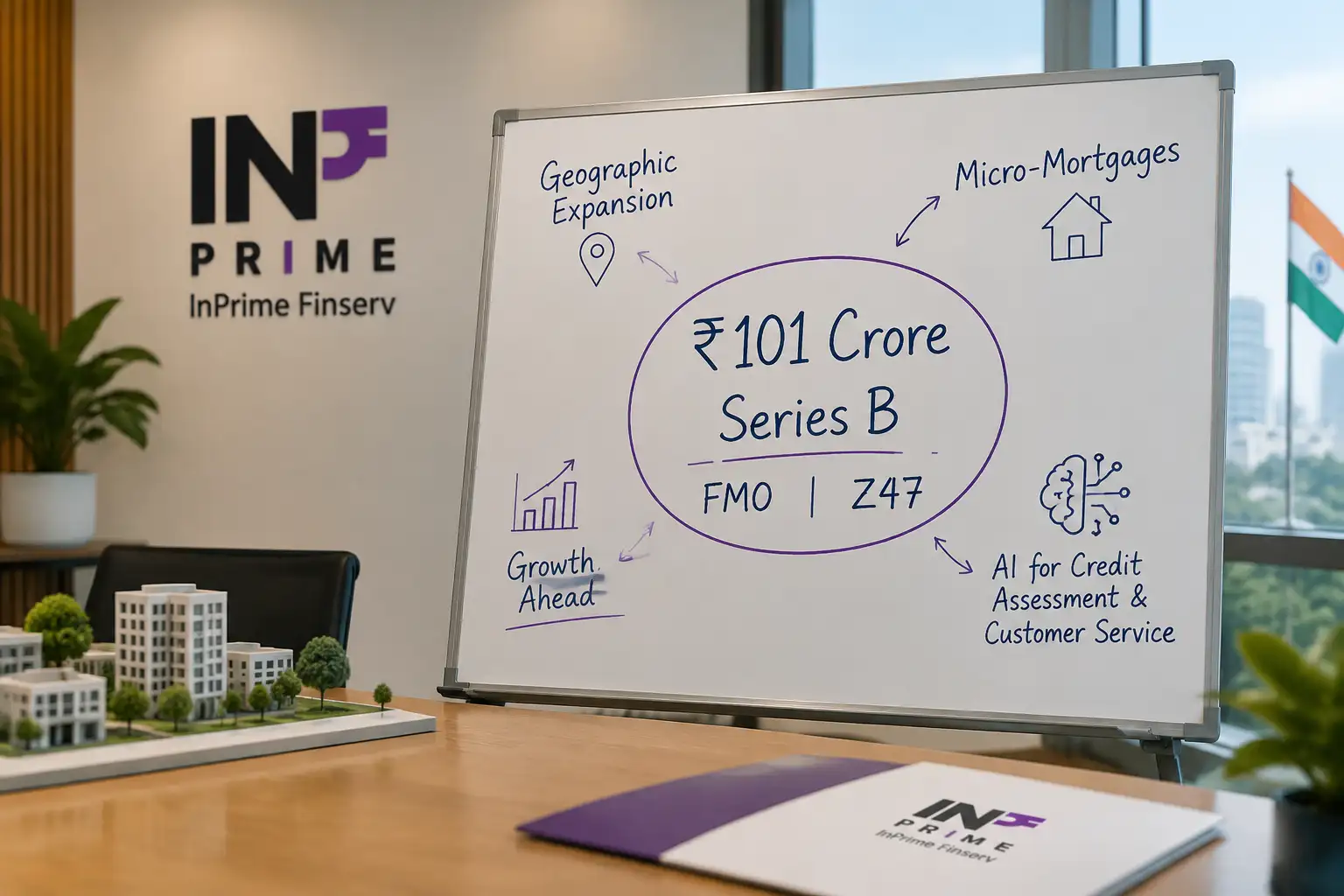
InPrime Finserv has raised ₹101 crore in a Series B funding round led by Dutch development bank FMO. The Bengaluru-based NBFC plans to expand its lending operations, introduce micro-mortgage products and strengthen artificial intelligence capabilities to serve underserved borrowers across India.
InPrime Finserv Raises ₹101 Crore in Series B Funding
Bengaluru-based InPrime Finserv has raised ₹101 crore (approximately $10.7 million) in a Series B funding round, marking another investment in India’s technology-led lending sector. The funding round was led by FMO, the Dutch entrepreneurial development bank, with participation from existing investors Z47, formerly known as Matrix Partners India, and Pravega Ventures.
The latest investment takes InPrime Finserv’s total funding to ₹190 crore. The company plans to use the fresh capital to expand its existing lending products, enter the micro-mortgage segment and increase investments in artificial intelligence (AI).
The funding announcement, made on November 19, 2026, comes as fintech companies explore technology-driven approaches to reach borrowers who often remain outside conventional banking and lending systems.
According to the company, its strategy focuses on combining technology, data-driven credit assessment and local field operations to serve India’s informal economy.The Economic Times+2
Why InPrime Finserv Is Targeting India’s Informal Economy
A significant part of India’s small-business economy operates through informal financial systems. Kirana store owners, dairy farmers, beauty parlour operators, small retailers and independent entrepreneurs often maintain active businesses without having the conventional financial documentation required by traditional lenders.
Many of these individuals receive payments through cash, UPI transactions and cooperative banking channels. Their financial activity may not always be reflected in formal income-tax returns or GST records.
This creates a challenge for conventional credit assessment systems, which frequently depend on documented income, formal employment records, tax filings and established credit histories.
InPrime Finserv calls this customer group the informal prime segment. The term refers to borrowers who may have established businesses, assets and repayment capacity but face difficulties accessing formal credit because their financial profiles do not fit conventional underwriting models.
The company aims to address this gap by examining a broader range of financial information instead of relying exclusively on traditional documentation.
For smaller businesses, access to suitable credit can support inventory purchases, equipment upgrades, business expansion and working capital requirements. However, the availability of loans must also be accompanied by responsible lending practices and repayment capacity assessments.z47.com+1
How AI Technology Is Changing InPrime’s Lending Model
Artificial intelligence is central to InPrime Finserv’s lending strategy. The company uses technology to support credit assessment, customer communication and operational processes.
According to its November 2026 announcement, four in-house AI co-pilots currently support its sourcing, credit and operations teams. These systems are designed to assist employees with different stages of the lending process.
The company has also deployed three agentic AI voice agents that handled more than 126,000 customer calls between April and September 2026.
These developments indicate how AI tools are being integrated into lending operations beyond basic chatbots and automated customer support.
For lenders working with informal borrowers, analysing financial information can involve understanding transaction patterns, cash flows and other records that may not follow standard formats.
AI-assisted systems can help organise and interpret such information, potentially reducing manual work involved in credit assessment. They can also support customer communication in regional languages, an important consideration when serving borrowers across different states.
However, AI does not automatically guarantee accurate lending decisions. Credit assessment still requires appropriate verification, human oversight, data protection and responsible risk management.
The effectiveness of InPrime’s technology will ultimately depend on whether it can maintain lending quality while expanding its customer base.z47.com+2
Micro-Mortgage Loans to Become a New Business Segment
One of the important developments associated with the latest funding is InPrime’s plan to enter the micro-mortgage market.
Micro-mortgage products generally involve smaller property-backed loans designed for borrowers who may not qualify easily for conventional home or mortgage financing.
For small entrepreneurs and self-employed individuals, such products could provide another financing option, depending on their property ownership, documentation and repayment capacity.
InPrime intends to diversify its lending portfolio while continuing to serve customers within the informal economy.
The proposed expansion could help the company address financial requirements beyond its existing credit products. It may also allow borrowers to access financing for longer-term needs.
However, the company has not publicly detailed the proposed micro-mortgage loan amounts, interest rates, repayment periods or eligibility conditions in its funding announcement.
These details will be important in determining how the new product differs from existing mortgage and secured lending offerings.
The expansion also introduces additional responsibilities for the lender, particularly in property valuation, documentation, collateral verification and recovery processes.The Economic Times+1
InPrime Finserv’s Expansion Across Six Indian States
InPrime Finserv’s business model combines digital lending capabilities with a physical presence in the markets it serves.
As of November 2026, the company operated 46 area offices across Karnataka, Uttar Pradesh, Rajasthan, Haryana, Uttarakhand and Madhya Pradesh.
Its geographical presence is significant because borrowers in smaller towns and semi-urban locations may require assistance with documentation, financial verification and loan-related queries.
The company reported serving more than 27,000 households and disbursing approximately ₹517 crore in loans to date.
As of September 30, 2026, its assets under management (AUM) stood at approximately ₹333 crore. Its gross non-performing assets (GNPA) ratio was reported at 0.80%.
AUM represents the outstanding loan portfolio managed by a lender, while GNPA indicates the proportion of gross loans classified as non-performing under applicable norms.
These figures provide an indication of the company’s operating scale and reported portfolio quality. However, they should be viewed alongside future disclosures on profitability, collection efficiency, borrower concentration and loan performance.
For InPrime, expanding its geographical presence while maintaining asset quality will be an important test as it deploys the new capital.z47.com+2
What the Funding Means for India’s Tier-2 and Tier-3 Markets
The latest funding round highlights the growing investor interest in financial services companies targeting borrowers beyond major metropolitan markets.
In smaller Indian cities and towns, many businesses operate through local customer networks, cash transactions and digital payment systems. These businesses may have regular revenue but limited access to formal credit because their financial records do not always meet conventional lending requirements.
Technology-led NBFCs are attempting to address this challenge through alternative data assessment, digital processes and local customer support.
For example, a kirana store owner may receive daily payments through cash and UPI, while a dairy farmer may have recurring income linked to local buyers or cooperative networks. A conventional credit assessment process may not fully capture these income patterns.
Technology-assisted underwriting can potentially help lenders evaluate such borrowers more efficiently.
The expansion of this lending model could have implications for regional entrepreneurship. Access to appropriately priced credit may help small businesses manage working capital, purchase equipment and expand their operations.
At the same time, borrowers must understand interest rates, repayment schedules, processing charges and the consequences of missed payments. Easier access to loans should not translate into excessive borrowing.
The long-term impact of technology-led lending will depend on whether financial institutions can balance wider credit access with affordability and responsible risk management.
What FMO’s Investment Signals About India’s Fintech Lending Sector
FMO’s participation as the lead investor is another notable aspect of the funding announcement.
The Dutch entrepreneurial development bank invests in businesses and initiatives connected to economic development and financial inclusion.
Its investment in InPrime reflects interest in lending models that aim to serve entrepreneurs and households who are often overlooked by traditional financial institutions.
Existing investors Z47 and Pravega Ventures also participated in the latest funding round. Other investors associated with InPrime include Info Edge Ventures, Kettleborough VC and Titan Capital.
The participation of existing investors alongside a new lead investor brings additional institutional backing to the company’s expansion plans.
InPrime was founded in 2021 by Rajat Singh, Sneh Thakur and Manish Raj. The founders previously worked at Ujjivan Small Finance Bank, where they gained experience in lending to customers from underserved segments.
The company began operations in 2023 and has since developed a lending model combining AI, data-led underwriting and local field operations.
Its latest funding round indicates that investors see potential in technology-enabled credit delivery to India’s informal economy. However, the company’s ability to scale sustainably will depend on maintaining portfolio quality, managing operating costs and developing suitable financial products.z47.com+2
Can Technology-Led Lending Improve Financial Inclusion in India?
India’s financial inclusion landscape has expanded through digital payments, banking access and the growth of non-banking financial companies. However, access to affordable formal credit remains a challenge for many small entrepreneurs and self-employed individuals.
Technology-led lenders are attempting to bridge this gap by using digital transaction records, alternative financial information and automated processes to understand borrowers more effectively.
InPrime Finserv’s expansion represents one example of this approach.
Its proposed investments in AI, additional lending products and micro-mortgages could help it serve a wider customer base. Its existing presence across six states also provides a foundation for reaching borrowers outside major financial centres.
Nevertheless, financial inclusion should not be measured only by the number of loans disbursed or households served. Affordability, transparent pricing, repayment capacity and customer protection are equally important.
As the company expands, its performance will offer insights into whether AI-led underwriting can make lending to informal businesses more efficient without increasing credit risks.
The ₹101 crore investment therefore represents more than a funding milestone. It places InPrime among the fintech lenders attempting to build a financial system that better recognises the economic activity of India’s small entrepreneurs and self-employed workforce.
Key Takeaways
- InPrime Finserv raised ₹101 crore in a Series B round led by FMO, taking its total funding to ₹190 crore.
- The company plans to expand existing lending products, introduce micro-mortgages and strengthen its AI capabilities.
- It operates 46 area offices across six states and has served more than 27,000 households.
- Its reported AUM stood at ₹333 crore, with a GNPA ratio of 0.80% as of September 30, 2026.
Frequently Asked Questions
1. How much funding has InPrime Finserv raised in November 2026?
InPrime Finserv raised ₹101 crore, approximately $10.7 million, in a Series B funding round led by FMO. Existing investors Z47 and Pravega Ventures also participated.
2. What will InPrime Finserv do with the ₹101 crore funding?
The company plans to expand its existing lending operations, introduce micro-mortgage products and increase investments in artificial intelligence, including agentic AI and AI co-pilots.
3. Who are InPrime Finserv’s target customers?
The company primarily serves small retailers, kirana store owners, dairy farmers, beauty parlour operators, micro-entrepreneurs and self-employed individuals operating in India’s informal economy.
4. How many households has InPrime Finserv served?
According to company-reported figures, InPrime Finserv has served more than 27,000 households and disbursed approximately ₹517 crore in loans as of November 2026.












Leave a comment