

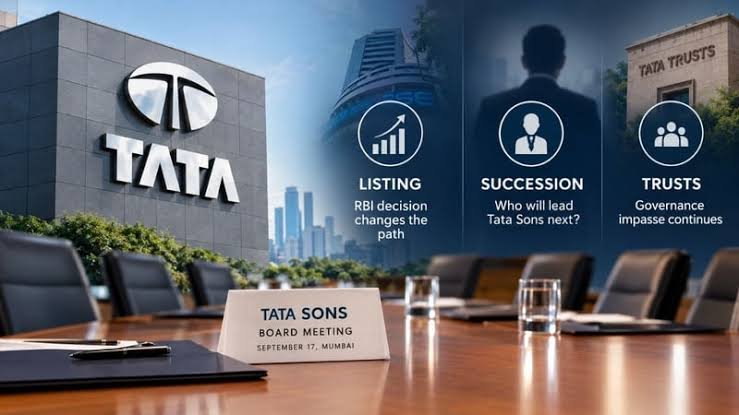
Tata Sons has postponed its November 26 board meeting to November 30 after Tata Trusts chairman Noel Tata raised concerns over the notice period given to directors. The delay comes amid disagreements over the company’s proposed listing, leadership and future governance structure.
Why Was the Tata Sons Board Meeting Postponed?
The Tata Sons board meeting has been rescheduled from November 26 to November 30, 2026, following objections raised by Noel Tata, chairman of Tata Trusts and a nominee director on the Tata Sons board.
According to reports published on November 24, Noel Tata objected to the late circulation of the meeting agenda and supporting documents. The papers were reportedly uploaded on November 22, leaving directors with only four days to examine important matters before the originally scheduled meeting.
Noel argued that directors should receive at least seven days’ notice to review the agenda and supporting information. The requirement is also reflected in Section 173(3) of the Companies Act, 2013, which provides for at least seven days’ written notice for a board meeting, subject to specified exceptions.
The postponement gives directors additional time to examine the proposals before making decisions on issues that could influence the future structure of India’s largest business conglomerates.
The agenda is reportedly unchanged, meaning the November 30 meeting will continue to address the major governance and regulatory questions facing the holding company. Business News+2
Tata Sons and Tata Trusts: Understanding the Governance Structure
To understand the significance of the dispute, it is important to examine the relationship between Tata Sons and Tata Trusts.
Tata Sons is the principal holding company of the Tata Group. It holds stakes in several major businesses operating across automobiles, information technology, steel, hospitality, aviation, telecommunications and consumer products.
Tata Trusts, on the other hand, is the group’s largest shareholder and plays an important role in its ownership and governance structure. The trusts hold a majority stake in Tata Sons, with their shareholding historically linked to the group’s philanthropic activities.
This ownership arrangement has helped the Tata Group maintain a distinctive business model in which commercial operations and philanthropic objectives remain closely connected.
However, the current disagreement highlights the challenges of balancing shareholder interests, regulatory compliance and the group’s traditional governance framework.
Noel Tata, who became chairman of Tata Trusts in October 2024 following the death of Ratan Tata, has emerged as an important voice in discussions about the future direction of the holding company.
The differences between the Tata Sons leadership and Tata Trusts have become increasingly visible during discussions about the proposed listing and leadership decisions. Business News – The Indian Express+2
RBI’s Listing Requirement Puts Tata Sons Under Pressure
One of the most important issues expected to feature in the November 30 meeting is the Reserve Bank of India’s listing requirement.
In 2022, the RBI classified Tata Sons as an upper-layer non-banking financial company (NBFC). This classification brought the company under stricter regulatory requirements applicable to certain large and systemically important financial institutions.
Under the RBI framework, upper-layer NBFCs are generally required to list their shares within the prescribed period. Tata Sons was expected to comply with the listing requirement within three years of its classification.
However, Tata Sons subsequently cleared its debt and applied to surrender its registration as a core investment company, seeking to avoid the requirement associated with its earlier regulatory classification.
The RBI rejected the company’s application in September 2026 and reiterated its position on the listing requirement in November.
This has created an important regulatory challenge for Tata Sons. The company must determine how to comply with the central bank’s position while considering the potential impact of a public listing on its ownership structure.
A listing could introduce greater public-market scrutiny, disclosure obligations and participation from outside investors. It could also change how the holding company manages its long-term capital and shareholder relationships.
The issue is therefore not simply about entering the stock market. It concerns the future ownership and governance model of the Tata Group. Company News – Business Standard+2
Noel Tata’s Alternative Restructuring Proposal
Another important aspect of the disagreement is Noel Tata’s reported proposal to restructure Tata Sons.
According to media reports, Tata Trusts has supported an alternative structure that could potentially change the company’s regulatory position and avoid the need for a public listing.
The proposal reflects a broader concern about how listing Tata Sons could affect the group’s existing ownership model and philanthropic commitments.
Noel Tata has reportedly opposed the proposed listing, arguing for an alternative approach that protects the group’s established structure. The Tata Sons board, meanwhile, has been preparing to address the RBI’s regulatory requirements.
The disagreement raises questions about how a company with a significant philanthropic ownership structure should balance regulatory obligations with the interests of its existing shareholders.
The November 30 meeting is expected to provide an opportunity for directors to discuss these competing approaches. However, the final outcome will depend on the board’s decisions and the applicable regulatory framework.
Importantly, the restructuring proposal should not be treated as an approved plan. It remains part of the ongoing discussions surrounding Tata Sons’ future. Business News – The Indian Express+2
N Chandrasekaran’s Leadership and Boardroom Differences
The leadership of Tata Sons is another major issue connected to the ongoing governance developments.
N Chandrasekaran, who has served as chairman of Tata Sons since 2017, received board approval for another five-year term during the September 17, 2026, meeting.
However, Noel Tata reportedly opposed the reappointment, making the leadership decision another point of disagreement within the board.
The September meeting also brought differences over the proposed listing into focus. According to reports, most directors supported moving ahead with regulatory compliance, while Noel Tata maintained his opposition.
These developments are significant because Tata Sons plays a central role in overseeing the group’s strategic direction and major investments.
The chairman’s position involves coordinating the interests of several businesses operating in different sectors. Decisions made at the holding company level can influence capital allocation, corporate strategy and long-term planning across the group.
For investors and industry observers, the situation highlights the importance of boardroom alignment in large business organisations.
However, the postponement of a board meeting does not automatically indicate a leadership crisis or a change in the chairman’s position. The board’s approved decisions and any subsequent shareholder requirements must be considered separately. Company News – Business Standard+2
Shareholder Meetings Add Another Governance Challenge
Apart from the board meeting, Tata Sons also faces questions regarding its upcoming shareholder meetings.
The company could not hold its annual general meeting (AGM) scheduled for August 2026 because the required quorum was not available.
Under the company’s Articles of Association, the participation of an authorised representative jointly nominated by Sir Ratan Tata Trust and Sir Dorabji Tata Trust is required for the shareholder meeting.
The situation became complicated by issues concerning the Sir Ratan Tata Trust’s representation. As a result, the AGM could not proceed as planned.
The Registrar of Companies subsequently granted Tata Sons an extension to hold its AGM until December 31, 2026.
The November 30 board meeting is also expected to discuss the possibility of convening an extraordinary general meeting (EGM). Such a meeting could address special shareholder matters, including decisions connected with the company’s leadership and proposed listing.
However, organising an EGM will also require attention to shareholder representation, procedural requirements and the company’s governing documents.
This makes the coming weeks particularly important for Tata Sons, as the company works towards meeting its regulatory and corporate governance obligations before the end of the year. Business News+2
What the Dispute Means for the Wider Tata Group
The developments at Tata Sons matter beyond the holding company because of the group’s extensive presence across the Indian economy.
Tata companies operate in industries such as automobiles, steel, information technology, aviation, financial services, consumer products and telecommunications.
A change in the holding company’s ownership or governance structure could have implications for how the group approaches long-term investments, capital allocation and strategic decision-making.
For example, the group’s emerging businesses in electric vehicle batteries, advanced manufacturing and telecommunications require significant capital commitments. Clear decision-making at the holding company level can help provide strategic direction to these businesses.
The proposed listing also has implications for investors. If Tata Sons eventually enters the public market, investors could gain an opportunity to participate directly in the holding company rather than investing only through its listed subsidiaries.
At the same time, a listing would bring additional disclosure requirements and public-market expectations.
For India’s corporate sector, the situation offers a broader example of the challenges faced by large family-influenced and trust-owned business groups when regulatory requirements intersect with established ownership structures.
The outcome could become relevant for other Indian businesses considering changes to their holding-company arrangements.
What Happens Next in the Tata Sons Governance Dispute?
The November 30 board meeting is the next important development to watch.
Directors are expected to discuss the RBI’s listing requirement, the proposed restructuring approach, shareholder meeting arrangements and other corporate matters.
Reports also indicate that the agenda includes discussions concerning the Shapoorji Pallonji Group’s stake in Tata Sons and business reviews involving companies such as Agratas, Tata AIG and Tejas Networks.
The Shapoorji Pallonji Group is a minority shareholder in Tata Sons, making its financial position another important consideration in discussions about the holding company’s capital structure.
However, the board meeting alone may not resolve every outstanding issue. Any major decision involving shareholder approval or regulatory compliance could require additional steps.
For now, the postponement has provided more time for directors to examine the proposals. The larger question remains whether Tata Sons can find a way to meet regulatory expectations while maintaining the governance principles associated with the Tata Group.
Key Takeaways
- Tata Sons has postponed its November 26 board meeting to November 30 after Noel Tata raised concerns about the notice period.
- The RBI’s upper-layer NBFC listing requirement remains a central issue in the company’s regulatory discussions.
- Noel Tata has reportedly supported an alternative restructuring proposal, while the Tata Sons board has been preparing to comply with the RBI’s requirements.
- The company’s AGM, leadership decisions and shareholder representation remain important governance matters ahead of the December 31 deadline.
Frequently Asked Questions
1. Why was the Tata Sons board meeting postponed?
Tata Sons postponed its November 26 meeting to November 30 after Noel Tata objected to the late circulation of the agenda and supporting documents. He sought the required seven-day notice period for directors to examine the matters.
2. Why does the RBI want Tata Sons to go public?
The RBI classified Tata Sons as an upper-layer NBFC in 2022. This classification brought the company under stricter regulatory requirements, including a mandatory listing requirement. The RBI rejected Tata Sons’ application to surrender its registration in September 2026 and reiterated its position in November.
3. What is Noel Tata’s position on the proposed listing?
Noel Tata has reportedly opposed listing Tata Sons and supported an alternative restructuring proposal. His concerns relate to the company’s future ownership and governance structure, including the potential implications for its philanthropic model.
4. When will the Tata Sons board meet next?
The postponed board meeting is scheduled for November 30, 2026. Directors are expected to discuss regulatory compliance, the proposed listing, restructuring options and shareholder-related matters.








Leave a comment