

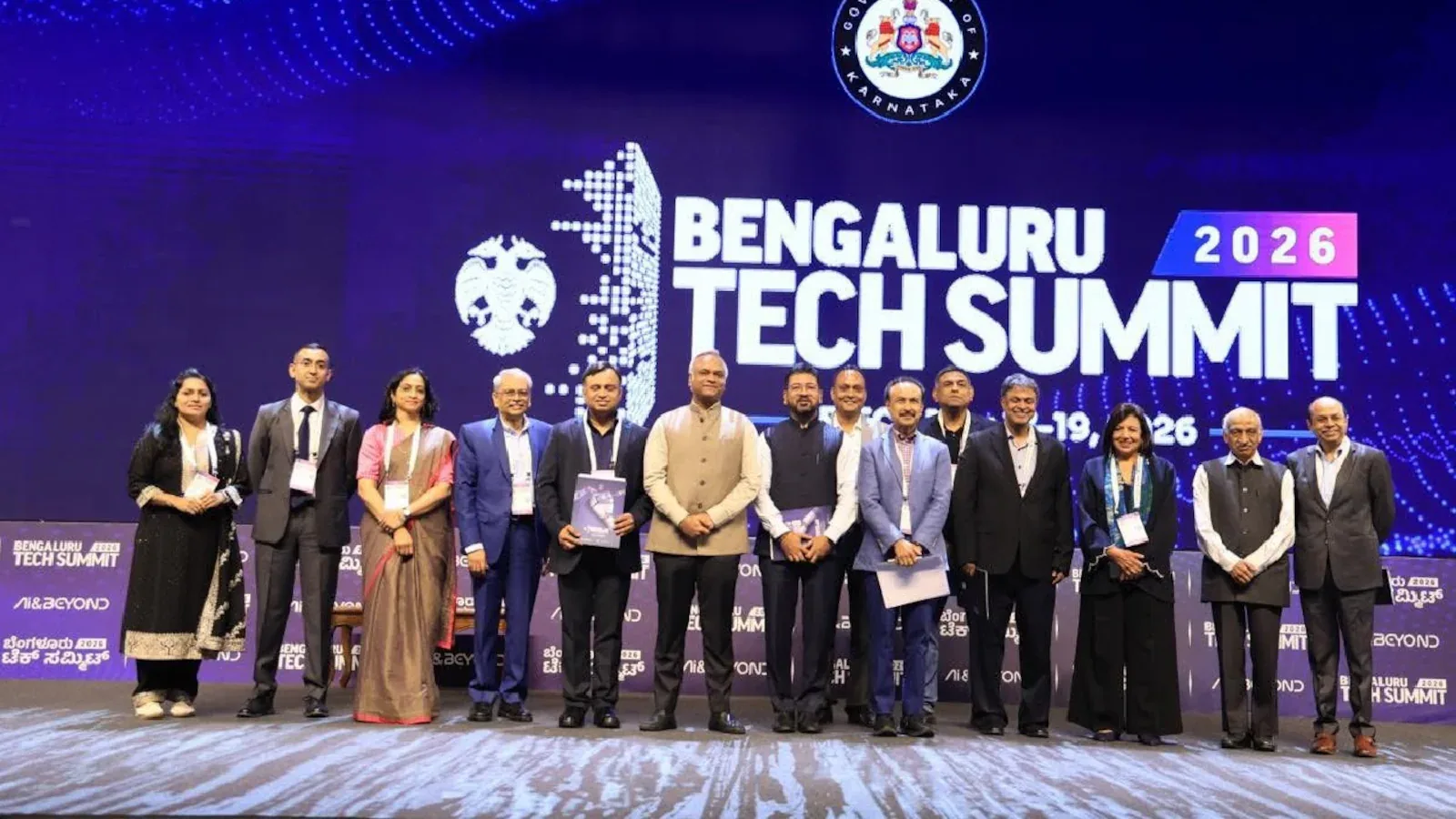
Twenty-four venture capital firms have announced investment commitments worth approximately ₹1,050 crore for Karnataka’s deeptech startups at Bengaluru Tech Summit 2026. The development highlights investor interest in artificial intelligence, robotics, aerospace and biotechnology, while raising questions about opportunities beyond Bengaluru.
24 Venture Capital Firms Announce ₹1,050 Crore Commitments
Karnataka’s deeptech startup ecosystem received a significant investment commitment on November 19, 2026, when 24 venture capital firms announced investments worth approximately ₹1,050 crore at the Future Makers Conclave, held during Bengaluru Tech Summit 2026.
The announcements cover more than 68 startups working across emerging technology sectors, including artificial intelligence (AI), aerospace, defence technology, robotics, biotechnology, semiconductors and industrial automation.
The announcement was made during the concluding day of the three-day Bengaluru Tech Summit. Karnataka IT and Biotechnology Minister Priyank Kharge highlighted the growing participation of private investors in the state’s technology ecosystem.
The latest commitment is considerably higher than the ₹400 crore announced for AI and deeptech startups at the previous year’s Future Makers Conclave.
However, the ₹1,050 crore figure represents announced investment commitments, not necessarily money already transferred to startups. The actual deployment will depend on individual investment arrangements and timelines.
The development is important for Karnataka because deeptech businesses often require longer development cycles, specialised infrastructure and significant capital before their products become commercially viable. Moneycontrol+3
Accel, 3one4 Capital and Gaja Capital Lead Investments
A significant portion of the announced investment commitments comes from three venture capital firms: Accel, 3one4 Capital and Gaja Capital.
According to the investor-wise details reported by The Times of India, the three firms account for approximately ₹749 crore, or around 71% of the total announced amount.
The reported investment commitments include:
| Venture capital firm | Announced investment |
|---|---|
| Accel | ₹321.3 crore |
| 3one4 Capital | ₹228.2 crore |
| Gaja Capital | ₹200 crore |
| Merak Ventures | ₹44 crore |
| Avana Capital | ₹35.95 crore |
| Arali Ventures | ₹30.7 crore |
| Ideaspring Capital | ₹27.5 crore |
| Speciale Invest | ₹24.5 crore |
The remaining commitments involve other participating investors.
Accel’s listed investments include companies such as Ajna Aerospace & Defence, Alt Inc, Chaos Engine Labs and Dreamteam AI.
The 3one4 Capital allocation includes companies such as Sunfox Technology, Neufin, Fernbox and Green Aero. Gaja Capital’s investment is linked to QNu Labs, a company working on quantum-security technology.
The distribution indicates that investors are backing businesses across multiple technology areas rather than concentrating exclusively on conventional software startups.
It also highlights the importance of specialised venture capital funds that understand the technical, regulatory and commercial requirements of emerging industries. The Times of India+2
Why Venture Capital Firms Are Investing in Deeptech
Deeptech startups differ from conventional technology businesses because their products are often based on scientific research, engineering breakthroughs or advanced technological development.
Companies working in artificial intelligence, biotechnology, aerospace, quantum computing and semiconductors may require years of research, testing and product development before generating substantial revenue.
This creates a different funding environment compared with businesses that can launch software products with relatively limited initial infrastructure.
Several factors are contributing to investor interest in deeptech.
Artificial intelligence: Businesses are exploring AI applications across healthcare, manufacturing, finance, education and enterprise operations. Startups developing specialised AI systems and infrastructure are attracting attention.
Aerospace and defence: Demand for indigenous technology, advanced electronics, unmanned systems and defence-related innovation is creating opportunities for Indian companies.
Robotics and automation: Manufacturing companies are exploring automation to improve productivity, reduce operational errors and address labour-intensive processes.
Biotechnology: Startups working on precision fermentation, medical technology, drug discovery and industrial biotechnology are developing solutions for specialised markets.
Semiconductors and quantum technology: India’s efforts to strengthen domestic semiconductor capabilities and advanced computing research are creating opportunities for startups developing specialised products.
For venture capital investors, these sectors offer the possibility of building technology businesses with specialised capabilities and long-term commercial applications. However, they also involve significant technical and financial risks. The Economic Times+2
Karnataka’s ELEVATE Programme Supports Startup Development
The ₹1,050 crore investment announcement also draws attention to Karnataka’s broader efforts to strengthen its startup ecosystem through government-backed programmes.
One of the important initiatives is ELEVATE, a startup funding and mentorship programme designed to support promising early-stage businesses.
The programme marked its 10th anniversary during Future Makers Conclave 2026. According to figures presented at the event, ELEVATE had supported 1,084 startups, including 390 from regions outside Bengaluru.
The programme has committed approximately ₹393.58 crore in grants and helped generate more than 6,500 jobs, according to the event presentation.
Unlike conventional venture capital investment, ELEVATE provides grant-based support that does not require founders to surrender equity. This can be particularly useful for early-stage companies that need financial assistance to develop prototypes, conduct research or validate their products.
The distinction matters for deeptech startups because founders may need substantial capital before they can demonstrate commercial traction.
Government grants can help businesses reach important development milestones and potentially attract private investors later.
At the conclave, founders from ELEVATE-supported companies also discussed how government assistance helped them develop their businesses and build investor confidence.
This combination of public support, private capital and mentorship is an important part of Karnataka’s approach to startup development. The Times of India+3
Can Deeptech Startups Scale Beyond Bengaluru?
Bengaluru has established itself as one of India’s major startup and technology centres. Its technology workforce, research institutions, established companies and investor networks provide advantages to founders building complex businesses.
However, concentrating deeptech development in one city can limit access to opportunities for entrepreneurs in other regions.
Cities such as Mysuru, Hubballi, Mangaluru and Belagavi have opportunities to develop specialised startup ecosystems based on their educational institutions, industrial capabilities and regional business networks.
Beyond Karnataka, cities such as Nagpur, Pune, Ahmedabad, Coimbatore, Indore and Jaipur also have potential to support technology-led businesses.
For example, a startup developing agricultural technology may benefit from access to farming communities and agricultural research institutions. A robotics company may need relationships with manufacturing facilities, while a biotechnology business may depend on laboratory infrastructure and specialised research talent.
These requirements are not necessarily tied to metropolitan startup hubs.
The ELEVATE programme’s reported support for 390 startups outside Bengaluru provides an example of how regional entrepreneurship can form part of a state’s startup strategy.
However, access to funding alone cannot guarantee that deeptech businesses will succeed outside major technology centres.
Founders also need experienced mentors, research facilities, specialised talent, reliable infrastructure and access to customers.
Venture capital firms will need to build stronger connections with regional founders if investment opportunities are to become more geographically distributed.
Challenges Facing Deeptech Startups Outside Major Cities
Despite the growing investment interest, scaling deeptech businesses beyond Bengaluru involves several practical challenges.
1. Limited access to specialised infrastructure
Deeptech companies may require advanced laboratories, testing facilities, manufacturing equipment and computing infrastructure. Such facilities are not equally accessible across Indian cities.
2. Shortage of specialised talent
Startups working in semiconductors, aerospace, biotechnology and robotics require professionals with specialised technical knowledge. Smaller cities may face difficulties attracting and retaining these employees.
3. Longer funding cycles
Deeptech businesses often need multiple rounds of investment before their products become commercially viable. Investors must be prepared for longer development timelines compared with conventional technology ventures.
4. Limited industry connections
Building relationships with manufacturers, research institutions, government departments and large enterprise customers can be difficult for founders operating outside established startup centres.
5. Commercialisation challenges
A technically successful product still needs customers, regulatory approvals where applicable, manufacturing capabilities and a sustainable business model.
Addressing these challenges will be necessary if India’s deeptech ecosystem is to expand beyond its established technology hubs.
What the ₹1,050 Crore Commitment Means for Tier-2 and Tier-3 Cities
The investment announcement has implications for India’s wider startup ecosystem, particularly smaller cities looking to develop technology-driven businesses.
Deeptech innovation does not always require a startup to operate from a major metropolitan location. In some sectors, access to industrial facilities, research institutions, agricultural networks and specialised regional expertise can be equally important.
For example, a robotics startup may find opportunities near manufacturing clusters, while an agricultural technology company may benefit from operating closer to farming communities.
Cities such as Nagpur could explore opportunities in agricultural technology, industrial automation, logistics technology and advanced manufacturing.
Similarly, Coimbatore has an established industrial and engineering base, while Indore has a growing business and educational ecosystem.
However, these opportunities require more than investment announcements. Regional startup ecosystems need incubators, research partnerships, testing facilities, skilled professionals and investors willing to support businesses over longer development periods.
The participation of venture capital firms in Karnataka’s deeptech ecosystem could create a useful reference point for other states seeking to attract private investment into emerging technology sectors.
The key question is whether funding networks and startup support programmes can become accessible to founders outside the largest technology centres.
What Lies Ahead for India’s Deeptech Funding Market?
The ₹1,050 crore announcement at Bengaluru Tech Summit 2026 highlights growing investor participation in India’s deeptech sector.
The involvement of 24 venture capital firms and the coverage of more than 68 startups indicate that investors are exploring opportunities across several advanced technology industries.
However, the long-term impact will depend on how quickly these commitments translate into actual investments, product development, commercial partnerships and revenue generation.
Karnataka’s next challenge will be to strengthen the infrastructure required for deeptech companies to move from research and prototypes to commercial operations.
For other Indian states, the development also highlights the importance of building regional startup ecosystems rather than relying entirely on metropolitan technology centres.
If funding, research facilities and industry partnerships become more accessible, Tier-2 and Tier-3 cities could play a larger role in India’s deeptech growth.
The ₹1,050 crore announcement is an important funding signal. Its real economic impact will become clearer as the investments are deployed and the supported startups begin scaling their businesses.
Key Takeaways
- Twenty-four venture capital firms announced approximately ₹1,050 crore in investment commitments for Karnataka’s deeptech startups.
- The announcements cover more than 68 startups working in AI, aerospace, robotics, biotechnology, semiconductors and defence technology.
- Accel, 3one4 Capital and Gaja Capital account for approximately 71% of the announced investment.
- Karnataka’s ELEVATE programme has supported 1,084 startups, including 390 from outside Bengaluru, highlighting the potential for regional entrepreneurship.
Frequently Asked Questions (FAQs)
1. Why have 24 venture capital firms announced ₹1,050 crore for Karnataka startups?
The commitments were announced at Future Makers Conclave 2026 during Bengaluru Tech Summit. The investments are intended to support deeptech startups working in areas such as AI, aerospace, robotics, biotechnology and advanced engineering.
2. Which venture capital firms announced the largest investments?
Accel announced approximately ₹321.3 crore, followed by 3one4 Capital with ₹228.2 crore and Gaja Capital with ₹200 crore.
3. What is Karnataka’s ELEVATE programme?
ELEVATE is a Karnataka government initiative that provides funding, mentorship and ecosystem support to promising startups. It marked 10 years in 2026 and has supported more than 1,000 startups.
4. Can deeptech startups grow beyond Bengaluru?
Yes. Cities with strong engineering institutions, manufacturing facilities, research centres and specialised talent can support deeptech businesses. However, access to funding, infrastructure, skilled professionals and commercial partnerships remains important.









Leave a comment