

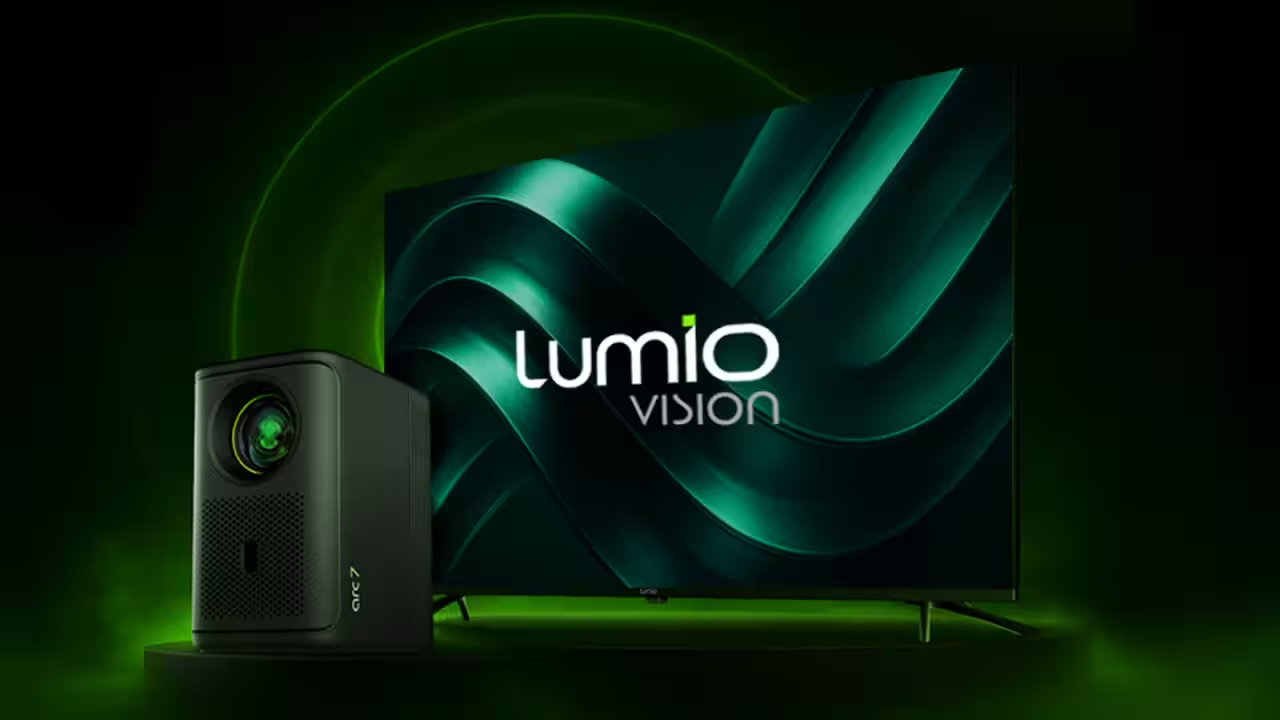
Lumio, the Indian consumer electronics brand operated by Circuit House Technologies, has raised $12 million in Series A funding led by Blume Ventures. The investment will support product research, software development, new categories, after-sales services and wider retail expansion as the company competes with established electronics brands.
Lumio Funding Round Signals Ambitions in Consumer Electronics
Lumio’s $12 million funding round marks a significant development for the young Indian consumer electronics company. Announced on October 7, 2026, the Series A round was led by Blume Ventures, with continued participation from existing investors Stellaris Venture Partners and 3one4 Capital. <Cite refs={[“turn956604search2″,”turn956604search4”]}/>
The Bengaluru-based company operates under Circuit House Technologies and focuses on home entertainment products, including smart televisions, projectors and speakers. It entered the market with its first television range in early 2025 and subsequently expanded its portfolio into additional categories.
The fresh capital is expected to support research and development, product and software improvements, hiring, brand building and stronger after-sales operations. The company also plans to explore new product categories and make its devices available to more consumers through offline retail.
The funding comes as Indian consumers have access to an increasingly broad range of electronics brands. Established manufacturers compete with newer companies offering alternative combinations of specifications, software features, pricing and customer support.
For Lumio, the challenge will be to convert early customer adoption into sustained growth while building the operational capabilities needed to compete across multiple product categories.
How Lumio Is Building Its Smart TV and Home Entertainment Business
Lumio was founded in 2024 by Raghu Reddy, formerly chief business officer at Xiaomi India, and Kailash Sankaranarayanan, a former Flipkart executive. Their experience in consumer technology and e-commerce provides relevant industry knowledge as the company develops its home entertainment business. <Cite refs={[“turn956604search8″,”turn956604search9”]}/>
The brand’s product portfolio includes Vision Smart TVs, Arc projectors and Aura home audio speakers. Rather than focusing exclusively on hardware specifications, Lumio is attempting to combine device performance with software designed to improve how consumers discover and watch content.
This approach addresses a familiar issue with smart televisions. Consumers may purchase devices offering access to multiple streaming platforms, but navigating different applications and deciding what to watch can remain inconvenient.
Lumio has been developing its own content discovery software, including its TLDR platform, which aims to simplify the process of finding movies, television shows and other entertainment.
For a newer consumer electronics company, software can provide a way to differentiate its products beyond screen quality, processor specifications or speaker output. However, its effectiveness will depend on the quality of the user experience, compatibility with services and the company’s ability to keep its software updated.
What the $12 Million Investment Will Finance
The funding is intended to support several areas of Lumio’s expansion, rather than a single product launch.
Research and development is one of the main priorities. Consumer electronics companies must continually improve hardware, software and reliability to remain competitive. Product development also requires testing, supplier coordination and investment in engineering talent.
Lumio plans to explore additional product categories while strengthening its existing television, projector and audio businesses. Entering new categories can expand a company’s addressable market, but it also increases the complexity of product design, inventory management and customer support.
The company also intends to strengthen after-sales services. This is particularly important in electronics, where buyers expect warranty support, repairs and access to replacement parts after a purchase.
Brand building and offline retail expansion are other stated priorities. Physical locations can allow potential customers to examine picture quality, test sound output and compare products before making a purchase.
The funding will therefore support both product development and the infrastructure needed to serve a wider customer base. The eventual impact will depend on how effectively the company allocates capital across these priorities.
Lumio’s Early Growth and Customer Adoption
Lumio has reported encouraging early commercial traction. According to company figures reported by FoneArena and Inc42, the brand crossed ₹100 crore in gross merchandise value within 13 months of commercial sales. It also reported a threefold year-on-year increase in GMV between April and August 2026. <Cite refs={[“turn956604search4″,”turn956604search10”]}/>
Gross merchandise value, or GMV, represents the total value of goods sold through a business over a particular period, subject to the company’s calculation methodology. It is not the same as recognised revenue, gross profit or net profit.
The company has also said that its products are present in more than 35,000 households across India. Its reported reach extends across more than 5,000 postal codes, suggesting that demand is not confined to a single city. <Cite refs={[“turn956604search4″,”turn956604search14”]}/>
These figures provide an indication of early market acceptance, but they do not independently establish long-term profitability or customer retention. Investors will need to assess future revenue, margins, repeat purchases and service costs to understand whether this growth can be sustained.
For Lumio, the next challenge is to build on its initial customer base without allowing expansion costs to outpace business performance.
Why India’s Consumer Electronics Market Attracts Startups
India’s consumer electronics market offers opportunities for companies that understand changing household preferences. Smart televisions, streaming devices, projectors and connected audio systems have become part of the broader home entertainment market.
Consumers increasingly compare products through online reviews, specifications, demonstrations and user feedback. This gives newer brands opportunities to reach customers who may be willing to consider alternatives to established manufacturers.
However, competition remains demanding. Large electronics companies have established distribution networks, recognised brands, supplier relationships and service infrastructure. These advantages can make it difficult for newcomers to build trust and maintain consistent product availability.
A startup must also account for price sensitivity. Buyers may be interested in premium features but still expect products to deliver value for money. A lower purchase price alone may not be enough if the device offers an inconsistent user experience or limited service support.
For brands such as Lumio, differentiation must extend beyond advertising. Product reliability, software performance, transparent warranty terms and convenient repairs can influence whether customers recommend a product or purchase from the same brand again.
The ability to balance these factors will help determine whether a young electronics company can develop into a lasting consumer brand.
Offline Retail and After-Sales Support Could Shape Lumio’s Next Phase
Lumio’s planned expansion into offline retail reflects a practical challenge in selling consumer electronics online. Product listings can explain specifications, but they cannot fully reproduce the experience of viewing a television in a showroom or comparing the sound of different speakers.
Physical retail touchpoints may help the company reach customers who prefer to evaluate products before buying them. They could also improve brand visibility among households that are less familiar with newer electronics companies.
The approach carries costs, including retail partnerships, demonstration units, staffing and inventory management. The company will need to determine where physical availability can generate sufficient sales to justify these expenses.
After-sales support presents a similar challenge. As sales grow across more cities and postal codes, service coverage must expand accordingly. Delays in repairs or difficulty obtaining replacement parts can damage customer confidence even when the original product meets expectations.
This is especially relevant for buyers in Tier-2 and Tier-3 cities, where the convenience of local service can influence purchasing decisions.
If Lumio can combine competitive products with dependable support, offline expansion may help it build credibility beyond its early online customer base.
What Lumio’s Funding Means for India’s Startup Ecosystem
Lumio’s Series A round highlights investor interest in Indian consumer businesses that combine physical products with technology and software. The investment also illustrates that startup opportunities extend beyond fintech, enterprise software and artificial intelligence.
Consumer hardware companies generally face different challenges from software businesses. They must manage product development, manufacturing relationships, inventory, logistics, returns and warranty obligations. These activities can require substantial capital before a company reaches consistent profitability.
Investors therefore need to evaluate more than headline sales figures. Product margins, inventory turnover, customer acquisition costs and the cost of maintaining service networks can all influence the financial performance of a hardware startup.
For other Indian founders, Lumio’s expansion offers a useful example of how a company can build around a defined consumer need and then broaden its product range. Yet expanding into additional categories is most effective when the company has the operational capacity to maintain quality and service standards.
The funding does not guarantee that Lumio will displace established electronics brands. It gives the company additional resources to pursue its plans, while placing greater importance on execution.
Over the coming months, its product launches, retail availability, customer feedback and financial performance will offer clearer evidence of whether the strategy is working.
Key Takeaways
- Lumio raised $12 million in a Series A funding round led by Blume Ventures, with existing investors Stellaris Venture Partners and 3one4 Capital participating.
- The company plans to invest in research and development, software, new product categories, hiring, branding and after-sales support.
- Lumio has reported crossing ₹100 crore in GMV within 13 months of commercial sales, alongside expansion across more than 35,000 households.
- Its long-term growth will depend on product quality, competitive pricing, reliable service and the ability to scale operations efficiently.
Frequently Asked Questions
1. How much funding has Lumio raised in 2026?
Lumio raised $12 million in a Series A round announced on October 7, 2026. Blume Ventures led the round, while Stellaris Venture Partners and 3one4 Capital participated as existing investors.
2. What products does Lumio manufacture or sell?
Lumio’s home entertainment portfolio includes Vision Smart TVs, Arc projectors and Aura speakers. The company is also developing software intended to improve content discovery and the overall viewing experience.
3. How will Lumio use its new funding?
The company plans to use the capital for research and development, product and software improvements, new categories, hiring, brand building, offline retail expansion and stronger after-sales support.
4. What challenges could Lumio face as it expands?
Lumio will need to compete with established electronics brands, maintain product quality, manage inventory and operating costs, and build reliable service coverage. Its ability to sustain customer demand while improving financial performance will be important to its long-term prospects.









Leave a comment