

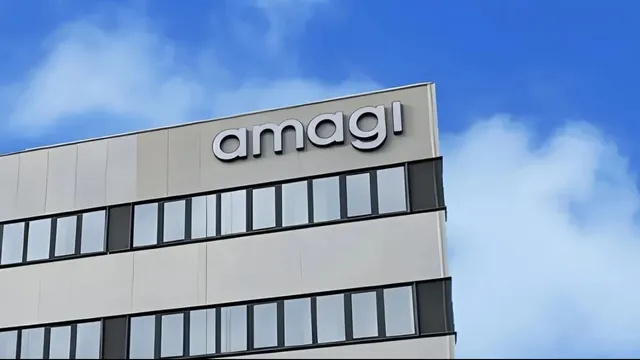
Amagi Media Labs is in focus after 1.05 crore shares, representing about 4.85% of the company’s equity, changed hands in a ₹587 crore block deal on August 21. The transaction comes alongside strong Q1 FY27 results and growing interest in media technology.
Amagi Media Labs block deal draws market attention
Amagi Media Labs shares were among the stocks in focus on August 21 after a large block transaction involving the newly listed media technology company.
Around 1.05 crore shares, equivalent to approximately 4.85% of the company’s equity, changed hands at ₹560 per share in a transaction valued at about ₹587 crore, according to Moneycontrol. The stock gained around 5% after the deal was reported, while separate market coverage showed it rising more than 7% during morning trading.
The transaction followed reports on August 20 that existing investors including Trudy Holdings, AVP I Fund and Accel were looking to sell up to around 5% of Amagi’s equity through a block deal of approximately ₹600 crore. The reported offer price at that stage was ₹550 per share.
The final reported transaction at ₹560 per share was therefore higher than the initially reported floor price.
Existing investors are selling their stake
A key point about the transaction is that it is a secondary share sale rather than a fresh fundraise by Amagi Media Labs.
In a secondary block deal, existing shareholders sell their shares to other investors. The proceeds generally go to the selling shareholders rather than directly into the company’s balance sheet.
The reported sellers include Trudy Holdings, AVP I Fund and Accel. NDTV Profit had reported that the sellers would be subject to a 90-day lock-in period for any further sale, with Kotak acting as the broker for the transaction.
For investors, a large block deal can affect short-term trading volumes and market sentiment. It can also increase the amount of shares available for trading.
However, the sale itself should not be treated as evidence of either improving or weakening business fundamentals. The financial performance of Amagi and the reasons individual shareholders choose to sell remain separate issues.
Amagi’s strong Q1 FY27 results provide context
The block deal comes just days after Amagi reported its financial results for the quarter ended June 30, 2026.
The company reported its highest-ever quarterly revenue of ₹437 crore, representing 32.4% year-on-year growth. Adjusted EBITDA increased 201% to ₹50 crore, while profit after tax rose 760% to ₹34 crore from ₹4 crore in Q1 FY26.
Amagi also reported cash, investments and bank balances of ₹1,616 crore at the end of June, while stating that it had zero debt. The company attributed revenue growth to existing customers expanding their use of its platform and continued adoption of cloud-based streaming, monetisation and broadcast workflows.
These numbers are important because the block deal is occurring against a backdrop of strong recent operating performance.
At the same time, one quarter does not establish a long-term trend. Investors will need to track whether Amagi can maintain revenue growth, expand margins and convert its growing business into sustainable cash generation.
Media technology is moving towards the cloud
Amagi operates in a media technology segment that has changed significantly as broadcasters and content companies have moved away from traditional infrastructure.
The company describes itself as a cloud-native SaaS platform serving the global media and entertainment industry. Its technology allows media companies to launch, manage, distribute and monetise live, linear and on-demand content across cable, OTT and FAST platforms.
This model addresses a practical challenge for broadcasters.
Media companies increasingly need to distribute the same content across television, streaming platforms, connected TVs and digital channels. Managing those workflows through traditional infrastructure can require significant hardware and operational resources.
Cloud-based platforms can give broadcasters more flexibility in managing content and distribution.
The growth of FAST channels, or free ad-supported streaming television, has added another layer to this demand. Media companies can launch digital channels and distribute them across multiple platforms, creating technology requirements around scheduling, distribution, advertising and monetisation.
AI is becoming another growth opportunity
Artificial intelligence is also becoming increasingly important to Amagi’s business.
The company said in its Q1 FY27 results that a major US news network selected its NEWSPULSE product for AI-led newsroom transformation. Amagi also reported more than 10 active AI pilots with news organisations globally.
The development illustrates how AI is moving beyond experimental use within media companies.
Newsrooms can explore AI for areas such as content workflows, production assistance, distribution and operational processes. Broadcasters can also use technology to manage large volumes of content more efficiently.
For media technology companies, this creates an opportunity to sell AI-enabled services alongside existing cloud infrastructure.
But the commercial opportunity still needs to be proven at scale. An AI pilot does not automatically become a large recurring contract, and media companies will increasingly assess whether AI products deliver measurable improvements in cost, speed, productivity or revenue.
Amagi has built a global customer base
Although Amagi is an Indian company, its business is heavily international.
The company works with broadcasters, content owners and streaming platforms across global markets. Its Q1 FY27 update highlighted several international developments, including the operation of 104 FIFA World Cup 2026 matches and more than 300 hours of live programming across three global regions.
It also reported a major US news network moving broadcast operations to Amagi and two major US television networks selecting the platform for FAST channel mandates.
This international exposure matters because the media technology market is not restricted to India’s television industry.
At the same time, Amagi’s growth prospects depend on its ability to continue winning customers, expand existing accounts and maintain strong execution as the company operates at a larger scale.
Why the deal matters for India’s media-tech sector
The block transaction puts attention not only on Amagi but also on India’s growing media-tech ecosystem.
Indian media companies are dealing with a fragmented distribution environment. Consumers now move between traditional television, OTT platforms, connected TVs, social media and other digital channels.
This fragmentation increases the importance of technology that can help media companies manage content across multiple platforms.
For businesses in the sector, the opportunity extends beyond streaming. Cloud infrastructure, content management, advertising technology, analytics, AI and monetisation tools are becoming increasingly connected.
Amagi’s business sits at this intersection.
The company is therefore an example of how an Indian technology business can build a global offering around a specialised industry problem rather than competing solely in broad consumer technology categories.
What the transaction means for investors
The immediate market response shows that investors are closely watching Amagi after its listing.
The company became publicly traded in January 2026. Its IPO included both a fresh issue and an offer for sale, giving public-market investors access to the company while allowing existing shareholders to partially monetise their holdings.
The August 21 block deal represents another significant change in the company’s shareholder base.
For investors evaluating the stock, however, the more important questions extend beyond the transaction itself.
They include whether Amagi can sustain its 30% plus revenue growth, whether profitability can continue improving, how quickly AI products turn into revenue and whether international customer expansion remains strong.
The company will also need to manage the costs associated with scaling its technology platform while continuing to invest in product development.
India’s media-tech market is becoming more technology intensive
The broader media industry is undergoing a structural shift.
Television remains important in India, but streaming, connected TV and digital video have created new ways for audiences to consume content. Advertising is also becoming more data-driven as brands seek better measurement and targeted distribution.
This creates demand for technology companies that can connect content distribution with monetisation.
AI could accelerate the transition further. Media companies are increasingly looking at ways to automate workflows, improve content operations and create new revenue opportunities.
For Tier-2 and Tier-3 audiences, this transition is also relevant. Regional-language programming and digital video consumption are expanding the addressable audience for broadcasters and content companies outside India’s largest cities.
As media consumption becomes more fragmented, technology platforms that help companies reach audiences across different channels could become increasingly important.
What comes next for Amagi Media Labs
The ₹587 crore block deal is significant in size, but its long-term importance will depend on what happens after the transaction.
The company enters this phase with strong Q1 FY27 operating numbers, a growing focus on AI and a business model built around cloud-based media infrastructure.
Its recent results show that customer expansion and cloud adoption are supporting revenue growth. The company also has substantial cash and no debt according to its Q1 FY27 disclosure.
However, investors will need to watch the sustainability of growth, the commercial performance of AI products and the company’s ability to expand its international customer base.
The block deal itself is best viewed as a shareholder transaction rather than a fresh investment into Amagi.
What makes it noteworthy for India’s media-tech sector is the combination of significant investor activity, strong recent financial performance and the broader shift towards cloud, streaming and AI in global media.
Key Takeaways
- About 1.05 crore Amagi Media Labs shares, representing 4.85% of equity, changed hands for around ₹587 crore on August 21.
- The reported sellers included Trudy Holdings, AVP I Fund and Accel, making the transaction a secondary share sale rather than a fresh fundraise.
- Amagi reported Q1 FY27 revenue of ₹437 crore, up 32.4% year on year, while PAT rose 760% to ₹34 crore.
- Cloud media infrastructure, streaming, FAST channels and AI are becoming increasingly important parts of the company’s growth strategy.
FAQ
What happened in the Amagi Media Labs block deal?
Around 1.05 crore shares, representing approximately 4.85% of Amagi Media Labs’ equity, changed hands at ₹560 per share in a block transaction valued at about ₹587 crore on August 21, 2026.
Is the Amagi block deal a fresh funding round?
No. The transaction involves existing shareholders selling their shares. The proceeds therefore go to the sellers rather than directly to Amagi as fresh capital.
How did Amagi perform in Q1 FY27?
Amagi reported revenue of ₹437 crore, up 32.4% year on year. Adjusted EBITDA rose 201% to ₹50 crore and profit after tax increased to ₹34 crore from ₹4 crore in Q1 FY26.
Why is Amagi important to India’s media-tech sector?
Amagi provides cloud-based technology for media companies across broadcast, streaming and FAST environments. Its growing focus on AI-enabled workflows also places it within the wider transition towards cloud and AI-driven media operations.
(Internal keywords: Amagi Media Labs block deal, Amagi shares August 21 2026, Amagi ₹587 crore block deal, Amagi Media Labs latest news, Amagi Q1 FY27 results, India media-tech sector, media technology companies India, cloud media technology, AI media technology, FAST channels India, Amagi investors, Indian media-tech industry)










Leave a comment