

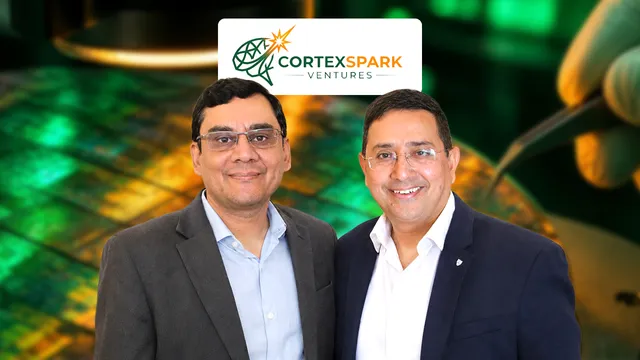
CortexSpark Ventures has launched Viksit Bharat Fund-I, a ₹1,000 crore fund targeting Indian deeptech and artificial intelligence startups. Founded by former Infosys executives, the venture firm plans to invest in around 20 companies developing proprietary technologies across six strategic sectors.
CortexSpark Ventures Launches Viksit Bharat Fund-I
CortexSpark Ventures entered India’s venture capital market on November 24, 2026, with the launch of its debut fund, Viksit Bharat Fund-I. The fund has a target corpus of ₹1,000 crore and an additional ₹400 crore greenshoe option, which could take its potential size to ₹1,400 crore.
The fund is registered with the Securities and Exchange Board of India (SEBI) as a Category II Alternative Investment Fund (AIF) under the name CortexSpark Ventures Alpha Fund.
The firm plans to invest in approximately 20 startups, with an average investment of $4 million to $5 million per company, according to reports.
An important distinction is that ₹1,000 crore represents the fund’s target corpus, not money already raised or deployed. The additional greenshoe option provides scope to increase the fund size if investor demand supports it. Inc42 Media+2
Who Founded CortexSpark Ventures?
CortexSpark Ventures was founded by former Infosys executives Vinay Peshwa and Sanjay Khanduri.
Vinay Peshwa has nearly three decades of experience in software, banking technology and startup investing. He was involved in the development of Infosys Finacle, the banking technology platform, and has made more than 30 angel investments, primarily in AI and deeptech companies.
Sanjay Khanduri has experience across global capital markets and alternative investments. His professional background includes roles at Citigroup, Infosys and Standard Chartered Bank. He holds degrees from IIT (BHU) and IIM Lucknow, along with an MBA from the Wharton School.
The investment committee will be chaired by Manoj Kohli, former country head of SoftBank Group in India and former CEO and managing director of Bharti Airtel.
The fund’s advisory committee includes N. Vedachalam, former director of ISRO’s Liquid Propulsion Systems Centre, and Ashutosh Sharma, former secretary of the Department of Science and Technology. Their presence brings experience from technology, scientific research and large-scale business operations. Inc42 Media+2
Six Deeptech Sectors the Fund Plans to Support
CortexSpark intends to invest in startups developing proprietary technology across six sectors.
- Space technology: Satellite systems, space-based applications and technologies supporting India’s commercial space ecosystem.
- Defence technology: Indigenous technologies for defence applications, including specialised hardware and advanced systems.
- Embodied AI and robotics: Artificial intelligence integrated with physical machines, robots and autonomous systems.
- Enterprise AI: AI technologies designed to address complex business and industrial requirements.
- Medtech and bio-AI: Medical technologies and artificial intelligence applications in healthcare and biological research.
- Energy and advanced materials: Technologies that can support energy systems, industrial applications and new material development.
The common investment theme is original intellectual property rather than businesses built mainly around existing technologies.
The firm says it will prioritise startups with defensible IP, strong technical foundations, experienced founders and clear commercialisation plans. This approach is relevant because deeptech companies often need to prove that their technology works before they can establish a scalable business model. Inc42 Media+2
Why India’s Deeptech Startups Need Long-Term Capital
Deeptech companies differ from many consumer internet and software startups because their products often depend on scientific research, engineering breakthroughs and specialised hardware.
A software company may be able to launch a product and test customer demand relatively quickly. A startup developing a satellite component, medical device, advanced material or industrial robot may need years of research, prototyping, testing and regulatory approvals before reaching commercial scale.
This creates a funding challenge. Such businesses can require substantial investment before generating meaningful revenue. They also face technical risks that are difficult to assess through conventional startup metrics such as user growth or customer acquisition costs.
CortexSpark’s focus on proprietary technology and commercialisation addresses this gap. Its planned investments of $4 million to $5 million per company could provide meaningful capital for startups moving from research and development towards product validation and market entry.
However, the fund’s actual impact will depend on how much capital it raises, when it reaches its first close and which companies it eventually backs. Inc42 Media+2
India’s Deeptech Funding Market Is Drawing Investor Interest
The launch comes amid rising investor interest in India’s deeptech ecosystem. According to Inc42’s Indian Tech Startup Funding Report for the third quarter of 2026, deeptech startups raised approximately $290 million across 28 deals. This was a 176% increase compared with $105 million across 29 deals in the same quarter of the previous year.
The increase suggests that investors are paying greater attention to businesses developing advanced technologies. However, quarterly funding figures can fluctuate depending on the size and timing of individual transactions. They should not be interpreted as evidence that every deeptech segment is experiencing equal growth.
Other investment initiatives have also emerged. Oister Global launched a ₹600 crore growth-stage deeptech fund, while IIT Madras Research Park and Unicorn India Ventures have introduced a fund focused on early-stage deeptech companies.
These developments indicate that India’s investment ecosystem is gradually building specialised pools of capital for technology businesses with longer development cycles. Inc42 Media+2
CortexSpark’s AI-Based Investment Approach
Alongside its investment strategy, CortexSpark is developing an AI-enabled fund management platform called CortexSpark OS.
The platform is intended to support deal sourcing, startup screening, due diligence and portfolio monitoring. These processes involve collecting and evaluating information about companies, their technology, market opportunities and business performance.
For a fund covering six technically different sectors, an AI-enabled platform could help organise large volumes of information and support the initial evaluation of investment opportunities.
However, deeptech investment decisions require more than automated analysis. Investors must understand whether a technology is technically viable, whether its intellectual property offers a meaningful advantage and whether customers have a commercial reason to adopt it.
CortexSpark says it intends to combine AI-enabled processes with scientific evaluation, commercial due diligence and human judgement. The investment committee will retain responsibility for investment decisions.
The firm also plans to provide portfolio companies with support beyond funding, including product development, hiring, business development, access to enterprise customers and connections with international markets and follow-on investors. Entrackr+2
Can India Build More Global Technology Leaders?
India has developed a large technology services industry, but building globally competitive product companies based on original research remains a different challenge.
Deeptech businesses can create valuable intellectual property in areas such as semiconductor design, robotics, defence systems, medical technology and advanced materials. These technologies can serve global markets, but startups need access to specialised talent, testing facilities, manufacturing partners and patient capital.
For example, a robotics startup may develop a promising prototype but still need funding to test it in industrial environments and establish reliable production. A medtech company may need clinical validation and regulatory approvals before commercialisation. Similarly, a space technology startup must demonstrate that its hardware can operate under demanding conditions.
Investment funds can help bridge part of this gap by supporting companies through these stages. But capital alone cannot guarantee success. Startups also need experienced management, research partnerships, customers and access to infrastructure.
CortexSpark’s planned focus on technical depth and commercialisation reflects these requirements. Its ability to help portfolio companies move from laboratory development to paying customers will be an important measure of the fund’s effectiveness.
Challenges That Could Affect the Fund’s Performance
Despite the opportunity, investing in deeptech carries risks that differ from those associated with conventional software businesses.
Long development timelines: Some technologies require several years of research, testing and validation before they are ready for commercial use.
High capital requirements: Hardware development, specialised equipment, manufacturing and testing can require significant investment beyond the initial funding round.
Commercialisation risks: A technically successful product may still struggle to find customers at a price that supports a sustainable business.
Talent and infrastructure gaps: Deeptech companies need specialised engineers, scientists and access to advanced research facilities. These resources are not equally available across all locations.
Global competition: Indian startups must compete with established international companies that may have larger research budgets, stronger supply chains and long-standing customer relationships.
For CortexSpark, selecting companies that can overcome these challenges will be as important as raising the targeted fund corpus. The quality of its investment decisions and the performance of its portfolio will determine whether it can generate long-term returns for investors.
What to Watch Next
The next important milestone for CortexSpark Ventures will be the progress of Viksit Bharat Fund-I towards its first close. The firm has announced its target corpus and investment strategy, but it has not publicly disclosed a completed ₹1,000 crore fundraise or named its first portfolio companies.
The startup ecosystem will also watch which sectors receive the initial investments and whether the fund supports early-stage research-led businesses or companies closer to commercialisation.
Its planned average investment size of $4 million to $5 million suggests that the firm intends to make meaningful commitments rather than spread capital across a very large number of startups.
If the fund reaches its target and successfully backs technology businesses with commercial potential, it could become an important source of domestic venture capital for India’s deeptech ecosystem.
For now, the launch represents a new investment opportunity for founders working on proprietary technologies. The larger test will be whether this capital helps convert Indian research and engineering capabilities into globally competitive products.
Key Takeaways
- CortexSpark Ventures has launched Viksit Bharat Fund-I with a target corpus of ₹1,000 crore and an additional ₹400 crore greenshoe option.
- The fund plans to invest in around 20 startups across six sectors, including space technology, defence, robotics, enterprise AI, medtech and advanced materials.
- Former Infosys executives Vinay Peshwa and Sanjay Khanduri founded the venture firm, with Manoj Kohli chairing its investment committee.
- The fund’s impact will depend on its fundraising progress, investment selection and ability to help deeptech startups commercialise their technologies.
Frequently Asked Questions
1. What is CortexSpark Ventures’ new ₹1,000 crore fund?
It is Viksit Bharat Fund-I, a SEBI-registered Category II Alternative Investment Fund targeting ₹1,000 crore to invest in Indian deeptech and AI startups. It also has a ₹400 crore greenshoe option.
2. Which sectors will CortexSpark Ventures invest in?
The fund will focus on space technology, defence technology, embodied AI and robotics, enterprise AI, medtech and bio-AI, and energy and advanced materials.
3. Who founded CortexSpark Ventures?
The firm was founded by former Infosys executives Vinay Peshwa and Sanjay Khanduri. Its investment committee is chaired by Manoj Kohli, former CEO and managing director of Bharti Airtel.
4. Has CortexSpark already raised ₹1,000 crore?
No completed fundraise of ₹1,000 crore has been announced. This is the target corpus of Viksit Bharat Fund-I, with an additional ₹400 crore greenshoe option.











Leave a comment