

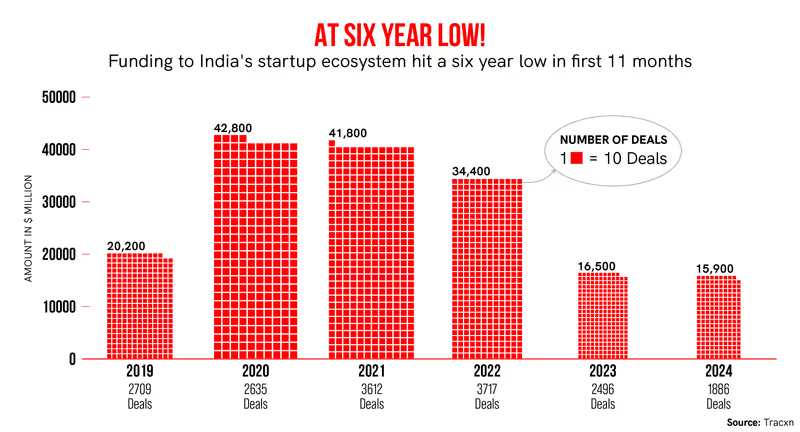
Early stage funding slowdown is becoming a defining trend in 2026 even as startup activity continues to grow across India. The gap between new startup creation and available capital is widening, reflecting a shift in investor behavior and market conditions.
Early Stage Funding Slowdown Reflects Investor Caution
Early stage funding slowdown is closely linked to changing investor sentiment in India’s startup ecosystem. While more founders are launching startups than ever before, investors are becoming increasingly selective about where they deploy capital.
Over the past few years, easy liquidity and aggressive valuations encouraged rapid funding across early stages. However, the current environment is marked by caution. Investors are now prioritizing capital preservation and risk management over rapid deal-making.
This has led to fewer early-stage deals being closed, even though the number of startup pitches and new ventures has increased. The result is a more competitive funding landscape for founders seeking seed and pre-seed capital.
Venture Capital Trends Show Shift Toward Quality
Venture capital trends in India indicate a clear shift from quantity to quality. Investors are focusing on startups with strong fundamentals, including clear business models, realistic revenue projections, and experienced founding teams.
Early-stage investments inherently carry higher risk, and in a tighter funding environment, investors are less willing to back unproven ideas. Instead, they are favoring startups that demonstrate early traction or a clear path to monetization.
Many venture capital firms are also reserving funds for follow-on investments in existing portfolio companies. This reduces the capital available for new early-stage deals, further contributing to the slowdown.
Rising Startup Activity Creates Funding Imbalance
Startup growth in India has not slowed at the same pace as funding. In fact, the number of new startups continues to rise, driven by increased awareness, access to digital tools, and supportive government policies.
This creates a supply-demand mismatch in the funding ecosystem. More startups are competing for a limited pool of capital, making it harder for early-stage founders to secure investment.
The barrier to entry for starting a business has lowered significantly, but access to funding has become more challenging. As a result, only startups with strong differentiation and execution capabilities are able to stand out.
Impact on Tier 2 and Tier 3 Startup Ecosystems
Early stage funding challenges are particularly visible in Tier 2 and Tier 3 cities. While these regions are witnessing increased entrepreneurial activity, access to investors remains limited compared to metro cities.
Startups in smaller cities often face difficulties in building investor networks and gaining visibility. This makes it harder for them to secure early-stage funding despite having viable business ideas.
At the same time, these startups tend to operate with leaner cost structures, which can be an advantage in a funding-constrained environment. Founders are focusing more on bootstrapping and building sustainable businesses from the outset.
Alternative Funding Sources Gain Importance
Startup funding alternatives India are becoming more relevant as traditional venture capital becomes harder to access. Founders are exploring options such as angel investors, crowdfunding, and government-backed schemes.
Platforms like Startup India provide support through funding programs, mentorship, and policy incentives. These initiatives help bridge the gap for early-stage startups.
In addition, revenue-based financing and strategic partnerships are emerging as viable alternatives. These models allow startups to grow without relying solely on equity funding.
Long Term Impact on Startup Ecosystem Quality
The early stage funding slowdown may have a positive impact on the overall quality of startups in India. With less easy capital available, founders are forced to focus on building sustainable and efficient business models.
This shift encourages better financial discipline, stronger product-market fit, and more thoughtful scaling strategies. Startups that survive this phase are likely to be more resilient and better prepared for long-term growth.
Investors also benefit from this environment, as it reduces the risk of overvalued investments and improves the chances of backing fundamentally strong companies.
What Lies Ahead for Early Stage Funding in India
The outlook for early stage funding in India remains cautious but not negative. Investors are still active, but they are taking a more measured approach to deal-making.
As market conditions stabilize and successful exits increase, confidence in early-stage investments may gradually return. In the meantime, founders will need to adapt to a more disciplined funding environment.
The ecosystem is evolving toward a balance where innovation continues, but capital is allocated more efficiently. This transition is expected to strengthen the long-term foundation of India’s startup landscape.
Key Takeaways
• Early stage funding slowdown is driven by cautious investor sentiment and tighter capital
• Venture capital firms are prioritizing quality and existing portfolio companies
• Rising startup activity has created a funding imbalance in the ecosystem
• Alternative funding sources are becoming important for early-stage founders
FAQs
Why is early-stage funding slowing in India?
Investors are becoming more cautious, focusing on risk management and strong fundamentals rather than funding a large number of startups.
Are startups still being launched despite funding challenges?
Yes, startup activity continues to grow, leading to increased competition for limited funding.
What alternatives do founders have for funding?
Options include angel investors, government schemes, crowdfunding, and revenue-based financing.
Will early-stage funding recover in the future?
It is expected to improve gradually as market conditions stabilize and investor confidence returns.










Leave a comment