

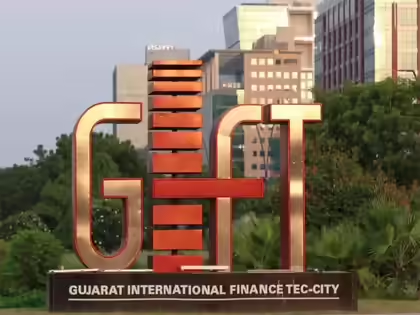
India’s GIFT City policy push is gaining momentum as regulators and policymakers position it as a global BFSI hub. With tax incentives, regulatory flexibility, and growing institutional participation, the initiative aims to attract international financial activity over the next 3 to 5 years.
India’s GIFT City policy push reflects a strategic effort to build an international financial services ecosystem within the country. Located in Gujarat International Finance Tec-City, GIFT City is being developed to compete with established global financial centres.
Policy Framework Designed to Attract Global Capital
The foundation of GIFT City’s growth lies in its policy framework, which offers a combination of tax benefits, regulatory clarity, and operational flexibility. The International Financial Services Centres Authority or International Financial Services Centres Authority acts as a unified regulator, simplifying compliance for entities operating within the zone.
Key incentives include tax holidays for financial institutions, exemptions on certain transactions, and liberalised foreign exchange regulations. These features are designed to attract global banks, asset managers, insurance companies, and fintech firms.
The policy direction signals a clear intent to position India as a competitive destination for cross-border financial services that were traditionally routed through offshore centres.
Growing Participation From Global and Domestic Institutions
Over the past two years, participation in GIFT City has increased steadily. Several domestic banks and financial institutions have set up units within the IFSC to tap into international business opportunities.
Global players are also entering the ecosystem, particularly in areas such as fund management, aircraft leasing, and reinsurance. The presence of these institutions is critical in building credibility and liquidity within the financial ecosystem.
Additionally, stock exchanges operating in GIFT City are enabling international trading in derivatives and debt instruments. This expands India’s footprint in global capital markets and provides investors with new avenues.
Expanding Product Ecosystem Strengthens BFSI Capabilities
A key factor behind the GIFT City policy push is the expansion of its financial product ecosystem. The IFSC now supports a range of activities, including banking, capital markets, insurance, and fintech innovation.
Emerging segments such as global in-house centers, sustainable finance, and international bullion trading are also being developed. These initiatives aim to diversify the ecosystem and reduce dependence on a single line of business.
The introduction of new frameworks for fund management and alternative investment vehicles is attracting asset managers looking for cost-efficient and regulated environments.
This diversification is essential for building a resilient and globally competitive BFSI hub.
Infrastructure and Regulatory Alignment Remain Critical
While policy incentives are strong, infrastructure and regulatory alignment remain key to scaling GIFT City. High-quality physical infrastructure, reliable connectivity, and seamless digital systems are essential for attracting global institutions.
Efforts are being made to improve ease of doing business through faster approvals, streamlined processes, and integrated services. However, competition from established global financial centres such as Singapore and Dubai remains intense.
To compete effectively, India must ensure consistency in policy implementation and maintain regulatory predictability. Global investors prioritise stability and transparency when choosing financial hubs.
Challenges in Achieving Global Hub Status
Despite the progress, several challenges could impact the pace of growth. Liquidity depth is still developing, and attracting large-scale international participation takes time.
Talent availability is another constraint. Building a global financial hub requires a skilled workforce with expertise in international finance, risk management, and compliance.
There are also structural challenges, including aligning domestic regulations with global standards and ensuring smooth capital movement across jurisdictions.
Addressing these issues will be critical for achieving the vision of a globally competitive BFSI hub.
Outlook for the Next 3 to 5 Years
The next few years will be crucial for GIFT City’s evolution. If current policy momentum continues, India has the potential to capture a meaningful share of global financial services activity.
Growth is likely to be driven by niche segments such as aircraft leasing, offshore fund management, and cross-border fintech services. These areas offer immediate opportunities where India can build competitive advantages.
However, becoming a full-scale global BFSI hub will require sustained effort, policy consistency, and ecosystem development. The transition will be gradual rather than immediate.
GIFT City represents a long-term strategic play rather than a short-term transformation.
Takeaways
• GIFT City policy push aims to position India as a global BFSI hub
• Tax incentives and unified regulation are attracting financial institutions
• Product diversification is strengthening the financial ecosystem
• Infrastructure, liquidity, and talent remain key challenges
FAQs
1. What is GIFT City and why is it important?
GIFT City is India’s international financial services centre designed to attract global financial activity and reduce reliance on offshore hubs.
2. What incentives are offered to companies in GIFT City?
Incentives include tax benefits, regulatory ease, and liberalised foreign exchange rules.
3. Can GIFT City compete with global financial centres?
It has potential in niche areas, but competing with established hubs will require time, scale, and consistent policy support.
4. What sectors are growing in GIFT City?
Key sectors include banking, fund management, insurance, aircraft leasing, and fintech services.











Leave a comment