

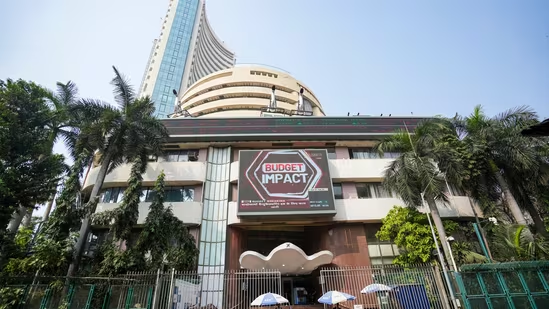
Nifty and Sensex outlook after Budget 2026 has become a key focus for investors assessing sectoral shifts and earnings visibility. The post budget market reaction reflects how policy priorities, fiscal math, and growth assumptions are being repriced across sectors that dominate Indian indices.
Market context and why Budget 2026 matters for indices
This topic is time sensitive and news driven, as it depends on immediate post Budget positioning. The Nifty and Sensex outlook after Budget 2026 is shaped less by headline announcements and more by how allocations align with earnings momentum. Equity markets entered the budget with high expectations around capital expenditure, fiscal discipline, and support for consumption.
Initial volatility reflects recalibration rather than panic. Investors are distinguishing between sectors that benefit directly from policy support and those facing margin pressure or muted demand. Index heavyweights determine near term direction, while broader market trends influence sustainability of gains.
Capital expenditure push and infrastructure linked sectors
One of the strongest signals from Budget 2026 is continued emphasis on capital expenditure. Infrastructure, engineering, construction, and capital goods companies are positioned to benefit as project pipelines expand. These sectors have meaningful weight in the broader market through PSU banks, industrial majors, and cement companies.
For Nifty and Sensex, infrastructure linked stocks support index stability because of earnings visibility and order book strength. Execution remains the key variable. Delays or cost overruns could limit upside, but policy continuity improves medium term confidence.
Banking and financial services outlook post Budget
Banking and financial services play a decisive role in index movement. Budget 2026 maintains fiscal discipline, which supports bond yields and limits pressure on interest rates. This is positive for large banks with stable net interest margins.
Public sector banks benefit from higher credit demand linked to infrastructure and MSME activity. Private banks gain from stable asset quality and retail loan growth. However, non banking financial companies face mixed outcomes depending on funding costs and regulatory clarity. Overall, financials remain a core driver rather than a drag for indices.
Consumption sectors and rural demand signals
Consumption oriented sectors show a more nuanced outlook. Budget measures aimed at rural development and income support may support staples, two wheeler manufacturers, and select consumer durables. However, discretionary consumption depends on real income growth and inflation trends.
For the Sensex and Nifty, large FMCG companies provide defensive support but limited upside. Margins remain sensitive to input costs. Investors are watching volume growth closely rather than relying on pricing led earnings expansion.
Technology and export oriented sectors under pressure
Technology stocks face a challenging phase despite long term relevance. Global demand uncertainty, currency volatility, and pricing pressure from automation trends weigh on sentiment. The Nifty IT index has underperformed in the immediate post Budget phase, dragging broader indices during weak global cues.
Export oriented sectors such as IT services and chemicals are sensitive to external factors rather than domestic policy. Budget 2026 offers limited direct relief here, making stock selection critical. Companies with diversified clients and strong balance sheets are better positioned.
Energy, metals, and commodity linked sectors
Energy and metals present a mixed picture. Infrastructure spending supports steel and cement demand, but global commodity prices influence margins. Budget provisions for energy transition and domestic production support select players in renewables and power transmission.
Oil marketing companies and upstream energy firms respond more to global crude trends than budget announcements. For indices, these sectors contribute to volatility rather than directional clarity.
What investors should watch in the coming months
The post Budget phase is about earnings delivery. Investors should track quarterly results, management commentary, and progress on government spending. Sector rotation is likely as markets respond to data rather than announcements.
For Nifty and Sensex, leadership will come from sectors combining policy support with earnings visibility. Overvalued segments may see time correction even without sharp price declines.
Takeaways
- Nifty and Sensex outlook after Budget 2026 depends on earnings execution, not announcements alone.
- Infrastructure and banking sectors are positioned to lead gains if spending accelerates.
- Technology and export driven sectors may remain under pressure due to global uncertainty.
- Consumption stocks offer stability but limited upside without volume growth.
FAQs
Why do markets react sharply after the Union Budget?
Markets price in expectations before the budget and adjust positions once policy details and fiscal priorities become clear.
Which sectors are likely to outperform after Budget 2026?
Infrastructure, capital goods, and banking sectors are better positioned due to policy continuity and credit growth.
Are IT stocks a risk to Nifty and Sensex in 2026?
IT stocks can act as a drag during global slowdowns, but selective recovery is possible based on client spending trends.
Should retail investors change portfolios immediately after the budget?
Portfolio changes should be gradual and based on earnings outlook rather than short term market reactions.










Leave a comment