

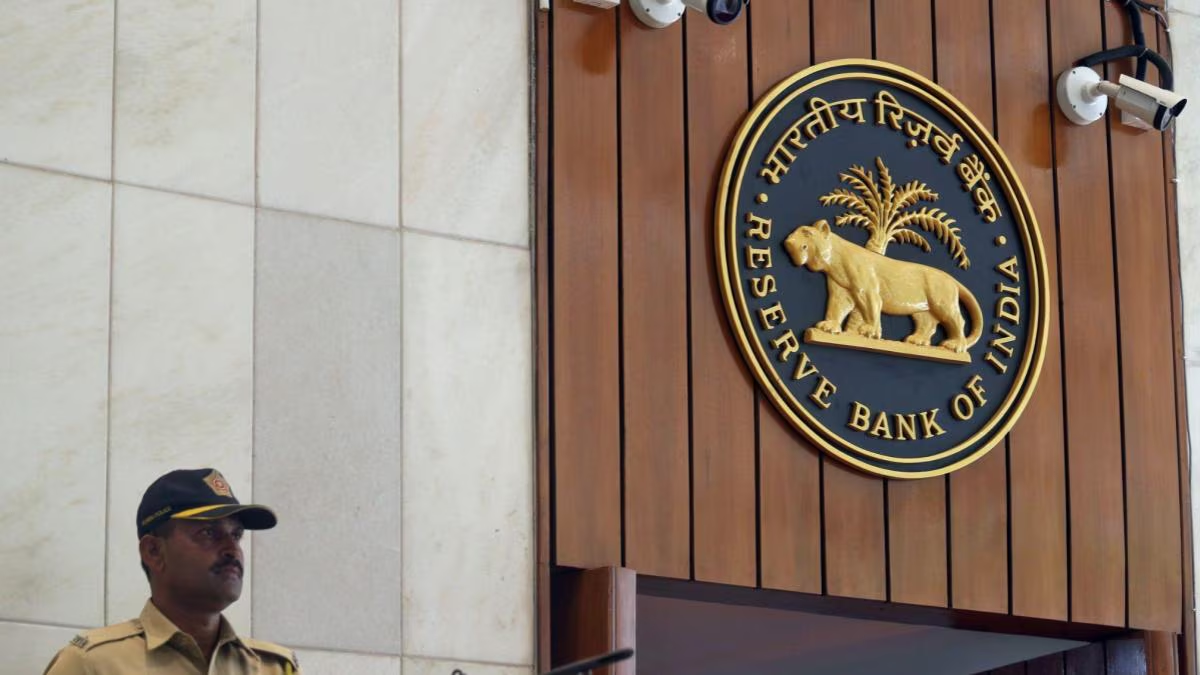
The RBI ease-of-business reforms are set to reshape MSME lending in India, especially in smaller cities. By simplifying compliance, improving credit access, and strengthening financial systems, these changes aim to unlock faster and more inclusive growth for local businesses.
The Reserve Bank of India has recently introduced a set of regulatory and operational measures aimed at improving the ease of doing business in the financial ecosystem. These reforms are particularly significant for MSME lending in Tier-2 and Tier-3 cities, where access to formal credit has historically remained uneven.
What RBI Ease-of-Business Reforms Actually Change
The RBI ease-of-business reforms focus on reducing friction across lending processes. Banks and NBFCs are being encouraged to streamline documentation, improve turnaround times, and adopt technology-led underwriting systems. This includes better use of digital data, such as GST records and account aggregators, to assess borrower credibility.
For MSMEs in smaller cities, this reduces dependency on collateral-heavy loans. Earlier, businesses without strong asset backing struggled to secure formal credit. Now, cash flow-based lending is gaining importance, enabling more entrepreneurs to access working capital.
Impact on MSME Lending in Tier-2 and Tier-3 Markets
MSME lending in small cities stands to benefit the most from these reforms. Financial institutions are now better positioned to expand beyond metro-centric portfolios. With simplified norms and clearer regulatory guidance, lenders can scale outreach in semi-urban and rural markets.
This shift is already visible in the growing presence of small finance banks and fintech lenders in non-metro regions. These institutions are leveraging digital onboarding and vernacular interfaces to acquire new customers. As a result, credit penetration in smaller cities is gradually improving.
Another critical change is faster loan processing. Reduced compliance burdens mean lenders can approve loans quicker, which is crucial for MSMEs that operate on tight cash cycles.
Role of Digital Infrastructure and Policy Support
Digital public infrastructure plays a central role in amplifying the impact of RBI reforms. Systems like UPI, Aadhaar-based KYC, and account aggregators allow seamless data sharing between borrowers and lenders. This reduces manual verification and speeds up credit decisions.
Government-backed initiatives such as credit guarantee schemes further strengthen the ecosystem. These schemes reduce the risk for lenders, encouraging them to extend loans to first-time borrowers and small enterprises.
For MSMEs in smaller towns, this combination of policy and technology creates a more level playing field. Businesses that were previously outside the formal credit system can now build financial histories and access larger loans over time.
Challenges That Still Remain for Small Businesses
Despite the positive direction, certain challenges continue to limit the full impact of these reforms. Financial literacy remains uneven across Tier-2 and Tier-3 regions. Many MSME owners are still unaware of new lending options or hesitant to engage with formal institutions.
Additionally, while digital adoption is increasing, infrastructure gaps such as inconsistent internet connectivity can slow down onboarding processes. Lenders also need to manage credit risk carefully, especially when expanding into new borrower segments.
There is also a need for better coordination between banks, NBFCs, and fintech platforms. A fragmented approach can dilute the effectiveness of reforms and create confusion for borrowers.
What This Means for the Future of MSME Growth
The RBI ease-of-business reforms signal a clear shift towards inclusive credit growth. By making lending more efficient and accessible, the central bank is enabling MSMEs to scale operations, invest in expansion, and generate employment.
For small cities, this could translate into stronger local economies. As more businesses gain access to formal financing, they can reduce reliance on informal lenders, lower borrowing costs, and improve long-term sustainability.
Over time, this also strengthens the broader financial system. A diversified lending base reduces concentration risk and supports balanced economic development across regions.
Takeaways
- RBI reforms are reducing barriers in MSME lending processes
- Tier-2 and Tier-3 cities are becoming key growth markets for lenders
- Digital infrastructure is enabling faster and collateral-light credit access
- Financial literacy and infrastructure gaps still need attention
FAQs
What are RBI ease-of-business reforms in lending?
These are regulatory changes aimed at simplifying compliance, improving credit flow, and making lending more efficient for businesses and financial institutions.
How do these reforms help MSMEs in small cities?
They improve access to credit by reducing documentation, enabling faster approvals, and promoting cash flow-based lending instead of collateral-heavy loans.
Are fintech companies benefiting from these reforms?
Yes, fintech lenders are leveraging digital tools and data to expand into smaller markets and serve underserved borrowers.
What challenges still exist for MSME lending?
Key challenges include low financial literacy, infrastructure gaps, and the need for better coordination among lenders.






Leave a comment