

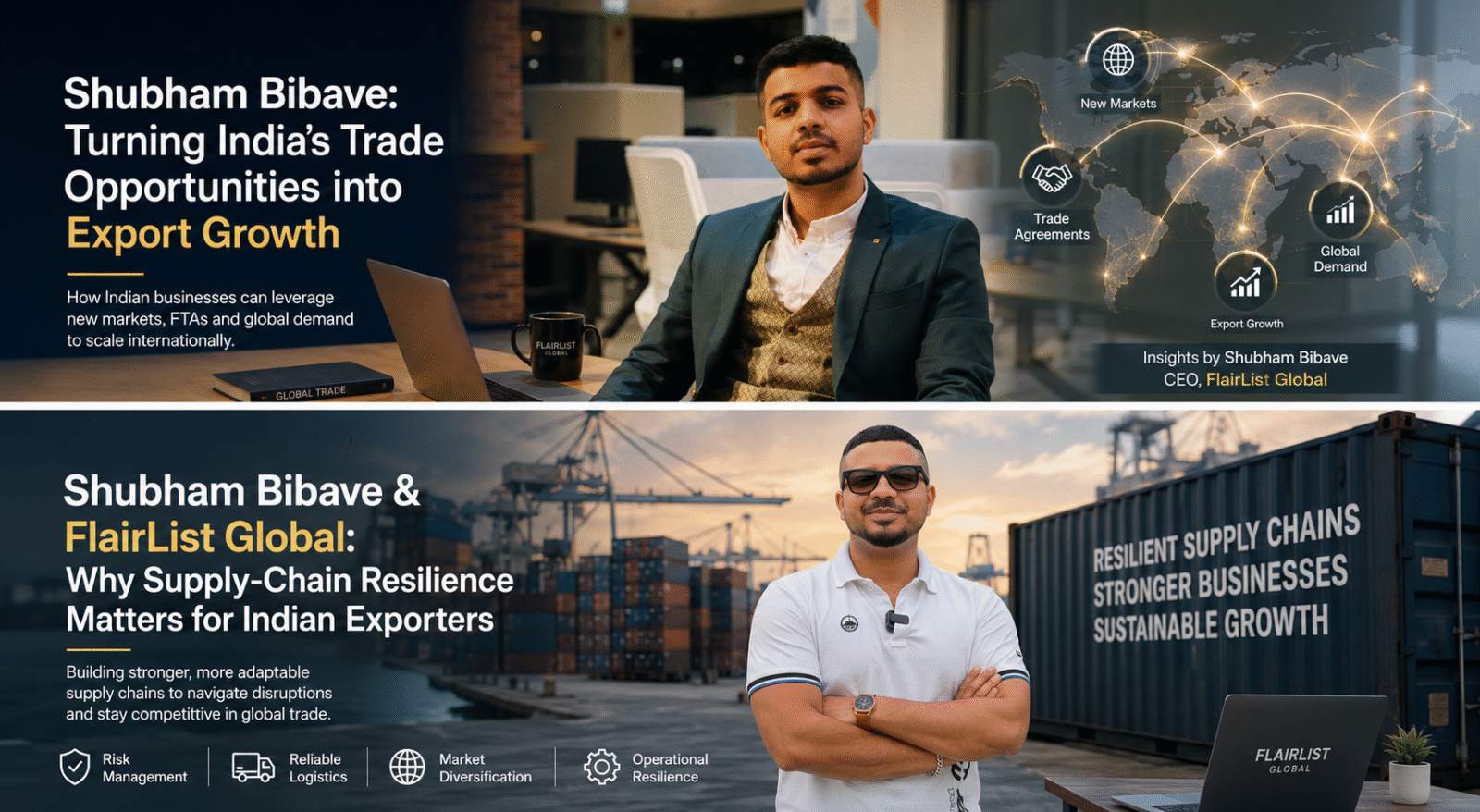
India’s export story is entering an important phase.
For years, the conversation around Indian exports focused largely on increasing production, finding international buyers and expanding manufacturing capacity. Today, the opportunity is broader. India is increasingly building trade relationships that can give its businesses access to new markets, preferential tariffs and more predictable commercial conditions.
But signing a trade agreement is only the beginning.
The bigger question is whether Indian businesses-particularly small and mid-sized exporters-are equipped to actually use the opportunities these agreements create.
India recorded its highest-ever combined exports of US$863.1 billion in FY 2025–26, comprising US$441.8 billion in merchandise exports and US$421.3 billion in services exports. The government has also been actively expanding trade partnerships and focusing on greater utilisation of existing agreements.
That shift could be significant for Indian exporters.
From Trade Agreements to Real Market Access
A Free Trade Agreement can reduce tariffs and create better market access, but the benefits do not automatically reach every exporter.
Businesses still need to understand product eligibility, rules of origin, documentation, certifications, labelling requirements, customs procedures and market-specific regulations.
For a large corporation with dedicated international trade teams, these requirements may be manageable.
For an MSME trying to export for the first time, they can become barriers.
This is where export readiness becomes just as important as production capacity.
An exporter may have a competitive product, but if the business does not understand the destination market, cannot meet compliance requirements or fails to calculate the complete landed cost, the opportunity can quickly disappear.
India’s recent trade strategy reflects this challenge. Government initiatives are increasingly focusing not only on negotiating agreements but also on helping businesses access preferential benefits and diversify their export markets.
The Exporter’s Real Checklist
For Indian businesses looking to enter a new market, the first step should not necessarily be asking, “Which country should I export to?”
It should be asking:
“Is my business ready to export to that country?”
That means understanding five fundamental areas.
First, product-market fit.
Demand for a product varies significantly across markets. Packaging, price points, consumer preferences and purchasing behaviour can all differ.
Second, regulatory readiness.
Every market has its own standards and compliance expectations. Food products, agricultural goods, pharmaceuticals, textiles and manufactured products may face very different requirements.
Third, pricing and landed cost.
An attractive factory price does not necessarily translate into a competitive export price. Freight, insurance, duties, handling, documentation and other costs must be considered.
Fourth, logistics.
The ability to move a product efficiently can determine whether an export order is profitable. Route selection, warehousing, freight partners and delivery timelines all matter.
Finally, buyer discovery.
Having a market does not mean having buyers.
Exporters need reliable methods to identify, qualify and communicate with international buyers rather than relying solely on online enquiries or unverified leads.
The Opportunity for Indian MSMEs
The growing network of India’s trade agreements could be particularly important for MSMEs.
The government has identified market diversification, export promotion, logistics reforms and e-commerce export hubs as important parts of strengthening India’s global trade footprint.
For smaller businesses, this could create opportunities to move beyond traditional markets.
Consider an Indian food processor, engineering manufacturer, textile producer or agricultural exporter.
Instead of depending heavily on one destination, the business can explore multiple markets, compare demand and regulations, identify the most viable route and build a more diversified customer base.
Diversification matters because global trade is rarely static.
Tariffs can change. Shipping costs can rise. Political tensions can disrupt routes. Currency movements can affect margins.
A business that depends entirely on one market or one logistics route is more exposed to these changes.
Shubham Bibave’s Perspective: Exporting Requires More Than a Product
For Shubham Bibave, the opportunity in Indian exports lies not simply in helping businesses sell internationally, but in helping them understand what it takes to operate internationally.
The transition from a domestic business to an export-ready business requires a different mindset.
It involves understanding documentation, international pricing, buyer qualification, logistics, compliance and relationship management.
It also requires businesses to think beyond the first order.
A successful export strategy should ideally create repeat business, reliable supply relationships and sustainable margins.
This is where FlairList Global sees an opportunity to work with businesses looking to make international trade more structured and accessible.
Rather than treating exports as a one-time transaction, exporters need to view international trade as a long-term business channel.
India’s Next Export Chapter
India’s trade agreements are opening doors, but businesses still have to walk through them.
The country’s merchandise exports to FTA partners show the scale of the opportunity. In FY 2025–26, India exported approximately US$7.45 billion in merchandise to Nepal, US$37.36 billion to the UAE and US$13.44 billion to the UK, among other FTA-linked markets.
These numbers demonstrate that trade agreements can become commercially meaningful markets.
But the next phase of India’s export growth may depend on how effectively smaller businesses participate.
FlairList Global believes that stronger market intelligence, buyer discovery, export planning and supply-chain support can help businesses approach international markets with greater confidence.
The goal should not be to encourage every business to export everywhere.
It should be to help the right businesses identify the right markets, understand the requirements and build a commercially viable path to international trade.
For Shubham Bibave, India’s export opportunity represents a broader shift: Indian businesses no longer need to think of global markets as something reserved for large corporations.
With the right product, preparation, partnerships and market strategy, smaller businesses can participate too.
The question is no longer whether India has global export potential.
The question is how many Indian businesses will be ready to capture it.
For exporters looking to explore international markets, build buyer networks or understand their next export opportunity, FlairList Global is working toward making that journey more structured and accessible.
Learn more about FlairList Global: www.flairlist.com












Leave a comment