

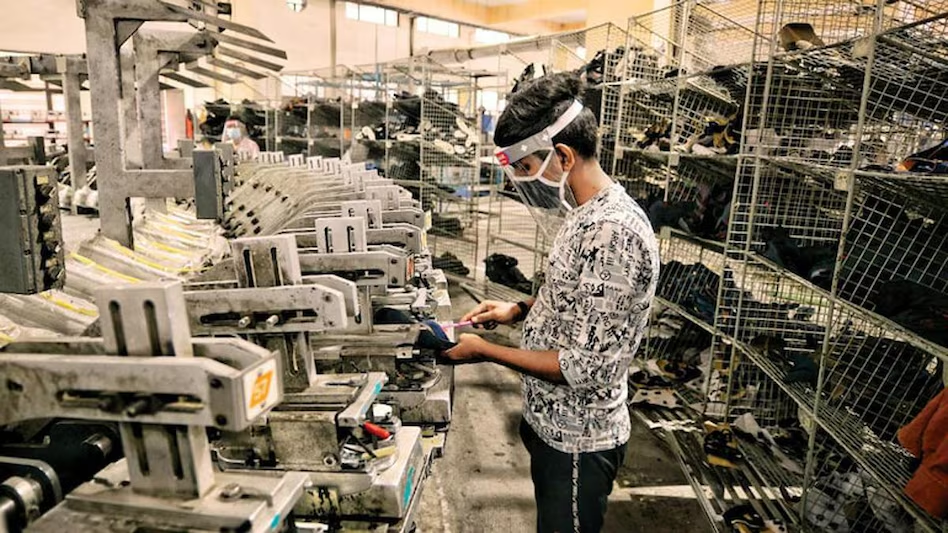
Uttar Pradesh has introduced a targeted MSME-focused budget aimed at accelerating local investment, expanding employment opportunities, and strengthening district-level industries. The new provisions are designed to improve credit access, modernize infrastructure, and integrate small businesses into state and national supply chains.
The Uttar Pradesh government’s latest budget places micro, small and medium enterprises at the center of its economic growth strategy. MSMEs already contribute a significant share of employment and industrial output in the state, especially across Tier 2 and Tier 3 districts. The new budget framework focuses on easing operational bottlenecks, reducing capital constraints, and encouraging formalization to make local businesses more competitive and scalable.
MSMEs Positioned as the Engine of Local Economic Growth
The budget signals a clear shift toward decentralized growth by prioritizing district-based industrial clusters and local manufacturing hubs. Uttar Pradesh has one of the largest MSME bases in India, spanning sectors such as food processing, textiles, leather, handicrafts, engineering goods, and agro-based industries. However, many of these units operate at suboptimal capacity due to limited capital access, outdated technology, and weak market linkages.
Under the new budget, the state has increased allocations for cluster development programs, common facility centers, and industrial estates in semi-urban and rural regions. These measures aim to lower input costs for small units, improve productivity, and enable shared access to machinery, testing facilities, and logistics infrastructure. By strengthening local ecosystems, the government expects MSMEs to generate sustainable employment closer to home, reducing migration pressure on large cities.
Credit Access and Financial Support Take Center Stage
One of the most critical elements of the MSME budget is the expanded focus on credit facilitation. Small businesses in Uttar Pradesh have traditionally relied on informal lending due to complex banking procedures and collateral requirements. The budget introduces enhanced credit guarantee coverage, interest subvention schemes, and faster loan processing mechanisms in collaboration with banks and NBFCs.
Special emphasis has been placed on first-time entrepreneurs, women-led enterprises, and businesses operating in aspirational districts. By reducing the cost of borrowing and improving loan approval timelines, the state aims to encourage formal financing and improve cash flow stability for MSMEs. Improved access to working capital is expected to directly impact hiring, capacity expansion, and supplier payments across local value chains.
Employment Generation Linked to Incentive-Based Policies
The new budget links financial incentives directly to job creation, making employment a measurable outcome of MSME support. Enterprises that expand workforce size, especially in manufacturing and labor-intensive sectors, are eligible for wage subsidies, skill training reimbursements, and compliance-related incentives.
This approach aligns MSME development with the state’s broader employment objectives. Uttar Pradesh has a young and growing workforce, and the budget recognizes the role of small businesses in absorbing semi-skilled and skilled labor. By tying incentives to payroll growth and formal employment records, the government is also encouraging businesses to move workers into the organized sector, improving long-term income security.
Infrastructure, Logistics, and Market Access Push
Beyond funding, the budget allocates resources to improve physical and digital infrastructure that directly impacts MSME competitiveness. Industrial corridors, warehousing facilities, and last-mile logistics support have been prioritized to reduce transportation delays and costs. Improved road connectivity between production clusters and markets is expected to benefit exporters and domestic suppliers alike.
On the market access front, the state is strengthening procurement linkages between MSMEs and large buyers, including government departments, public sector undertakings, and large private companies. Digital platforms for vendor registration and e-procurement are being expanded to improve transparency and participation by smaller firms. These measures aim to help local businesses secure stable demand and predictable revenue streams.
Long-Term Impact on Investment and Regional Balance
The targeted MSME budget is designed not just as a short-term stimulus but as a structural intervention to rebalance economic growth across regions. By channeling investment into smaller towns and industrial belts, the government is seeking to reduce regional disparities and create resilient local economies.
Improved infrastructure, easier credit, and skill-linked incentives are expected to attract new entrepreneurs and encourage existing businesses to reinvest profits locally. Over time, this could lead to stronger industrial ecosystems, higher household incomes, and improved tax compliance. If effectively implemented, the MSME-focused budget could play a pivotal role in sustaining Uttar Pradesh’s economic momentum while delivering inclusive growth.
Takeaways
The UP budget places MSMEs at the core of job creation and local investment strategy
Expanded credit support aims to reduce reliance on informal financing
Employment-linked incentives encourage formal hiring and workforce expansion
Infrastructure and market access reforms strengthen district-level industries
FAQs
What is the main objective of UP’s targeted MSME budget?
The primary objective is to boost local investment, generate employment, and strengthen small businesses across districts by improving credit access, infrastructure, and market linkages.
Which MSMEs benefit most from the new provisions?
Micro and small enterprises, first-time entrepreneurs, women-led businesses, and units operating in Tier 2, Tier 3, and aspirational districts are key beneficiaries.
How does the budget support job creation?
Incentives such as wage subsidies, training reimbursements, and financial benefits are linked directly to workforce expansion and formal employment generation.
Will this budget attract new investments into Uttar Pradesh?
Yes, improved infrastructure, easier financing, and predictable incentives are expected to attract both local and external investors into MSME-led sectors.












Leave a comment