

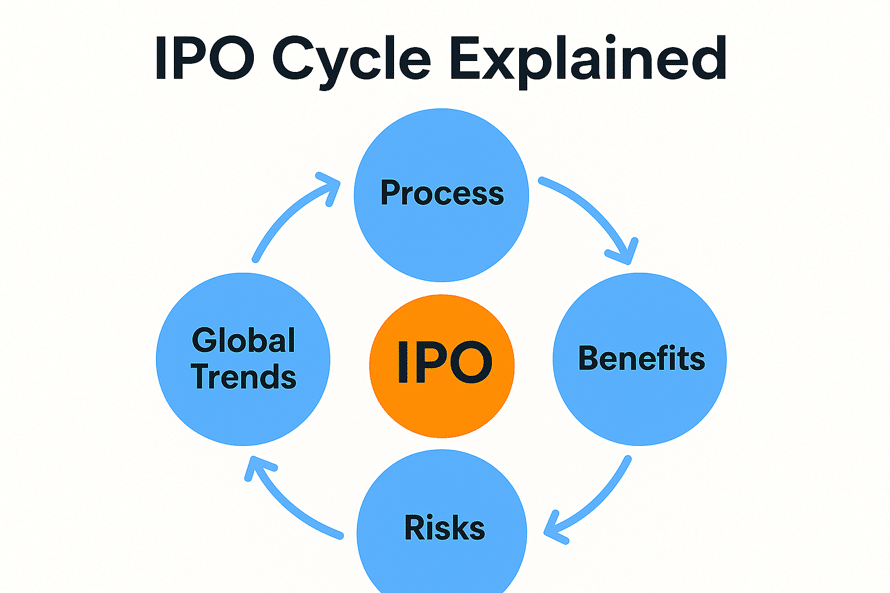
Initial public offerings play a central role in India’s business cycle, influencing capital formation, investor sentiment and founder exits. In this context the PhysicsWallah example is often discussed as a hypothetical case used by analysts to explain how digital first companies might approach public markets in the future without implying that the company has actually listed.
IPO listings act as both a growth vehicle and an exit mechanism, and understanding this duality helps investors and founders gauge where India’s capital markets are headed.
How IPOs influence India’s business cycle and capital flows
The main keyword in this discussion is IPO listings and their link to India’s business cycle. When companies approach the public markets during periods of economic expansion, they use investor appetite to raise larger pools of capital at higher valuations. These inflows feed the cycle by increasing corporate spending, improving hiring, expanding manufacturing capacity or accelerating digital operations.
During slower phases of the business cycle, IPOs function differently. Companies may still list, but valuations compress, anchor investors become selective and retail participation cools. This environment turns IPOs into more measured fundraising events rather than aggressive growth catalysts. Tier 2 and Tier 3 investors tend to reduce speculative interest during such phases, which stabilises the cycle by preventing overheating in small cap segments.
IPOs as growth engines for emerging companies
IPOs remain one of the strongest growth vehicles for scaling companies in India. They offer long term capital that is not tied to repayment cycles or venture conditions. For digital first businesses, consumer brands and manufacturing companies, public market capital can fund expansions across geographies, new product categories, supply chain upgrades and technology modernisation.
A hypothetical listing of a popular education startup such as PhysicsWallah is often used by analysts to explain how public markets might fund the next stage of digital education. Through an IPO, a company of that profile could use the proceeds to enter new cities, strengthen test preparation verticals, invest in hybrid centres and build deeper regional networks. While this example is hypothetical, it illustrates how the IPO route helps well known brands transition from founder led growth to institutionally supported expansion.
Such growth cycles also ripple outwards. Vendor ecosystems benefit from increased spending, local markets see upticks in hiring and retail investors in non metro regions get exposure to companies they engage with daily. This broadens participation in the business cycle and supports more predictable consumption patterns.
IPOs as structured exit mechanisms for founders and early investors
While IPOs are growth engines, they also function as formal exit windows. Early investors often seek liquidity after five to seven years, and public markets provide a transparent price discovery mechanism. A balanced exit also signals market maturity because it encourages earlier investors to recycle capital into new startups.
From a founder perspective the exit through an IPO is not immediate. Most promoters and early investors operate under lock in periods which delay large scale selling. However the listing itself creates a visible market for future dilution. This clarity helps founders shift from personal ownership to stewardship, enabling professional management to run daily operations.
The contrast between growth and exit also reveals how Indian markets have evolved. Investors no longer view IPOs as a complete exit event. Instead they assess post listing performance, governance track records and the company’s ability to meet guidance. This ensures healthier cycles where companies are rewarded for sustainable growth rather than short term valuation spikes.
How IPO cycles connect with Tier 2 and Tier 3 markets
IPOs have a direct relevance in smaller cities because retail participation is growing quickly. In non metro regions investors tend to focus on well known consumer brands, digital platforms they already use and companies with strong regional footprints. When such companies list the participation from Tier 2 and Tier 3 markets contributes significantly to subscription numbers.
The post listing behaviour of these stocks also shapes local sentiment. Strong listings often lead to increased inflows into equity mutual funds and direct trading accounts. Weak listings create caution and push investors toward safer large cap options. This pattern influences the broader business cycle by regulating how aggressively retail money enters the market at different points in time.
Takeaways
IPOs drive India’s business cycle by injecting long term capital into expanding sectors.
Public listings act as both growth accelerators and structured exit windows for early investors.
Retail participation from Tier 2 and Tier 3 markets now shapes subscription levels and post listing sentiment.
Healthy IPO cycles require companies to demonstrate governance, earnings visibility and execution strength.
FAQs
Q: Are IPOs mainly for founder exits or company growth?
IPOs serve both purposes. They provide liquidity for early investors while giving the company access to long term capital needed for expansion.
Q: Do all IPOs lead to strong post listing gains?
No. Performance depends on sector outlook, pricing discipline, earnings visibility and broader market conditions.
Q: How do smaller city investors affect IPO demand?
Their participation has increased sharply. Many consumer facing companies attract heavy subscription from Tier 2 and Tier 3 cities because of brand familiarity.
Q: Does every digital company benefit equally from listing?
Not necessarily. Only companies with stable revenues, strong governance and predictable margins sustain post listing investor confidence.











Leave a comment