

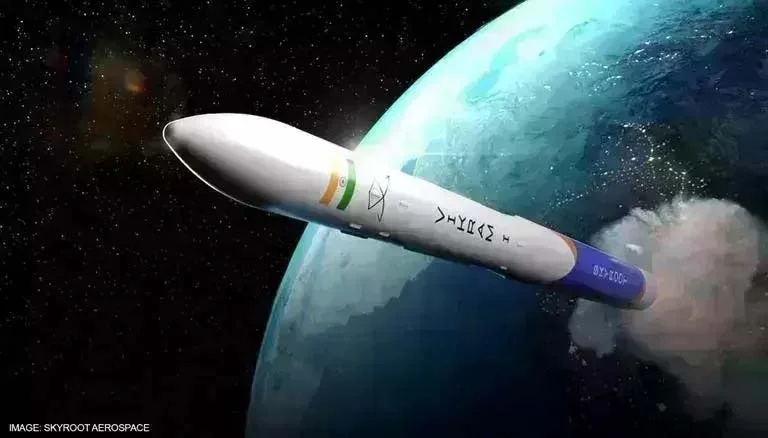
Skyroot Aerospace has become India’s first space-tech unicorn after raising $60 million at a valuation of $1.1 billion. The milestone reflects growing investor confidence in India’s private space sector and raises important questions about what comes next for the company and the broader industry.
Skyroot Aerospace Becomes India’s First Space-Tech Unicorn
Skyroot Aerospace has entered the unicorn club, becoming India’s first space-tech startup to cross the $1 billion valuation mark. The Hyderabad-based company achieved the milestone after securing $60 million in fresh funding from investors including Sherpalo Ventures, GIC, and BlackRock-backed funds. The latest round values the company at approximately $1.1 billion.
This is a time-sensitive news story because the funding round was announced in May 2026 and comes just ahead of a major milestone for the company. Skyroot is preparing for the maiden launch of Vikram-1, India’s first privately developed orbital rocket.
The achievement is significant not only for Skyroot but also for India’s private space industry, which has expanded rapidly since government reforms opened the sector to private participation in 2020.
Vikram-1 Launch Becomes the Next Major Test
While the unicorn valuation has captured headlines, the company’s next challenge is technological execution. Skyroot is preparing for the launch of Vikram-1, a rocket designed to place small satellites into low Earth orbit.
The mission carries high importance because it will be India’s first privately developed orbital launch vehicle. Success would validate years of engineering work and strengthen customer confidence in Skyroot’s launch services.
Industry experts often view launch capability as the defining factor separating ambitious space startups from commercially viable aerospace companies. A successful orbital mission could help Skyroot secure additional launch contracts from satellite operators, research organizations, and commercial customers.
The company previously made history in 2022 when its Vikram-S vehicle became the first privately developed Indian rocket to reach space. That achievement established technical credibility and laid the foundation for the company’s current growth trajectory.
India’s Private Space Industry Enters a New Phase
The rise of Skyroot reflects a broader transformation in India’s space ecosystem. For decades, space activities were largely led by the Indian Space Research Organisation, better known as ISRO. Recent policy reforms have encouraged private companies to participate in launch services, satellite manufacturing, propulsion systems, and space applications.
Several startups including AgniKul Cosmos, Bellatrix Aerospace, and others are developing technologies across different segments of the space economy. However, Skyroot is the first company in the sector to achieve unicorn status.
The funding milestone signals growing investor confidence in India’s ability to build globally competitive aerospace businesses. It also demonstrates that deep-tech startups can attract substantial capital despite longer development cycles and higher technical risks.
Global investors increasingly view India as a promising market for space innovation due to its engineering talent, lower development costs, and expanding satellite ecosystem.
What the Fresh Capital Will Help Skyroot Achieve
According to company statements, the newly raised capital will support increased launch frequency, manufacturing expansion, and development of future rocket programs including Vikram-2.
Manufacturing capacity is particularly important for commercial launch providers. As satellite deployments increase worldwide, customers are looking for reliable and frequent launch opportunities. Companies that can scale production efficiently may gain a competitive advantage.
Skyroot has also been investing heavily in infrastructure. Its facilities in Hyderabad support rocket design, manufacturing, testing, and integration. These capabilities are expected to play a crucial role as the company moves from demonstration missions toward commercial operations.
Beyond launch services, the company could eventually explore broader opportunities in satellite deployment, space logistics, and advanced aerospace technologies.
Why Skyroot’s Success Matters Beyond Space
The significance of Skyroot’s unicorn status extends beyond the aerospace sector. The achievement demonstrates that Indian startups can create globally relevant deep-tech businesses in industries traditionally dominated by governments and large corporations.
It also sends a positive signal to investors evaluating opportunities in sectors such as defence technology, advanced manufacturing, robotics, semiconductors, and artificial intelligence.
For young entrepreneurs, Skyroot’s journey highlights how innovation-driven businesses can emerge from highly specialized industries. The company’s growth from a startup founded by former ISRO engineers to a billion-dollar enterprise illustrates the increasing maturity of India’s innovation ecosystem.
The coming months will be crucial. While the unicorn valuation is a major achievement, the success of Vikram-1 and future commercial launches will ultimately determine whether Skyroot can establish itself as a long-term leader in the global space economy.
Key Takeaways
- Skyroot Aerospace has become India’s first space-tech unicorn with a valuation of $1.1 billion.
- The company raised $60 million from investors including Sherpalo Ventures and GIC.
- Vikram-1, India’s first private orbital rocket, is expected to be the company’s next major milestone.
- The achievement highlights growing investor confidence in India’s private space sector.
FAQs
Why is Skyroot Aerospace’s unicorn status important?
Skyroot is the first Indian space-tech startup to achieve a valuation exceeding $1 billion, marking a major milestone for the country’s private aerospace industry.
What is Vikram-1?
Vikram-1 is Skyroot Aerospace’s orbital launch vehicle designed to carry small satellites into low Earth orbit.
How much funding did Skyroot raise?
The company raised $60 million in its latest funding round, taking its valuation to approximately $1.1 billion.
What will Skyroot do with the new investment?
The company plans to increase launch frequency, expand manufacturing capacity, and accelerate development of future launch vehicles.
(Keyword Suggestions: Skyroot Aerospace, space-tech unicorn India, Vikram-1 rocket, private space startups India, Indian space industry, space technology funding, aerospace startup India, ISRO private sector, deep tech startups India, commercial satellite launches)











Leave a comment