

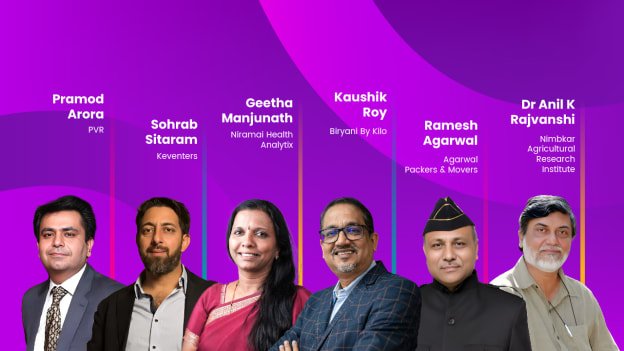
Year ender business movers highlight the biggest Indian entrepreneurs of 2025, capturing the founders, innovators and industry disruptors who influenced markets, policy shifts and consumer behaviour. Their decisions shaped sectors ranging from manufacturing and technology to logistics, finance and digital commerce.
The year saw consolidation, IPO momentum, operational resets and renewed interest in deep tech, all driven by leaders who adapted quickly to a shifting economic environment.
Founders who scaled operations despite funding constraints
Tightened funding cycles reshaped how many startups operated in 2025. Founders who focused on disciplined execution emerged stronger. Several growth stage companies shifted from rapid expansion to stable unit economics.
Entrepreneurs in manufacturing, mobility, health tech and enterprise software led this shift by trimming burn rates, improving supply chain visibility and prioritising sustainable customer acquisition. Their pragmatism helped them navigate cautious investor sentiment while preserving long term scale potential.
These founders also benefited from increased domestic capital participation. Family offices, corporate venture arms and sector focused funds filled the gap left by slowing global funding, enabling disciplined entrepreneurs to maintain momentum.
Business leaders driving India’s industrial and tech resurgence
2025 also marked a significant push toward indigenous production and technology innovation. Leaders in electronics manufacturing, renewable energy, precision engineering and space technology expanded capacity in response to government incentives and global supply chain diversification.
These industrial innovators demonstrated that India can build competitive manufacturing ecosystems by combining automation, process optimisation and strong workforce development. They also attracted global partnerships for component manufacturing, semiconductor tooling and green energy deployment.
In tech, founders building applied AI solutions, cyber security products and automation platforms gained traction due to strong enterprise demand. Their focus on solving real operational challenges strengthened adoption across banks, logistics operators and industrial plants.
Disruptors bringing new models to consumer and service sectors
Entrepreneurs in the consumer economy embraced more sustainable and digital first models. Direct to consumer brands focused on profitability rather than discount driven growth. Health and wellness ventures created hybrid delivery networks combining online engagement with local service hubs.
In mobility and logistics, founders introduced leaner operating models. Micro mobility, shared logistics infrastructure and regional warehousing networks gained attention as companies sought cost efficiency at scale. These models were particularly effective in Tier 2 and Tier 3 markets where consumer demand expanded steadily in 2025.
Education and skilling startups also adapted. Entrepreneurs shifted from high burn digital channels to blended learning models with better retention and unit economics, responding to both regulatory expectations and market realities.
Executives leading successful IPOs and public market transitions
The year saw a resurgence in IPO activity, driven by companies with strong fundamentals. Executives who successfully guided their organisations through public listings demonstrated financial discipline, governance maturity and long term value orientation.
These leaders focused on predictable revenue growth, customer loyalty and margin stability. They strengthened reporting mechanisms, reduced operational risk and improved transparency to meet public market standards. Their approach reset expectations for India’s broader startup ecosystem, signalling that profitable growth stories can unlock more resilient market valuations.
Their success also provided exit opportunities for early investors, freeing capital for new rounds in emerging sectors.
Regional entrepreneurs creating new economic centres outside metros
A major storyline of 2025 was the rise of entrepreneurs from smaller cities. Founders in Coimbatore, Jaipur, Lucknow, Indore, Kochi and Bhubaneswar built high quality ventures in manufacturing, agritech, deep tech, logistics and vernacular digital services.
These entrepreneurs leveraged cost efficiency, local domain knowledge and strong engineering talent to build highly competitive businesses. Their success demonstrated that innovation is no longer concentrated in Bengaluru, Mumbai or Delhi.
State backed programs, university incubators and regional angel networks supported this expansion. As a result, regional founders secured more visibility, investor interest and national scale opportunities.
Takeaways
2025 highlighted disciplined founders who prioritised profitability over aggressive expansion.
Industrial and tech leaders accelerated India’s manufacturing and innovation capabilities.
Consumer and service disruptors reshaped supply chains and product delivery models.
Regional entrepreneurs proved that startup excellence is expanding beyond metros.
FAQ
What defined India’s most influential entrepreneurs in 2025
Leaders with strong execution discipline, financial clarity and adaptive strategies stood out, especially those navigating tighter funding cycles.
Which sectors saw the most disruptive founders this year
Manufacturing, applied AI, logistics, health tech, renewable energy and vernacular digital services produced notable disruptors.
Did regional founders meaningfully impact the national ecosystem
Yes. Entrepreneurs from smaller cities gained visibility and demonstrated that high quality innovation can thrive outside metros.
How did IPO leaders influence startup expectations
They established benchmarks for transparency, governance and profitability, encouraging younger startups to adopt long term focused operations.











Leave a comment