


Gujarat has recently moved ahead of Maharashtra in SME IPO listings, marking a shift in India’s small business landscape. The development highlights changing regional dynamics, policy influence, and growing participation from emerging business hubs beyond traditional financial centers.
India’s SME IPO market is witnessing a notable shift as Gujarat overtakes Maharashtra in SME IPO listings, signalling a deeper transformation in the country’s small business economy. Traditionally dominated by Mumbai-based enterprises, the SME listing ecosystem is now expanding into new geographies, with Gujarat emerging as a strong contender.
Gujarat Leads SME IPO Growth with Strong Industrial Base
The rise of Gujarat in SME IPO listings is not accidental. The state has built a reputation for its business-friendly environment, strong industrial clusters, and efficient regulatory support. Cities like Ahmedabad, Surat, and Rajkot have become active centers for small and medium enterprises looking to raise capital through public markets.
One key driver is Gujarat’s long-standing entrepreneurial culture combined with access to manufacturing ecosystems. Sectors such as textiles, chemicals, engineering, and pharmaceuticals have contributed significantly to the growing number of SME IPOs from the state.
Secondary keyword focus like SME IPO growth in Gujarat also reflects how smaller cities are now directly participating in capital markets rather than relying solely on private funding or traditional bank loans.
Maharashtra Faces Competition Despite Financial Dominance
Maharashtra, home to Mumbai and India’s largest stock exchanges, has historically led SME IPO listings. However, the recent shift suggests that proximity to financial institutions is no longer the only advantage for companies seeking public listings.
Rising operational costs, regulatory complexities, and increased competition within Maharashtra may be prompting SMEs to explore opportunities elsewhere. At the same time, businesses in Gujarat appear more prepared to scale and meet listing requirements.
The shift does not indicate a decline in Maharashtra’s importance but rather highlights a broader decentralization of India’s SME capital market ecosystem.
SME IPO Boom Reflects Changing Funding Preferences
Across India, SME IPOs are gaining traction as an alternative funding route. For many small businesses, public listings offer better visibility, credibility, and access to growth capital compared to traditional debt financing.
The increasing number of SME IPOs also aligns with stricter lending norms from banks and NBFCs. Entrepreneurs are now more open to equity-based funding, especially in sectors with scalable business models.
This trend is particularly relevant for Tier-2 and Tier-3 cities, where access to venture capital remains limited. SME IPOs are helping bridge that funding gap and enabling regional businesses to expand beyond local markets.
Role of Policy Support and Regulatory Framework
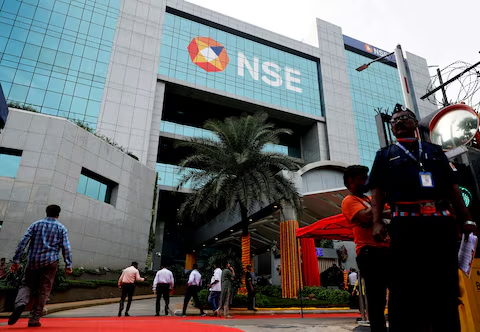
Government initiatives and regulatory support have played a crucial role in boosting SME listings. Platforms like BSE SME and NSE Emerge have simplified the listing process for smaller companies while ensuring transparency and investor protection.
Gujarat’s state-level policies, including ease of doing business reforms and infrastructure support, have further strengthened its position. Faster approvals, better industrial connectivity, and supportive local ecosystems have made it easier for SMEs to scale and go public.
Secondary keyword focus like SME IPO policy support in India becomes relevant here as regulatory clarity continues to influence listing decisions.
Tier-2 Cities Drive the Next Phase of Growth
One of the most significant implications of this shift is the growing importance of Tier-2 and Tier-3 cities in India’s financial ecosystem. Entrepreneurs from these regions are increasingly confident about tapping public markets.
Cities like Surat and Rajkot are not only producing manufacturing businesses but also companies with strong governance and compliance standards required for IPO listings. This reflects a maturing ecosystem where regional businesses are becoming investment-ready.
The rise of non-metro SME IPOs also signals broader financial inclusion, bringing more businesses and investors into the formal market structure.
What This Means for India’s Small Business Economy
The shift in SME IPO leadership from Maharashtra to Gujarat points to a more balanced and distributed growth model. Instead of being concentrated in a single financial hub, capital market participation is spreading across states.
This trend could lead to healthier competition among states to attract businesses, improve infrastructure, and streamline regulatory processes. It also encourages more SMEs to consider public listings as a viable growth strategy.
For investors, this means greater diversity in investment opportunities across sectors and geographies. For policymakers, it reinforces the importance of supporting regional entrepreneurship.
Key Takeaways
- Gujarat has emerged as a leading state in SME IPO listings due to strong industrial and policy support
- Maharashtra remains important but faces increasing competition from emerging business hubs
- SME IPOs are becoming a preferred funding route for small businesses across India
- Tier-2 and Tier-3 cities are playing a critical role in expanding the capital market ecosystem
FAQs
Q1. What is an SME IPO?
An SME IPO is a public offering where small and medium enterprises raise capital by listing on dedicated platforms like BSE SME or NSE Emerge.
Q2. Why has Gujarat overtaken Maharashtra in SME IPO listings?
Gujarat’s business-friendly policies, strong industrial base, and lower operational barriers have encouraged more SMEs to go public.
Q3. Are SME IPOs risky for investors?
SME IPOs can offer high growth potential but also carry higher risk due to smaller business size and limited track record.
Q4. How do SME IPOs benefit small businesses?
They provide access to capital, improve brand visibility, and help businesses expand operations without relying solely on loans.











Leave a comment